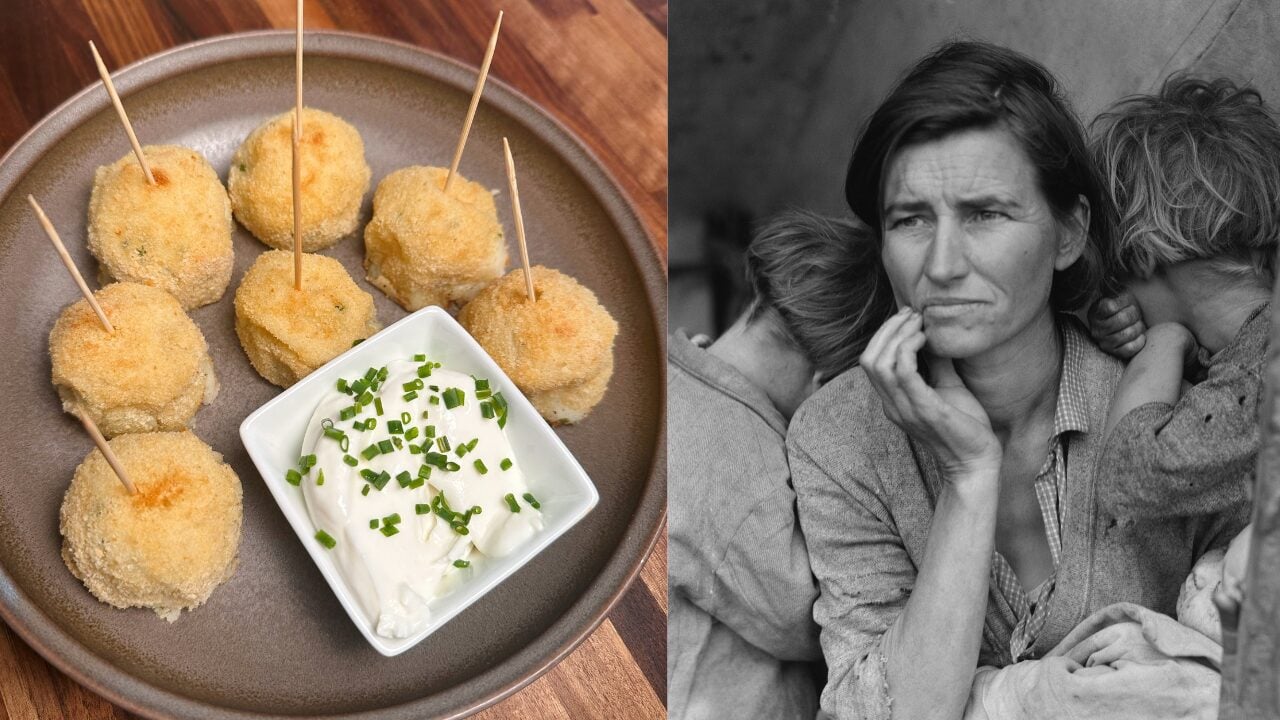
In 1937, with the Great Depression still gripping the country, a New England magazine printed a recipe for a party snack made almost entirely from potatoes: hot mashed potato centers wrapped in a buttery breadcrumb shell. They were called potato puff balls, and the magazine’s own modern editors later described them as an early version of baked homemade tater tots.
I made them this week with Idaho® potatoes, and I want to thank the Idaho Potato Commission for sponsoring this video. They gave me a good excuse to dig into one of my favorite topics: how a humble vegetable fed a struggling country, and how people made it feel like a celebration. They are crunchy outside, soft inside, and I rated them 8.9 out of 10.
The Potato in the Great Depression
By 1933, roughly one in four American workers was unemployed, and families who had never worried about dinner were counting every nickel. The potato was the answer to a lot of problems. It was cheap, it filled you up, and it stored for months in a cellar. In A Square Meal, a cultural history of the Depression, Jane Ziegelman and Andrew Coe describe Dust Bowl families who pared their diets down to flour, lard, and potatoes, and out-of-work West Virginia coal miners who survived on potatoes, bread, beans, and margarine. Clara Cannucciari, whose Depression cooking videos introduced a new generation to the era, said her family ate potatoes every day.
Next week
I cook these before I write them. Some of it never makes the post.
The failures, the source documents, the version that actually tasted good. That part goes out by email, and next week’s is already on the stove.
 Written and cooked by Donnie
Food advice at the time was focused on stretching every dollar. Government home economists pushed cheap, “wholesome” meals, and as Coe has put it, the emphasis was less about what foods tasted like and more about how inexpensive and nutritious they were. The potato was the perfect fit.
The Source: Yankee Magazine, 1937
Yankee Magazine was founded in 1935, in the middle of the Depression, with an attitude that suited the times: make do with less. In 1937, it ran a feature called “Aroostook’s Hundred Recipes,” written by Pearl Ashby Tibbetts, the wife of a country doctor in Bethel, Maine. Aroostook County, in northern Maine, was one of the country’s great potato regions, and the feature listed exactly one hundred recipes for the crop, packed into small, crowded paragraphs. That sounds excessive, but when no crop could afford to be wasted, a long list of ways to use one was useful.
One of those recipes was the potato puff ball. Decades later, Yankee’s editors featured it in a holiday series on party appetizers from each decade, and found that the hot mashed potato centers and buttery crumb shells tasted great showered with salt and dipped in ketchup. I like how that spirit holds up. Holiday entertaining was not high on the list for most Depression-era households, but a bowl of potato puffs was a way to put something festive on the table without spending money you didn’t have.
Idaho in the Depression Decade
Here is where I want to be careful, because the recipe came from a Maine potato feature, and Idaho was not yet the giant it is today. At the time the Idaho Potato Commission formed, Idaho was not a big player in the national potato industry. But the 1930s was the decade when Idaho’s industry was establishing itself.
Irrigation had opened up new farmland in the Snake River region, and the Russet Burbank, which grew well in Idaho’s soil, gave the state a distinctive product. Potatoes were shipped east by rail, and growers like Joe Marshall, later known as the “Idaho Potato King,” pushed for quality. His Blue Diamond brand reportedly commanded a premium price in Chicago, California, Kansas City, and points east. In May 1937, the same year as the Yankee recipe, Idaho growers formed the Idaho Fruit and Vegetable Advertising Commission, which became the Idaho Potato Commission, to promote the state’s crops and gain more control over how they were sold.
Idaho potatoes also found fans in restaurants. According to the Idaho Potato Commission’s historical account, a Chicago restaurateur named Dario Toffenetti bought a shipment of unusually large Idaho potatoes and turned them into “Genuine Jumbo Mealy Idaho Baked Potatoes,” sold for 25 cents during the Depression. They became a draw at his restaurants in Chicago and later in New York’s Times Square.
One tip when you shop: “Idaho®” tells you where a potato was grown, not what variety. Look for the “Grown in Idaho®” seal. Idaho’s warm days, cool nights, mountain-fed irrigation, and rich volcanic soil create ideal growing conditions, which is why I used Idaho® Russets here. Their high starch content makes a fluffy mash that holds together when you roll it.
My Rating
The outside bakes up crunchy and golden, and when you bite through, the inside is soft, hot, and creamy mashed potato. I served mine with sour cream and chives, and the cool, tangy cream is a good contrast to the rich, buttery crust. They are simple, comforting, and easy to eat by the handful, which makes them dangerous at a party.
Rating: 8.9 / 10

Great Depression Potato Puffs

Don’t lose this one.
I’ll email it to you so it’s waiting when you’re ready to cook.
Ingredients
Instructions
Notes
- Cold is the secret. The 1937 recipe shapes the balls while the mash is hot, but in my kitchen the balls slumped. Chilling the mash and freezing the breaded balls keeps them from melting in the oven.
- Keep the mash dry. Steam-drying the potatoes and using only 2 Tbsp of milk makes a firm mash that holds its shape.
- Serve right away. The crust is crispest straight from the oven and softens as it sits.