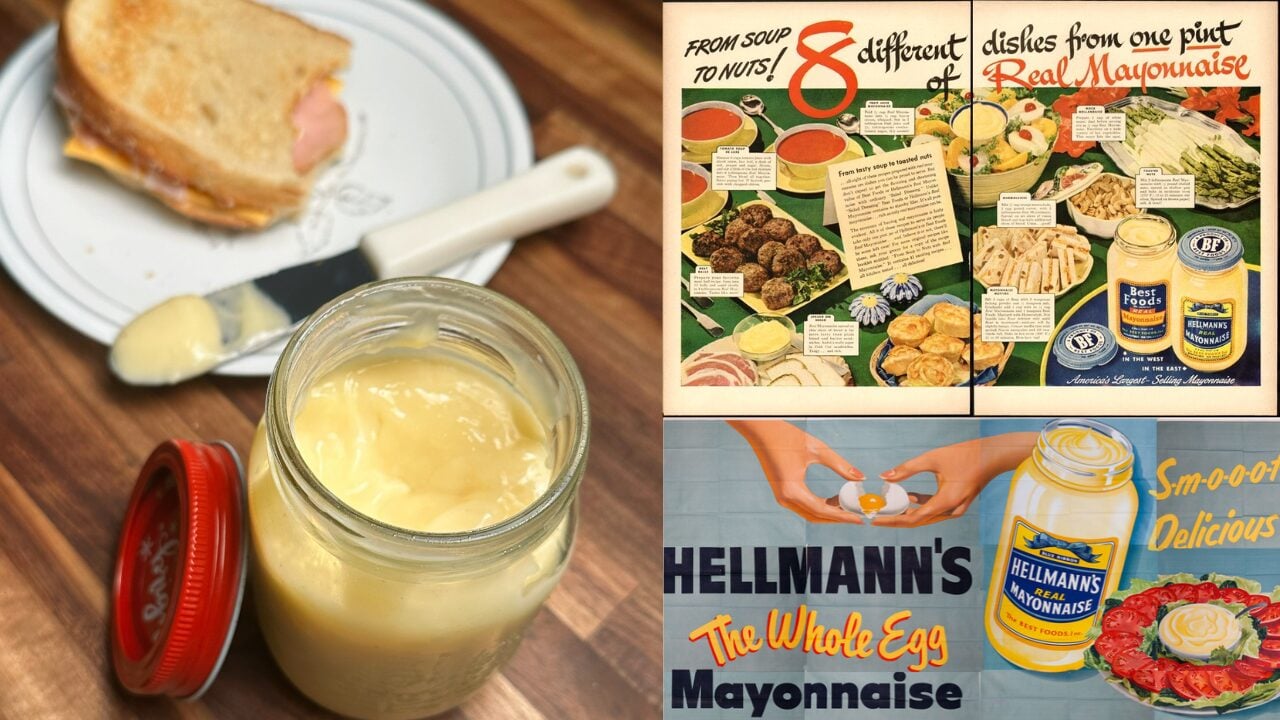
Mayonnaise is one of the few foods most people eat weekly without knowing what is in it. Egg yolk, oil, acid, a little seasoning. That is the whole list, and it is the reason mayo is such a good test for the From Scratch series. If any store-bought staple should be easy to beat at home, this is it.
Hey, my first cookbook, Cooking Ancient Rome, is now available for pre-order!!! Check it out!
So I made it the way American home cooks did in 1896, from Fannie Farmer’s Boston Cooking-School Cook Book, whisking by hand and adding the oil drop by drop. It tasted great, and I rated it 8.4 out of 10 for flavor. Whether it earns a spot in the Back to the Basics series is a separate question, and the numbers decide that one.
Where Mayonnaise Came From: The Legend and the Record
Next week
I cook these before I write them. Some of it never makes the post.
The failures, the source documents, the version that actually tasted good. That part goes out by email, and next week’s is already on the stove.
 Written and cooked by Donnie
The most repeated story goes like this. On April 18, 1756, French forces under the Duke of Richelieu captured Port Mahón on the island of Menorca from the British. At the victory banquet, the Duke’s chef had no cream, so he improvised a sauce from olive oil and egg and named it mahonnaise in honor of the town.
It is a great story, but the record does not back it up. No contemporary account links Richelieu’s chef to a new sauce. The name does not appear in print until 1806, forty-eight years after the battle, and it appears as mayonnaise, not mahonnaise. French chef Yannick Alléno has made the same point about the gap.
What is documented is this. In 1806, André Viard’s Le Cuisinier impérial uses the word mayonnaise, the earliest recorded use of the name. His mayonnaise there is a cooked sauce related to velouté and aspic rather than a clear emulsion, though the same book has a cold sauce thickened with egg yolk. In 1815, Marie-Antoine Carême describes a cold magnonaise emulsified with egg yolk, and the word appears in English the same year. Carême believed the name came from the French verb manier, to stir or work. Escoffier later ranked mayonnaise as the mother sauce of the cold sauces.
The Menorcan origin has serious defenders. Researchers including chef and doctor Pep Pelfort argue the sauce grew out of Menorca’s garlic-and-oil tradition, the same family as aioli, and that Richelieu’s army carried it home. I would call that a plausible theory rather than a settled fact, since no written recipe from before 1750 has been found.
Its purpose was simple. Mayonnaise was a cold sauce, the counterpart to the hot sauces of French cooking, made to dress cold meats, fish, eggs, and salads. Fannie Farmer calls hers “Mayonnaise Dressing I.” In the early 1900s, commercial makers like Richard Hellmann, a German immigrant selling from a New York deli, turned it into a jarred product, and it became the American staple it is today.
The Science: Why Oil and Egg Don’t Separate
Mayonnaise is an emulsion, a stable mix of two things that normally refuse to combine. Oil and water-based liquids (here, the yolk, lemon juice, and vinegar) separate on their own. Egg yolk is full of lecithin and proteins that grab onto both sides, coating each tiny oil droplet so it stays suspended instead of merging into a greasy pool.
This is why Farmer’s instruction is “drop by drop, at first.” In the first minutes there are only a few droplets, and each one needs to be wrapped in yolk before the next arrives. Pour too fast and the oil outruns the egg, and the sauce breaks. Once a thick base has formed, it can absorb oil in a thin stream. Dry mustard helps stabilize the emulsion, and the lemon juice and vinegar thin the sauce as it thickens, exactly as her method says.
The 1896 Recipe
Farmer’s method, which I confirmed against her text, is: mix the dry ingredients, add the egg yolks, and when well mixed, add a half teaspoon of vinegar. Then add the oil gradually, at first drop by drop, stirring constantly, and thin with vinegar or lemon juice as the mixture thickens.
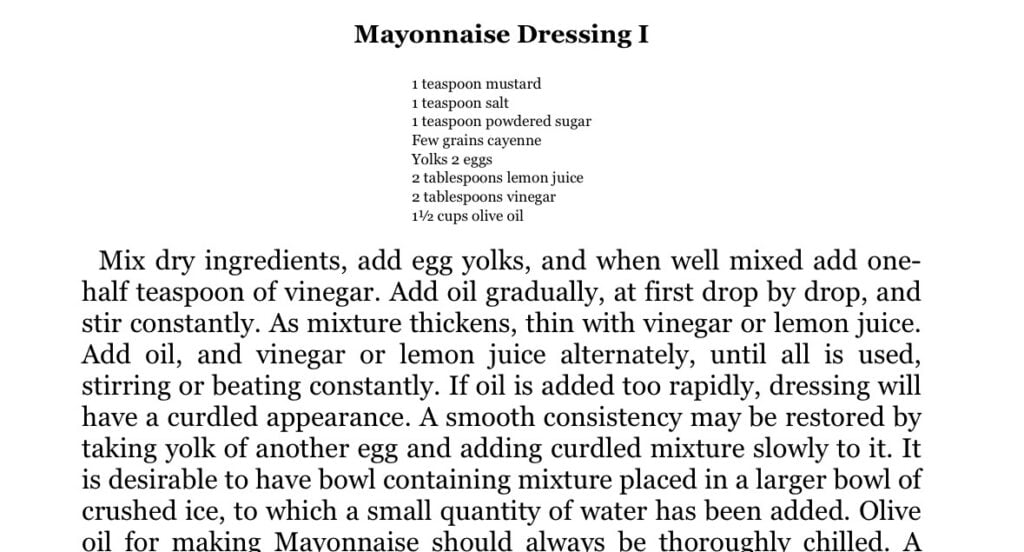
Two modern changes to flag: I used pasteurized yolks for safety, and the oil quantity in the ingredient list below is my own working amount. Farmer’s “mustard” is dry mustard powder, which was the standard in 1896.
Is It Worth Making? The Cost, Effort, and Shelf Life Math
These are my estimates, built from typical prices rather than a receipt. Swap in your own numbers.
| Homemade (olive oil) | Homemade (neutral oil) | Store-bought Hellmann’s | |
|---|---|---|---|
| Cost per batch | about $7 | about $3.75 | about $6.50 |
| Yield | about 15 fl oz | about 15 fl oz | 30 fl oz jar |
| Cost per fl oz | about 45 to 50¢ | about 25¢ | about 12 to 22¢ |
| Active time | 15 to 20 min by hand | same | 0 |
| Fridge life | about 4 days | about 4 days | about 2 months once opened |
Assumptions: olive oil at roughly 40¢ per fluid ounce, pasteurized eggs at about 90¢ each, one lemon at 50¢, vegetable oil at about 10¢ per fluid ounce. Hellmann’s 30 oz jar priced between roughly $3.75 on sale and $6.50 at full retail.
On cost, homemade olive oil mayo runs roughly two to four times the price of the jar. Even with cheap neutral oil, you only match the high end of store pricing. On effort, it is rated medium difficulty. The drop-by-drop stage takes patience, and a broken batch wastes your good oil. On shelf life, this is the biggest gap. Homemade mayo with raw or pasteurized yolk should be treated as a four-day product, while a commercial jar lasts about two months after opening.
Verdict: not approved for Back to the Basics. On price, effort, and shelf life it loses to the jar in every category. It earns its place only when you want something the store does not sell, such as a lemony olive oil aioli, a garlic or herb version, or mayo for a single big batch of deviled eggs or potato salad.
My Rating
The flavor is where homemade wins. You taste each ingredient: the olive oil, the sharp lemon, the mustard, the faint heat of cayenne. Store-bought mayo is smooth and neutral by design. This is livelier and more savory, closer to a loose aioli than a sandwich spread. It also has a softer, glossier texture than commercial mayo.
Taste Rating: 8.8 / 10
It tastes better than the jar, but it is not a better deal than the jar. Both of those things are true.
The Recipe: Mayonnaise Dressing, After Fannie Farmer (1896)
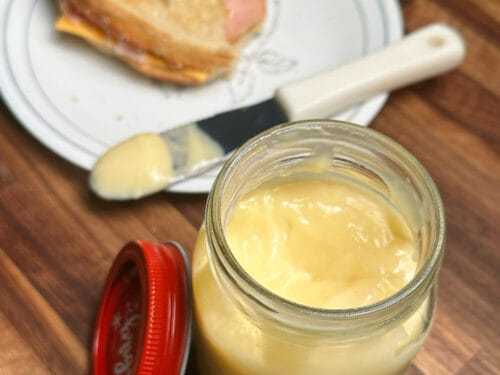
Mayonnaise Dressing

Don’t lose this one.
I’ll email it to you so it’s waiting when you’re ready to cook.
Ingredients
Instructions
Notes
- By hand (the historical method). It works, and it teaches you what an emulsion is, but it is slow and tiring. Anchor the bowl on a damp towel so you can use both hands, and do not rush the first quarter cup. Most failures happen there.
- Immersion blender (the shortcut). Put the yolks, mustard, salt, sugar, cayenne, and acid in a tall jar just wider than the blade head. Pour the oil on top, set the blender flat against the bottom, and blend without moving it for 10 to 15 seconds until white emulsion forms at the base. Then slowly tilt and lift the blender to pull in the rest of the oil. It takes about a minute and the result is nearly identical. Because Farmer’s recipe uses yolks only, the mayo will be a little looser than a whole-egg version.
- Obstacles to watch for:
- Broken or oily mayo. The oil went in too fast or the ingredients were cold. To fix it, put a fresh yolk in a clean bowl and slowly whisk the broken mixture into it, a teaspoon at a time.
- Bitter olive oil. Strong extra-virgin olive oil can turn bitter when it is whipped hard, especially with a blender. Use a mild or “light” olive oil, or replace half of the oil with a neutral one.
- Too thick. Whisk in a teaspoon of water or lemon juice.
- Cold ingredients. Room-temperature yolks and oil emulsify far more easily. Pull them out 30 minutes ahead.
- Food safety. Use pasteurized yolks, keep the mayo refrigerated at all times, and discard it after 4 days. It is not a good idea for anyone pregnant, elderly, or immunocompromised unless the eggs are pasteurized.