Go Back
–+ servings

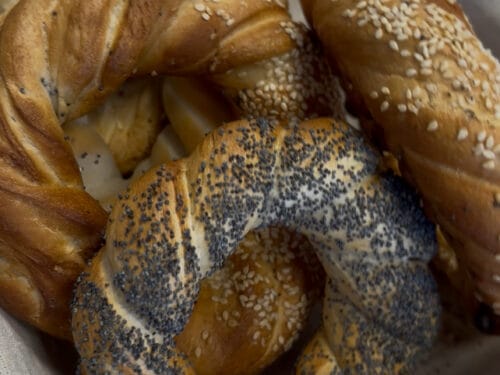
Obwarzanek Krakowski

Donnie
No ratings yet
Traditional Kraków braided ring bread, documented from March 2, 1394 in the royal household accounts of Queen Jadwiga and King Władysław II Jagiełło
Protected Geographical Indication status granted by the European Union, 2010
Primary source: Rachunki Dworu króla Władysława Jagiełły i królowej Jadwigi z lat 1388 to 1420, entry dated 2 March 1394: pro circulis obarzankij, one grosz.
Prep Time 30 minutes
Cook Time 25 minutes
Rising Time 1 hour
Servings: 8 obwarzanki

Jump To

Donnie Dodson

Don’t lose this one.

I’ll email it to you so it’s waiting when you’re ready to cook.

Ingredients
  

For the dough:
  • 500 g strong white bread flour plus extra for dusting
  • 7 g active dry yeast one standard sachet
  • 1 tsp fine salt
  • 1 tsp sugar — feeds the yeast during the initial rise
  • 300 ml warm water approximately 38°C
  • 2 tbsp lard or vegetable oil
For the parboiling water:
  • 2 litres water
  • 1 tbsp sugar — helps develop the crust colour during the brief boiling step
For the toppings, choose one or use all three traditionally:
  • Coarse sea salt
  • Poppy seeds
  • Sesame seeds

Instructions
 

Make the dough

  1. Dissolve the sugar in the warm water. Sprinkle the yeast over the surface and leave for 10 minutes until foamy. Combine the flour and salt in a large bowl. Add the yeast mixture and the oil. Mix until a rough dough forms, then turn out onto a lightly floured surface. Knead for 8 to 10 minutes until the dough is smooth, elastic and slightly tacky. It should not stick to the surface. Shape into a ball, place in a lightly oiled bowl, cover with a damp cloth and leave in a warm place for 1 hour until doubled in size.

Shape the obwarzanki

  1. This is the step that requires practice and is best learned by watching. Divide the risen dough into 8 to 10 equal pieces, approximately 75 to 80g each. Working with one piece at a time, roll it on a clean surface with both hands into a long thin rope approximately 50 to 60cm long and as even as possible. The rope is called a sułka.
  2. Fold the sułka in half so you have two parallel strands. Holding the two ends with one hand and the folded loop with the other, twist the two strands around each other three or four times to create a twisted rope. Bring the two loose ends together and press them firmly into the folded loop to form a sealed oval ring. The twist should be clearly visible on the outside of the ring. This braided appearance is the defining visual characteristic of the obwarzanek.
  3. Place each formed ring on a lightly floured surface. Leave to rest for 15 minutes.

Parboil

  1. Bring the 2 litres of water and tablespoon of sugar to a rolling boil in a wide saucepan. Working in batches of 2 to 3, lower the obwarzanki into the boiling water. They will sink initially and then rise to the surface. Boil for 30 to 45 seconds per side, turning once carefully with a slotted spoon. Do not boil for longer. The parboiling is brief and purposeful. Remove with a slotted spoon and place on a wire rack to drain for 30 seconds.

Top and bake

  1. Preheat your oven to 220°C / 425°F. Line two baking sheets with parchment paper. While the obwarzanki are still wet from the parboiling, dip or press each ring into your chosen toppings. The moisture from the parboiling is what holds the seeds and salt to the surface. Place on the prepared baking sheets.
  2. Bake for 20 to 25 minutes until deeply golden and the seeds are toasted and fragrant. The obwarzanek should sound hollow when tapped on the bottom and feel light for its size. Remove from the oven and cool on a wire rack for at least 10 minutes before eating.

Eat immediately or within a few hours

  1. The obwarzanek is best on the day it is baked. Unlike the American bagel, which has been engineered for storage, freezing and toasting, the traditional obwarzanek is designed to be eaten fresh. By the following day it will have softened and lost the crisp exterior that defines it. Make them the morning you intend to eat them. Eat them like the people of Kraków have been eating them for 630 years. On the move, over your wrist, with nothing added.

Notes

  • The braiding technique takes practice. Your first few will look rough. By the fifth or sixth they will look considerably better. This is exactly the experience of making them at the Muzeum Obwarzanka, where the instructors make it look effortless and the first attempt feels impossible and the fifth attempt feels almost right. Do not be discouraged by the first one.
 
  • The parboiling water sugar is not optional. It contributes to the Maillard reaction during baking, producing the specific amber-gold colour of a properly made obwarzanek. Water alone produces a paler, less visually attractive result.
 
  • The coarse salt version is the most traditional and the most historically grounded. Salt was the topping documented in the earliest records of the obwarzanek. Poppy seeds are the most characteristically Polish addition and the most visually distinctive. Sesame seeds produce a more international flavour profile. All three are traditional. Make a batch with one of each and decide which you prefer.

Tried this recipe?

Let us know how it was!