
Go Back

Ajo Blanco

Donnie
No ratings yet
The White Gazpacho of Andalusia, documented from the medieval Moorish period, built on Roman-era bread and garlic preparations, predating the tomato-based gazpacho by several centuries
Regional home of the dish: Málaga and Granada, Andalusia, Spain.
Prep Time 20 minutes
Chill Time 2 hours

Jump To

Donnie Dodson

Don’t lose this one.

I’ll email it to you so it’s waiting when you’re ready to cook.

Ingredients
  

  • 200 g blanched whole almonds — the skin must be off. Blanched almonds give the correct ivory-white colour. Skin-on almonds make the soup beige and slightly bitter
  • 3 to 4 thick slices of stale white bread crusts removed, approximately 100g — day-old bread is correct. Fresh bread makes the texture too gummy
  • 2 to 3 cloves raw garlic — raw not roasted. The sharpness of raw garlic is the entire point. Start with 2 cloves if nervous and adjust after tasting
  • ¾ cup good quality extra virgin olive oil
  • 3 tablespoons sherry vinegar — sherry vinegar specifically not white wine vinegar. This is the correct Andalusian vinegar and it makes a significant flavour difference
  • 1 teaspoon fine salt
  • 1¼ to 1¾ cups ice cold water — the quantity controls the final consistency. Add gradually until you reach a texture between cream soup and a thick drink
  • For serving the documented traditional garnish:
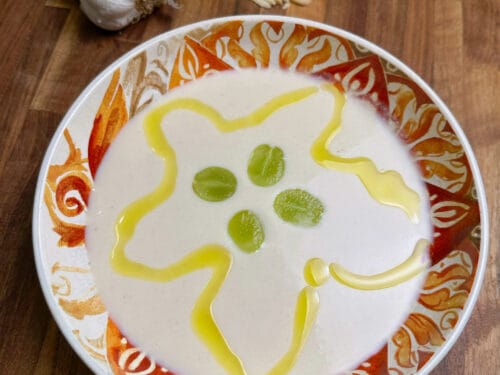
  • A small bunch of green grapes halved — this is not modern decoration. The sweet-sharp grape against the cold almond-garlic base is the documented traditional finish, used specifically in Málaga
  • Optional: a drizzle of good olive oil and a few toasted almond slivers on top

Instructions
 

Soak the bread

  1. Place the stale bread slices in a bowl of cold water and leave for 5 minutes until completely softened and saturated. Squeeze out as much water as possible with your hands until the bread forms a compact, nearly dry mass. Set aside. This hydration and squeezing step is essential. Dry bread going into the blender produces an uneven, grainy texture in the finished soup.

Blend the almonds first

  1. Place the blanched almonds in a blender and blend alone, without any liquid, for a full minute until they form a fine, pale paste. This initial dry-blending step produces a dramatically smoother final texture and is almost never mentioned in modern recipes. The almonds need to break down into a flour-like consistency before liquid is introduced.

Build the base

  1. Add the squeezed bread, raw garlic cloves, olive oil, sherry vinegar and salt to the almond paste in the blender. Blend on high speed for a full 2 minutes until completely smooth. The mixture will be very thick at this point, almost paste-like. This is correct.

Add the water gradually

  1. With the blender running, add the ice cold water gradually through the lid opening, stopping to check the consistency as you go. You are looking for something between single cream and a thick smoothie, pourable but substantial, not watery. The exact quantity will vary depending on how thick and dry your bread was. Stop and taste. Adjust salt and vinegar at this point. The soup should be sharp, rich and slightly pungent from the garlic.

Sieve for the authentic result

  1. Pass the soup through a fine mesh sieve into a large bowl, pushing it through firmly with the back of a spoon and working in batches. This step is not optional if you want the genuine article. Without sieving you have a rustic blended almond soup. With sieving you have something smooth, silky and remarkably white that is the correct ajo blanco. Discard whatever remains in the sieve.

Chill and rest

  1. Cover the sieved soup and refrigerate for a minimum of 2 hours. Overnight is significantly better. The flavour deepens and the raw garlic mellows considerably during the cold rest. A freshly blended ajo blanco tastes flat compared to one that has rested overnight.

Serve

  1. Serve very cold in shallow bowls or glasses. The Málaga tradition is to thin the soup slightly further and serve it in glasses for drinking, which is the most historically grounded serving method. Place halved green grapes in the cold soup. Add a drizzle of olive oil across the surface and a few toasted almond slivers if you want the complete presentation.
  2. Eat immediately. Ajo blanco is only itself when it is very cold.

Video

Notes

  • The blanched almond requirement is not flexible. Pre-blanched almonds are available at most supermarkets and any health food store. If you can only find skin-on almonds, blanch them yourself by covering with boiling water for 60 seconds, draining and slipping the skins off with your fingers while still warm. Do not proceed with skin-on almonds.
 
  • The sherry vinegar is available at most good supermarkets and any Spanish food importer. The bodegas of Jerez produce sherry vinegar through the same solera ageing system used for sherry wine and the result has a depth and complexity that no other vinegar replicates in this application. It is worth finding.
 
  • Raw garlic is essential and should not be tempered or roasted before going into the blender. The pungency of raw garlic against the richness of the almond base is the defining flavour tension of ajo blanco. Roasted garlic would produce something smoother and milder that is a different and inferior dish. Start with 2 cloves if you are uncertain about your garlic tolerance and adjust after tasting the blended but not yet sieved soup.

Tried this recipe?

Let us know how it was!