Go Back

Ancient Cretan Paximadi Barley Rusks

Donnie
No ratings yet
A living tradition documented from ancient Greek dipyros artos through the Byzantine period to the present day. Primary sources: Athenaeus of Naucratis, Deipnosophistae, c.200 AD; Hesiod, Works and Days, c.8th century BC; Andrew Dalby, food historian, documented in Aglaia Kremezi, Paximadia: Barley Biscuits Past, Present and Future; Diane Kochilas, Paximadia Bread Rusks
A note on the name: Paximadia derive their name from the ancient Greek dipyros, meaning twice-baked. The rusks are said to be named after a Byzantine monk called Paximus, who refined the ancient method. Both the Italian biscotti and the French and English word biscuit derive their names from the same twice-baked technique described in Latin. This is a living tradition still practiced across Crete today, historically sustaining farmers, fishermen and shepherds.
Prep Time 10 minutes
Cook Time 3 hours
Resting Time (optional) 1 day

Jump To

Donnie Dodson

Don’t lose this one.

I’ll email it to you so it’s waiting when you’re ready to cook.

Ingredients
  

For the rusks:
  • 2 cups 260g whole grain barley flour — the most important ingredient, darker and earthier than refined barley flour. Available at health food stores or online
  • 1 cup 130g whole wheat flour — provides the gluten structure barley lacks on its own
  • 1 teaspoon fine salt
  • 1 teaspoon active dry yeast
  • 1 teaspoon honey — feeds the yeast adds a faint sweetness
  • 1 tablespoon extra virgin olive oil — traditional Cretan addition
  • 1 tablespoon red or white wine vinegar — documented in Cretan rusk recipes for tang and keeping quality
  • 200 ml to 220ml lukewarm water added gradually
For serving, the dakos preparation:
  • Cold water for rehydrating — do not skip this step
  • Good quality feta cheese crumbled or sliced — the direct descendant of the fresh goat cheese documented in Bronze Age Aegean contexts
  • Good quality Kalamata olives pitted
  • Fresh or dried oregano — gathered across the Greek landscape since antiquity
  • Flaky sea salt
  • the best Greek olive oil you can find — the quality matters enormously in a preparation this simple
  • Optional: balsamic glaze for a touch of sweetness

Instructions
 

Day 1: First Bake

  1. Dissolve the honey in the lukewarm water. Sprinkle the yeast over the surface and leave for 10 minutes until foamy. If it does not foam the yeast is dead. Start again with fresh yeast.
  2. In a large bowl combine the barley flour, whole wheat flour and salt. Make a well in the centre. Pour in the yeast mixture, olive oil and vinegar. Mix with a wooden spoon until a rough dough forms, then turn out onto a lightly floured surface.
  3. Knead for 8 to 10 minutes. Barley dough behaves differently from wheat dough. It will feel denser, slightly sticky and less elastic. This is correct. It will not spring back the way wheat dough does. After 8 to 10 minutes it should be cohesive and pliable, slightly tacky but manageable.
  4. Shape into a ball, place in a lightly oiled bowl, cover with a damp cloth and leave in a warm place for 1 to 1.5 hours until roughly doubled. Barley dough rises more slowly and less dramatically than wheat dough. Do not expect a spectacular double.

Shaping

  1. Round rusks, the classic dakos shape: divide the dough into 12 to 16 equal pieces. Roll each into a ball then flatten into a disc roughly 8cm across and 2cm thick. Score a horizontal line around the equator of each disc with a sharp knife, not cutting all the way through. This score line is what lets you split the rusk cleanly after the first bake.
  2. Log and slice, the simpler method: shape the dough into two logs roughly 20cm long and 5cm wide. Place on a parchment-lined baking sheet. Score across the top at 2cm intervals, again not cutting all the way through.
  3. Cover the shaped dough and rest for 30 minutes. Preheat oven to 400°F / 200°C.
  4. Bake for 25 to 30 minutes until the outside is firm, golden and sounds hollow when tapped. The inside will still be slightly soft. This is correct since the second bake handles that.
  5. Remove from the oven and cool for 15 to 20 minutes until comfortable to handle. While still warm, not hot and not cold, split the rusks along the scored lines. For discs, pry apart into two thinner rounds. For logs, slice along the score lines into individual pieces. Arrange all pieces cut-side up on baking sheets.
Day 2: Second Bake

  1. This step is what makes them rusks rather than bread. The goal is to remove all moisture, producing something that can store for months.
  2. Reduce oven to 250°F / 120°C. Place the cut rusks cut-side up on baking sheets and bake for 1.5 to 2 hours. After 45 minutes flip so the cut side faces down. At the 1.5 hour mark tap one with your knuckle. It should sound completely hollow and feel light. If any softness remains continue for another 30 minutes.
  3. Turn the oven off and leave the rusks inside with the door slightly ajar for a further hour to finish drying passively. Remove and cool completely on a rack. They should feel and sound like small rocks. This is exactly correct.
  4. Storage: once fully cooled, store in an airtight container. They keep for months at room temperature, exactly as intended by the people who first developed this bread for exactly that purpose.

To serve: the rehydration step

  1. This step is not optional and is the difference between an extraordinary eating experience and a dental emergency.
  2. Briefly dip each rusk in cold water for 3 to 5 seconds. No longer. You are not soaking them, you are giving the surface moisture to rehydrate slightly. Shake off any excess water and place on your serving plate. Leave for 30 seconds to 1 minute to allow the moisture to distribute through the surface of the rusk. The inside will remain firm and structured while the surface becomes tender and receptive to the toppings.

Top and serve

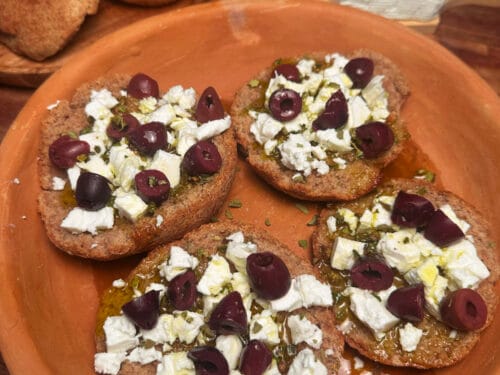
  1. Drizzle Mr. Papou's olive oil generously over the rehydrated rusk surface. Add crumbled or sliced feta. Arrange a few Kalamata olives alongside or on top. Scatter fresh or dried oregano. Add a pinch of flaky sea salt. If you want a touch of sweetness, a thin drizzle of balsamic glaze over the feta is an excellent modern addition that works beautifully with the other flavours.
  2. Eat immediately. The combination of the olive oil soaking into the just-rehydrated rusk surface, the salty feta, the briney olive and the herbal oregano is one of the cleanest and most satisfying flavour combinations in the Mediterranean food tradition. Plato was right.

Video

Notes

  • The barley flour is the single most important ingredient and cannot be substituted with white wheat flour without fundamentally changing what the recipe is. Whole grain barley flour is available at most health food stores, at Whole Foods and online. The darker, earthier character of barley is what makes this taste like ancient Crete rather than like a modern bread.
 
  • The twice-baked process takes patience and cannot be rushed. The second bake at low temperature is doing the work of removing all moisture, and any attempt to accelerate it with higher heat will produce a rusk that browns on the outside while retaining moisture inside, which will cause it to soften and go stale within days rather than lasting for months.
 
  • The olive oil quality matters more in this recipe than in almost any other on this channel. The combination of rehydrated barley rusk and good Greek olive oil is the ancient Mediterranean breakfast. Using a mediocre oil produces a mediocre result. Use Mr. Papou's or the best Greek extra virgin olive oil you can find.

Tried this recipe?

Let us know how it was!