Go Back
+ servings

Ancient Greek Olympian's Roast Lamb

Donnie
5 from 1 vote
The documented diet of Greek Olympians included significant quantities of meat, particularly beef, pork and goat, supplemented with bread and wine. This preparation uses olive oil and cumin, both thoroughly documented in ancient Greek cooking, with red wine vinegar documented as a common flavouring agent throughout the ancient Mediterranean.
Primary sources: Athenaeus of Naucratis, Deipnosophistae; Pausanias, Description of Greece 6.7.10 and 6.14.5-8; Phylarchus, Histories (fragments); Diogenes Laertius, Lives of the Philosophers 8.12; Strabo, Geographica; Plato, Republic 1.338c-d.
Prep Time 30 minutes
Cook Time 2 hours
Overnight Marinating 12 hours
Servings: 6

Jump To

Donnie Dodson

Don’t lose this one.

I’ll email it to you so it’s waiting when you’re ready to cook.

Ingredients
  

For the cumin marinade:
  • 2 tbsp whole cumin seeds — cumin is documented in ancient Greek cooking and is the defining flavour note of this preparation
  • 150 ml water — for extracting the cumin flavour by boiling
  • 4 tbsp extra virgin olive oil — the foundational fat of all ancient Greek cooking
  • 2 cloves garlic grated or very finely minced
  • 2 tbsp red wine vinegar
  • 1 tsp flaky sea salt — in addition to the initial coating salt
For the lamb:
  • 1 whole bone-in lamb leg approximately 2 to 2.5kg
  • 2 tbsp extra virgin olive oil — for the initial coating
  • Generous amount of flaky sea salt — for the initial coating before marinating
For the garnish:
  • Good quality Kalamata olives
  • Fresh thyme sprigs — thyme grew wild across the Greek landscape and is documented in ancient Greek cooking and medicine

Instructions
 

Build the cumin marinade

  1. Place the whole cumin seeds in a small saucepan with the water. Bring to a boil over medium heat and simmer for 5 minutes until the water has absorbed the cumin flavour and turned a pale amber colour. Strain the liquid, discarding the seeds, and allow to cool. This step extracts the flavour compounds from the cumin into the water, producing a more even distribution through the marinade than whole or ground cumin would achieve.
  2. Combine the cooled cumin liquid with the olive oil, grated garlic and red wine vinegar. Whisk together until combined. The marinade should smell immediately of cumin, garlic and the sharp brightness of the vinegar.

Prepare and marinate the lamb

  1. Coat the lamb generously with olive oil and season very generously with flaky sea salt on all surfaces.
  2. Place in a large dish or zip-lock bag and refrigerate overnight, or for a minimum of 4 hours. Turn the lamb in the marinade at least once during the marinating period.

Grill the lamb

  1. Remove the lamb from the refrigerator at least 45 minutes before cooking to allow it to come to room temperature. Cold meat placed directly on a hot grill will cook unevenly.
  2. Set up your grill for indirect cooking. For a charcoal grill, bank the coals to one side and place the lamb on the opposite side, away from direct heat. For a gas grill, light one side only and place the lamb on the unlit side. The lamb should cook primarily through indirect heat with the fat rendering slowly rather than flaring in direct contact with flames.
  3. Place the lamb on the grill. Baste frequently with any remaining marinade, applying a fresh coat every 15 to 20 minutes throughout the cooking process. The basting builds up layers of caramelised cumin and garlic on the surface of the lamb that define the finished flavour.
  4. Cook until the internal temperature reaches your desired doneness. For a medium result, the internal temperature should reach 145°F. For a more traditional well-done result appropriate to the ancient preparation, cook to 165°F. Total cooking time will be approximately 1.5 to 2 hours depending on the size of the leg and the temperature of your grill.
  5. Rest the lamb for at least 15 minutes before serving. The resting period allows the internal juices to redistribute through the meat and produces a significantly better result than cutting immediately after cooking.
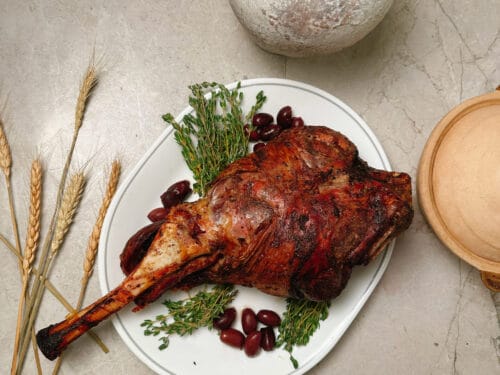
Plate and serve

  1. Present the whole lamb leg on a large platter. Scatter Kalamata olives generously around the lamb. Place fresh thyme sprigs over and around the meat as garnish. Serve with good bread and wine for the complete ancient Olympian feast. Milo of Croton would have eaten the entire thing. You have my permission to share it.

Video

Notes

  • The cumin extraction step is worth the extra 10 minutes it takes. Whole cumin seeds steeped in boiling water produce a flavour that distributes more evenly through a marinade than ground cumin and gives the finished lamb a distinctive warmth that is specifically ancient Mediterranean rather than generically spiced.
 
  • Red wine vinegar is not optional in this preparation. The acidity performs two functions: it begins to break down the surface protein of the lamb during marinating, improving the final texture, and it provides the brightness that prevents the cumin and garlic from becoming heavy and one-dimensional. The ancient Greeks used vinegar extensively as a flavouring and preserving agent and its presence in this marinade is historically grounded.
 
  • Basting frequency determines the quality of the exterior crust. A lamb basted every 15 minutes develops a deeply caramelised, flavour-concentrated surface that a single coat of marinade cannot produce. Plan to be present at the grill and baste consistently throughout the cooking time.

Tried this recipe?

Let us know how it was!