
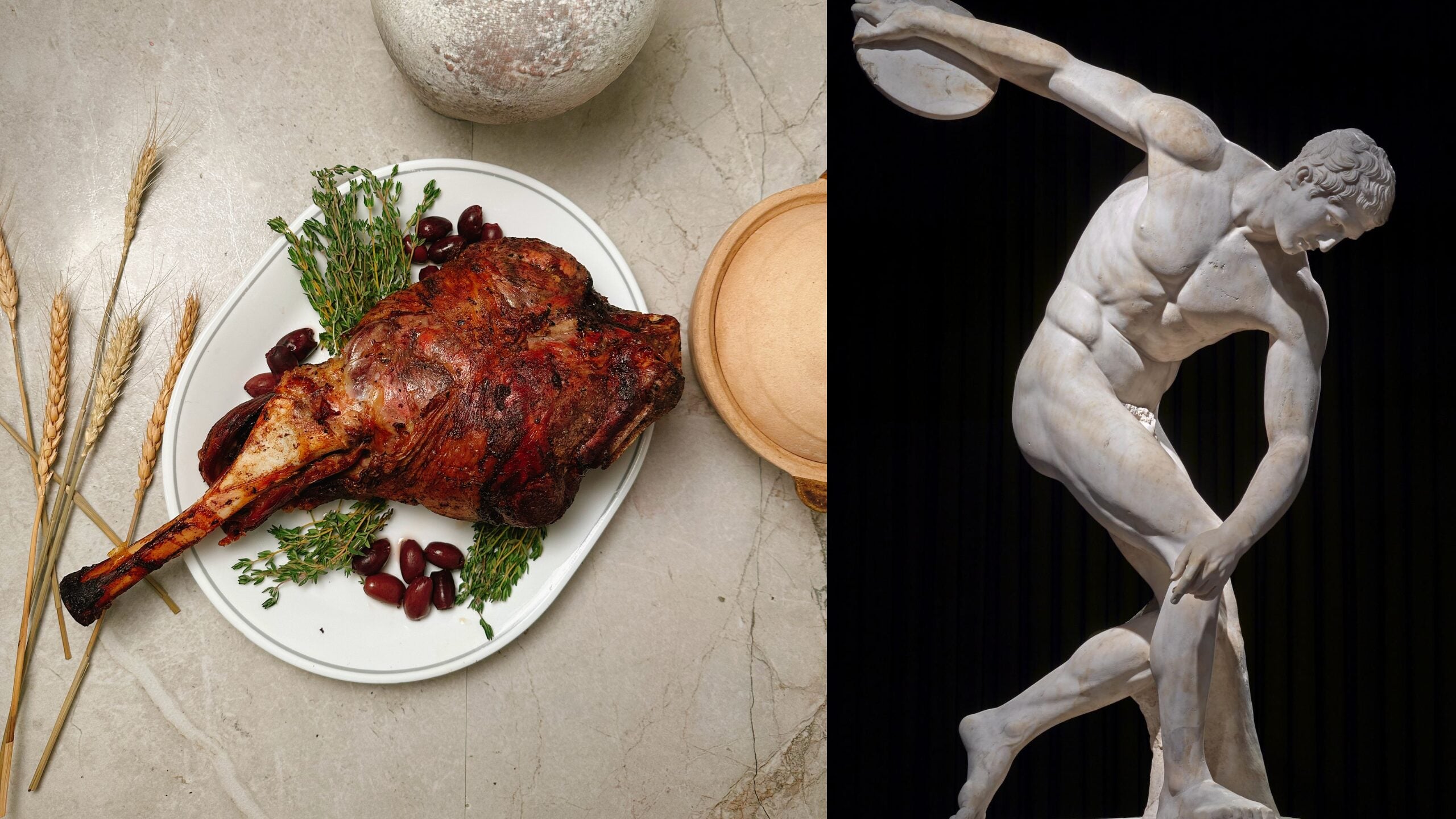
Before protein shakes, before creatine, before sports dietitians and periodised nutrition plans, before any of the modern apparatus of athletic performance science existed, ancient Greek athletes and their coaches were systematically experimenting with diet as a performance variable.
If you enjoy my content and the work/research I do, consider becoming a paid subscriber to support the channel!
The ancient Olympic Games ran continuously from 776 BC to 393 AD, over a thousand years of elite athletic competition. Across that millennium the documented diet of Greek Olympians underwent a systematic transformation from a carbohydrate-heavy baseline consistent with the general Greek population to an increasingly meat-focused, calorie-dense performance diet that would not look entirely out of place on the table of a modern strength athlete. It is one of the most fascinating documented examples of empirical nutritional experimentation in ancient history, and the man who represents its most extreme expression, Milo of Croton, remains one of the most extraordinary documented athletes in the history of human sport.
The Original Athlete Diet: Dried Figs and Fresh Cheese
Next week
I cook these before I write them. Some of it never makes the post.
The failures, the source documents, the version that actually tasted good. That part goes out by email, and next week’s is already on the stove.
 Written and cooked by Donnie
To understand how significant the shift to high-meat diets was for ancient Greek athletes, you first need to understand what they were eating before the change.
The diet of most ancient Greeks was, somewhat surprisingly to modern audiences, primarily vegetarian. The Journal of Nutrition, in a peer-reviewed study published in 1997 examining ancient Olympian diets, notes directly that the diet of most Greeks and Romans was basically vegetarian and consisted of cereals like barley, fruit, vegetables and legumes, and wine diluted with water. When meat was eaten, the most common source in antiquity was goat in Greece. Red meat was not a daily feature of even wealthy Greek households, and the ordinary diet of the population was built around barley porridge, cheese, vegetables, olives, figs and bread.
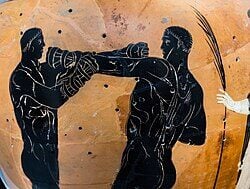
The earliest documented athlete diet reflects this general population baseline directly. The earliest Greek athlete of whose special diet we are told anything is Charmis of Sparta, who is said to have trained on dried figs. The use of dried figs as an athletic training food reflects the general Greek understanding of figs as an energising, nourishing food appropriate for physical exertion, and they were the official food of the ancient Olympics. The early Olympians, whose event in 776 BC was a single footrace of approximately 200 metres, were eating what their neighbours were eating with perhaps some deliberate additional emphasis on energy-dense plant foods.
Formerly, athletes had trained on dried figs, moist cheese, and wheat, as documented by Diogenes Laertius, writing in the early decades of the 3rd century AD and recording the earlier tradition. This pre-meat diet baseline was what Greek athletes were eating for the first century or so of the Olympic Games. It was the starting point from which the great dietary experiment of ancient Greek sports nutrition began.
The Transition: Who Invented the Meat Diet and Why Pythagoras Is the Most Confusing Figure in Sports Nutrition History
The shift from figs and cheese to large quantities of meat as the defining dietary practice of elite Greek athletes is documented in multiple independent primary sources, and the specific attribution of who introduced it is one of the more entertaining scholarly disputes in ancient history.
Tradition attributes the initiative to Dromeus of Stymphalus, a dolichos runner, the Greek long-distance race of about twenty-four lengths of the stadium, or 4.8 km, and a two-time Olympic victor. Thus Pausanias, in the 2nd century CE, writes: “It is said that he was the first to devise the eating of meat; until then, freshly drained cheese had been the food of athletes”. The specific Pausanias text, from Description of Greece 6.7.10, is the most frequently cited primary source for the introduction of meat to the athlete diet and dates Dromeus’s innovation to approximately 480 BC.
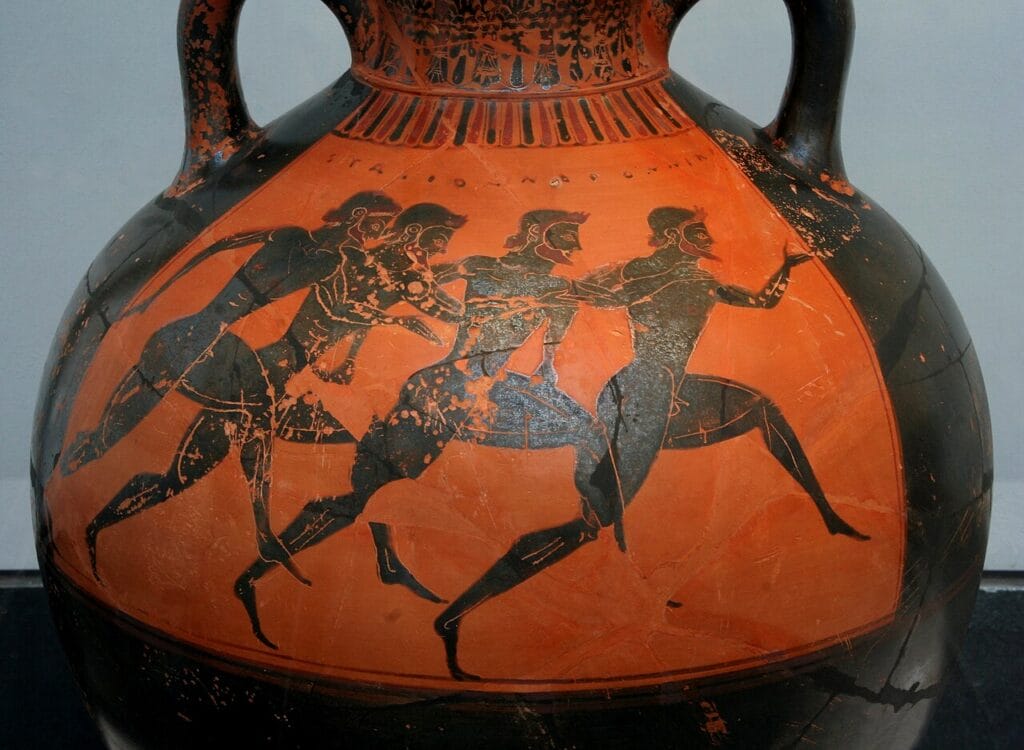
A competing version attributes the change to Pythagoras of Samos, who is said to have advised the wrestler Eurymenes, also of Samos, to feed daily on meat, which gave his body great strength. That the name of Pythagoras, associated in antiquity with abstinence from meat, should also be linked to the introduction of a meat diet for athletes did not escape ancient authors: the contradiction was already feeding learned dinner-table conversation.
The resolution most scholars have settled on is documented by Diogenes Laertius, who concluded that credit for introducing meat to the diet of athletes belonged to a trainer with the same name as the philosopher. In other words there were two people named Pythagoras in Samos at around the same time: the famous vegetarian philosopher-mathematician, and a sports trainer who happened to share his name. The trainer advised Eurymenes to eat meat. The philosopher got the credit because he was considerably more famous.
The Cambridge University Press academic paper on Greek athlete diets makes the case directly: the meat diet for heavy athletes probably predated both Dromeus and Eurymenes, and the real evidence for this is the documented behaviour of the most extraordinary athlete in ancient Greek history.
Milo of Croton: The Pinnacle of Ancient Sports Performance
Milo of Croton is the defining figure of ancient Greek athletic achievement and the most documented individual in the history of ancient sports nutrition. Milo of Croton, one of the most successful Olympians in world history with seven Olympic gold medals in wrestling and 26 wins at the Panhellenic Games, was also a meat lover.
The primary sources on Milo’s diet are extraordinary in their consistency and their scale. Athenaeus of Naucratis, writing in the Deipnosophistae in the 2nd to 3rd century AD, states that Milo regularly consumed five kilograms of meat, an equal amount of bread, and three pitchers of wine, approximately ten litres, at each meal. Theodorus of Hierapolis, in his book upon Olympic Games, records: “Milon of Croton ate twenty minae of meat, and an equal quantity of bread, and drank three choes of wine.“
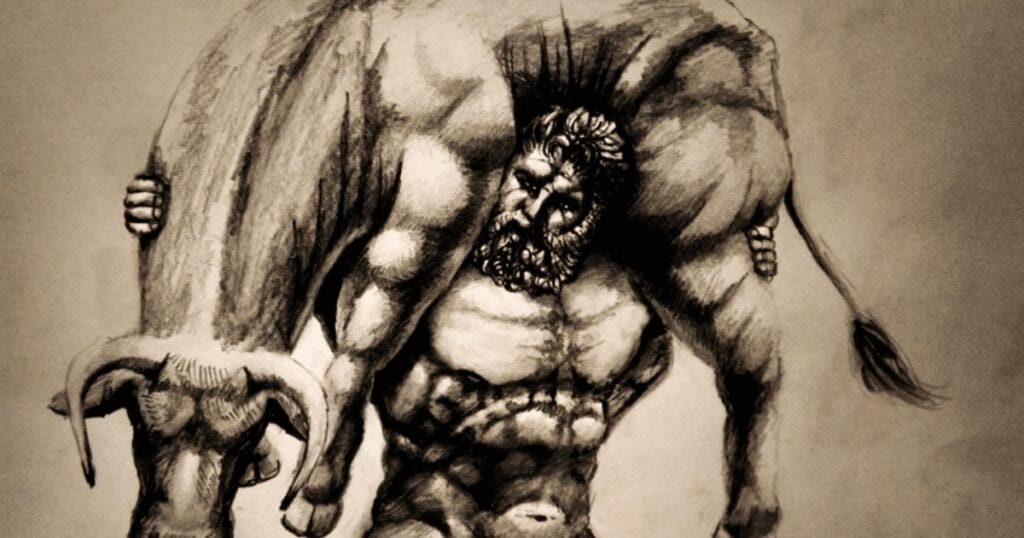
The most extraordinary account of Milo’s eating comes from Phylarchus, cited in the third book of his Histories, and from Athenaeus quoting multiple earlier sources. Once at Olympia he took a four-year-old bull on his shoulders and carried it all round the course, and after that he killed it and cut it up and ate it all up by himself in one day. Athenaeus’s account of Milo carrying, killing, butchering and consuming an entire bull in a single day represents the most extreme documented single-session food consumption in ancient history.
Modern researchers have attempted to calculate what Milo’s documented daily intake actually represented in caloric terms. The figures are staggering. Modern researchers estimate that Milo consumed 9 to 10 kilograms of meat, 9 to 10 kilograms of bread and 10 litres of wine daily, amounting to around 20,000 calories per day. Whether or not these exact figures are accurate, it is clear from the convergence of multiple independent ancient sources that Milo required, and consumed, quantities of food that would be extraordinary even by modern elite athlete standards.
Pausanias, in Description of Greece 6.14.5 to 6.14.8, provides the most comprehensive account of Milo’s athletic achievements, documenting his six Olympic victories in wrestling and his extraordinary physical strength. Strabo, in his Geographica, discusses Milo’s fame and his connection to the philosopher Pythagoras, who was himself from Croton and whom ancient sources describe as a personal friend of the wrestler.
The Evolution: From Bronze Age Figs to the First Sports Science
The documented evolution of ancient Greek athlete diets across the Olympic period represents the first systematic recorded attempt to use nutrition as a performance variable, and it is worth tracing that arc explicitly because it is genuinely the precursor of modern sports medicine.
The early Olympic period, from 776 BC through the early 6th century BC, shows athletes eating the general Greek diet with emphasis on energy-dense plant foods like dried figs. This is the baseline phase, nutrition as sustenance rather than as performance strategy.
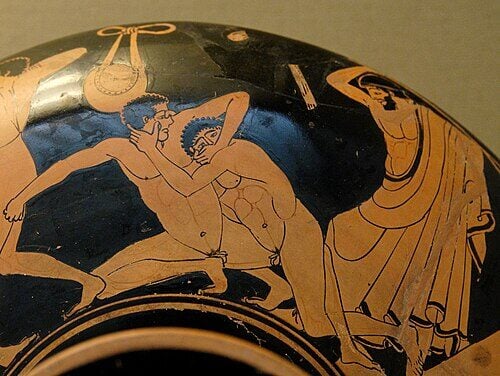
The middle period, from roughly 550 to 400 BC, shows the documented transition to high-meat diets for heavy athletes in particular. Eurymenes of Samos, Dromeus of Stymphalus and Milo of Croton all belong to this period, and the convergence of multiple independent sources on the meat diet transition in this specific timeframe suggests a genuine shift in athletic practice rather than isolated individual choices.
The later period, from roughly 400 BC onward, shows the development of what we might recognise as early periodisation. Galen, writing in the 2nd century AD and documenting earlier practice, describes the athletae who practised severe exercises eating pork and a particular kind of bread. Different events requiring different physical qualities began to produce differentiated nutritional approaches. Long-distance runners were noted as eating differently from wrestlers. Heavy event competitors were documented as consuming considerably more meat than runners.
The ancient Greek training system also developed what we might today call periodisation of training load and rest. Aristotle, in his Politics, documents that excessive training in early years exhausted the constitutions of athletes and argued explicitly that there should be a separation between intellectual and physical development with physical training concentrated in a specific developmental period. The observation that over-trained youth athletes rarely succeeded as adults reflects genuine empirical observation of athletic development across the long history of the Games.
This is not modern sports science as we know it, the Greeks had no understanding of protein synthesis, muscle fibre recruitment, energy system metabolism or any of the biochemical mechanisms that underlie the dietary and training practices they were empirically developing. But the intellectual framework, systematic observation of how diet and training affected performance, deliberate modification of those variables to improve outcomes, and the transmission of that knowledge through professional trainer-athlete relationships, is recognisably the ancestor of modern sports nutrition. The sophistication is real even where the specific understanding is wrong.
My Rating
The roast lamb with cumin and olive oil marinade is genuinely extraordinary and is one of the more satisfying meats I have made for this channel. The cumin marinade is the technique that elevates it from a very good roast lamb to something that tastes historically specific and immediately evocative of ancient Mediterranean cooking. The cumin blooms during the grilling process and its warmth runs through the meat in a way that garlic and olive oil alone cannot achieve. The red wine vinegar in the marinade brightens the whole preparation and cuts through the richness of the lamb fat in exactly the right way.
Served whole with olives and fresh thyme as garnish, this is the kind of meal that makes complete sense as the feast food of an elite athlete in ancient Croton or Olympia. It is substantial, protein-dense, flavourful and built from ingredients that would have been available and recognisable to anyone eating in ancient Greece.
Milo of Croton would have needed four of these. I managed one leg and a reasonable number of olives, I won’t be carrying entire cows on my back anytime soon…
Rating: 8.2/10
The Recipe: Ancient Greek Olympian’s Roast Lamb
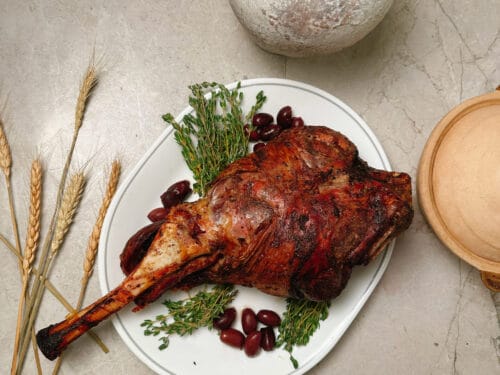
Ancient Greek Olympian’s Roast Lamb

Don’t lose this one.
I’ll email it to you so it’s waiting when you’re ready to cook.
Ingredients
Instructions
Notes
- The cumin extraction step is worth the extra 10 minutes it takes. Whole cumin seeds steeped in boiling water produce a flavour that distributes more evenly through a marinade than ground cumin and gives the finished lamb a distinctive warmth that is specifically ancient Mediterranean rather than generically spiced.
- Red wine vinegar is not optional in this preparation. The acidity performs two functions: it begins to break down the surface protein of the lamb during marinating, improving the final texture, and it provides the brightness that prevents the cumin and garlic from becoming heavy and one-dimensional. The ancient Greeks used vinegar extensively as a flavouring and preserving agent and its presence in this marinade is historically grounded.
- Basting frequency determines the quality of the exterior crust. A lamb basted every 15 minutes develops a deeply caramelised, flavour-concentrated surface that a single coat of marinade cannot produce. Plan to be present at the grill and baste consistently throughout the cooking time.

Excellent