
Go Back

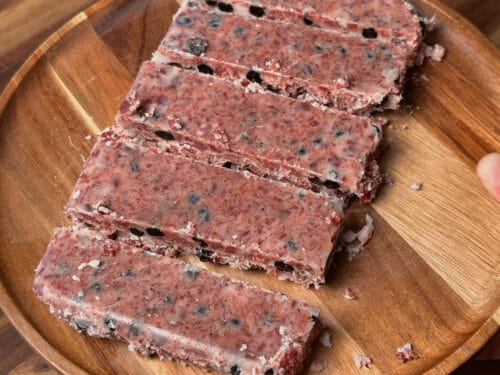
Bison Blueberry Pemmican

Print Recipe
A calorie dense bar of bison jerky, beef tallow, and wild dried blueberries. Based on the Plains tribes preparation documented in the Gary E. Moulton edition of The Journals of the Lewis and Clark Expedition, University of Nebraska Press, 1983 to 2001, and Mary Gunderson's The Food Journal of Lewis and Clark: Recipes for an Expedition, 2003William Clark journal entry, near Great Falls Montana, 1805: "the Hunters killed 3 buffaloe, the most of all the meat I had dried for to make Pemitigon."
Prep Time 20 minutes
Cook Time 8 hours

Ingredients

  • cups broken up jerky approximately 4 oz — bison jerky is the most historically accurate and is widely available online and at specialty food stores. Beef jerky is an acceptable substitute. Use the plainest, least seasoned jerky you can find. Heavily seasoned commercial jerky will produce an off flavour in the finished pemmican
  • 4 oz beef suet or beef tallow melted — the one to one ratio of dried meat to rendered fat by weight is critical and cannot be adjusted. This ratio is what produces a shelf stable product and what holds the pemmican together. Beef tallow is available at most butchers and online
  • ½ oz dried blueberries approximately 1 heaped tablespoon — saskatoon berries are the most historically accurate Plains tribe ingredient and can be found at specialty Canadian food importers. Dried blueberries, dried cranberries or dried chokecherries are all appropriate substitutes
  • Optional: pinch of coarse salt or a small drizzle of honey — both are documented in historical pemmican preparations and improve palatability noticeably

Instructions

Powder the jerky

  • Break the jerky into rough pieces and place in a food processor or mortar and pestle. Pulse until you have a rough fibrous powder with some slightly larger pieces remaining. You are not aiming for a fine uniform dust. Some texture is correct and historically accurate. The Plains tribes pounded the dried meat between stones on a hide, which produced a similarly rough, fibrous consistency. Set aside in a bowl.

Dry the berries further if needed

  • If your dried berries seem at all moist or sticky, spread them on a baking sheet and place in the oven at 200°F for 20 to 30 minutes until completely dry. Moisture in the berries can compromise the shelf stability of the finished pemmican. Allow to cool before adding to the meat powder.

Render the fat

  • If using suet rather than pre-rendered tallow, place the suet in a small heavy saucepan over the lowest possible heat. Allow it to melt slowly, stirring occasionally, until completely liquid and clear. Strain through a fine mesh strainer to remove any solid pieces. Allow the rendered fat to cool very slightly but keep it warm enough to remain liquid and pourable.

Combine

  • Add the dried blueberries to the meat powder and stir to combine. If using salt or honey add them now. Pour the warm rendered fat over the mixture gradually, stirring continuously as you pour, until everything is fully coated and the fat has bound all the dry ingredients together. The mixture should feel dense and slightly oily and hold together firmly when pressed between your fingers. If it feels too dry to hold together add a small additional amount of melted fat. If it feels too loose add a little more powdered meat.

Press and set

  • Press the mixture firmly into a small dish, loaf tin or silicone mold. Alternatively roll into balls or press into flat rectangular bars by hand. The historical preparation was pressed into whatever container was available, rawhide bags most commonly, and allowed to set in the cold. Refrigerate until completely firm and set, approximately one hour. Once set, cut into individual pieces if pressed in a dish.

To store

  • Wrap individual pieces in parchment or cloth. In cool, dry conditions pemmican keeps at room temperature for weeks to months. Refrigerated it keeps indefinitely. Do not store in an airtight plastic bag if storing at room temperature, as the pemmican needs to breathe.

To eat

  • Eat as is, chewing slowly. The fat coating will soften slightly from the warmth of your hands and mouth. Alternatively dissolve pieces in hot water with a pinch of salt and any available dried vegetables or grains to make rubaboo, the pemmican stew documented by North-West Mounted Police accounts and by fur trader journals as the most common cooked preparation of pemmican in the field. The stew version is significantly more palatable than the raw version and is recommended for anyone who finds the texture challenging on its own.

Notes

  • Do not reduce the fat. Every instinct will tell you that 4 oz of rendered fat to 4 oz of dried meat is excessive. It is not. It is the minimum ratio required for the pemmican to hold together and to be genuinely shelf stable. Less fat produces a crumbly, dry product that falls apart and spoils faster. The one to one ratio is not a preference. It is the engineering specification.
 
  • Bison jerky produces a significantly more authentic flavour than beef jerky. Bison is leaner, slightly sweeter and more gamey than beef in a way that is immediately apparent in the finished pemmican. It is worth sourcing if the channel is using this for a video recreation. Several online retailers including North Star Bison and various Etsy suppliers ship bison jerky nationally.
 
  • The honey addition is documented in some historical preparations and makes a noticeable difference to the palatability of the finished product. A small drizzle, no more than a teaspoon for this batch size, is enough to take the edge off the fat heaviness without compromising the historical integrity of the recipe.