
Go Back

Dr. Chase's Medicinal Root Beer, 1869

Donnie
No ratings yet
Dr. A.W. Chase, Dr. Chase's Recipes, 1869
One of the earliest documented root beer recipe with exact measurements, described as medicinal. Predates Charles Hires and commercial root beer production by six years.
Primary sources: Dr. A.W. Chase, Dr. Chase's Recipes, 1869, Michigan State University Feeding America Historic Cookbook Digital Collection; RecipeReminiscing, The History of Root Beer; Homebrewers Association, Root Beer: The Quintessential American Soda.
Prep Time 20 minutes
Cook Time 30 minutes
Fermenting Time 2 days

Jump To

Donnie Dodson

Don’t lose this one.

I’ll email it to you so it’s waiting when you’re ready to cook.

Ingredients
  

  • 1 gallon water
  • ½ oz each of hops burdock root, yellow dock root, sarsaparilla root, dandelion root and spikenard root, bruised — all available dried from herbal suppliers, health food stores and online. Bruise the roots by pressing firmly with the flat of a knife or in a mortar to open the plant material and allow the compounds to extract into the water
  • 8 to 10 drops of oil of spruce and sassafras mixed in equal proportions — safrole-free sassafras extract is the legal modern substitute for the sassafras oil. Available from homebrew suppliers and online. Oil of spruce is available from the same sources
  • pint molasses or ½ lb white sugar — molasses produces a darker more complex, more historically accurate result. White sugar produces a cleaner, lighter flavour
  • 2 to 3 tablespoons active dry yeast

Instructions
 

Build the herbal base

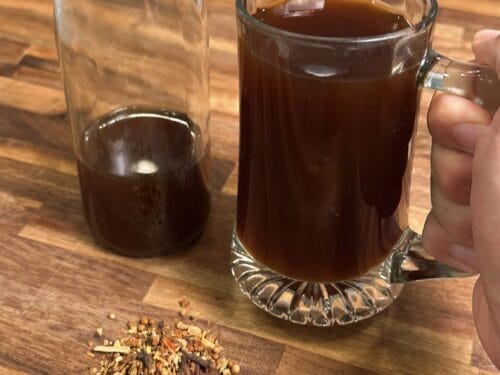
  1. Combine all the bruised roots and hops with the water in a large pot. Bring to a boil over medium-high heat. Reduce to a steady simmer and cook for approximately 20 minutes. The water will turn dark brown and deeply fragrant as the roots release their compounds. The kitchen will smell extraordinary at this stage, herbal, earthy and complex.

Strain and add the oils

  1. Strain the hot liquid while still very hot through a fine cloth or cheesecloth into a clean container, pressing firmly on the root solids to extract as much liquid as possible. Discard the spent roots. While the liquid is still hot, add the safrole-free sassafras extract and oil of spruce in equal proportions, 4 to 5 drops of each to reach your 8 to 10 drop total. Stir to distribute through the hot liquid.

Add the sweetener

  1. Allow the liquid to cool slightly to approximately 120 to 130°F. Add the molasses or sugar and stir continuously until completely dissolved. The molasses will darken the liquid further and add a deep, almost caramel sweetness.

Add the yeast

  1. Allow the liquid to cool further to approximately 80 to 90°F. It must be genuinely warm but not hot. Above 95°F will kill the yeast and prevent fermentation. Below 75°F will slow fermentation significantly. Dissolve the yeast in 2 tablespoons of the warm liquid with a pinch of sugar, leave for 5 minutes until foamy, then add to the main batch. Stir gently.

Ferment

  1. Pour into a large jar or container covered with a cloth, not sealed airtight. The fermentation needs to breathe. Leave at room temperature for 2 to 3 hours. You will see small bubbles beginning to form and a light foam developing on the surface. This is correct.

Bottle and condition

  1. After 2 to 3 hours of room temperature fermentation, pour into swing top bottles or screw cap bottles using a funnel and strainer to remove any sediment. Leave approximately 1 inch of headspace. Seal and leave at room temperature for a further 4 to 6 hours to build carbonation, then refrigerate immediately. The cold temperature slows fermentation and locks in the carbonation. Let ferment, and drink within 24 to 48 hours for the best result.
  2. Open carefully over a sink. This is a live fermentation and continues building pressure even in the fridge.

Video

Notes

  • The roots required for this recipe, burdock, yellow dock, sarsaparilla, dandelion and spikenard, are all available dried from Mountain Rose Herbs, Frontier Co-op and similar herbal suppliers online, as well as at most health food stores. Order them in advance as they are not always in stock locally.
 
  • The safrole-free sassafras extract is essential for the characteristic root beer flavour. Without it the recipe produces an interesting herbal beer but not something that reads as root beer to a modern palate. It is available from homebrew supply stores including Northern Brewer and MoreBeer, and online from Amazon and specialty suppliers. Look specifically for safrole-free or food-grade versions.
 
  • Plastic screw-cap bottles rather than glass are recommended for the carbonation phase. The fermentation continues building pressure and glass bottles can shatter if over-carbonated. Squeeze the plastic bottle periodically to check pressure. When it feels firmly resistant, it is carbonated. Refrigerate immediately.

Tried this recipe?

Let us know how it was!