
Both recipes from The Forme of Cury, compiled c.1390 by the master cooks of King Richard IIThe Forme of Cury is the oldest surviving cookbook written in English, held at the John Rylands Library in Manchester
Prep Time 30 minutesmins
Cook Time 2 hourshrs
Ingredients
For the Frumenty:
300gwhole wheat berriespearled spelt or bulgur wheat
500mlgood beef or chicken broth
300mlwhole milk or almond milk
4egg yolks
A generous pinch of saffron
Salt to taste
For the Roo Broth (Venison Stew):
600gvenison shoulder or haunchcut into 4cm pieces
250mlred wine
250mlwater
2thick slices stale brown breadcrusts removed, pounded to crumbs
50gcurrants
3tbspred wine vinegar
1tspground ginger
1tspground cinnamon
½tspground mace
Salt to taste
For the powder fort spice blend:
1tspground ginger
½tspground black pepper
¼tspground cinnamon
¼tspground cloves
Instructions
Start the frumenty first
If using whole wheat berries or pearled spelt: soak overnight in cold water. Drain and simmer in fresh water for 45 to 60 minutes until the grains have completely burst open. Drain and cool completely. If using bulgur wheat: rinse well, pour over boiling water in a ratio of 1 to 1.5, cover tightly and rest for 20 minutes. Drain any excess water.
Parboil the venison
Place the venison pieces in a saucepan and cover with cold water. Bring to a boil and parboil for 5 minutes. Drain, discard the water and pat the venison dry.
Braise the venison
Return the parboiled venison to the saucepan. Add the red wine and water in equal parts. Bring to a gentle boil, reduce to a steady simmer and cook covered for 45 minutes until completely tender.
While the venison braises, finish the frumenty
Warm the broth and milk together in a saucepan over medium heat. Add the cooked wheat. Steep the saffron in a tablespoon of warm water for 5 minutes then add to the pot. Simmer gently for 10 minutes until thick and smooth. Beat the egg yolks in a small bowl, pour a ladleful of hot frumenty over them whisking constantly to temper, then pour the tempered mixture back into the pot. Stir over the lowest possible heat for 2 to 3 minutes until glossy and thickened. Do not boil after the eggs go in. Season with salt. Keep warm.
Build the venison sauce
Mix the powder fort spices together and set aside. Remove the venison from the pot and set aside. To the remaining braising liquid add the pounded bread crumbs and whisk in until absorbed and thickened. Add the currants, red wine vinegar and all the spices including the powder fort blend. Simmer for 10 minutes stirring regularly until the sauce is thick, dark and glossy. Taste and adjust the balance of vinegar and spice. Return the venison to the sauce and heat through for 5 minutes until completely coated.
Serve
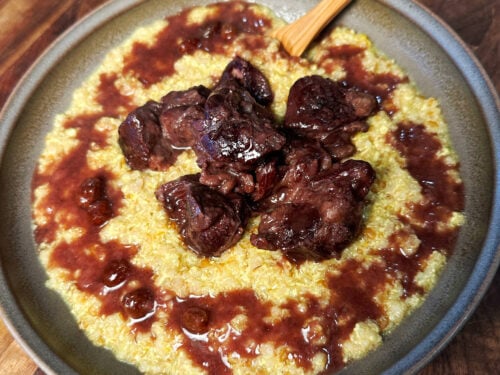
Spoon the golden saffron frumenty into wide bowls. Place the venison pieces on top and ladle the dark spiced sauce generously over everything.
Video
Notes
The saffron in the frumenty is not optional and cannot be substituted. Turmeric produces a similar colour but a completely different flavour profile that is not authentic to the medieval preparation. Saffron is expensive but a single generous pinch is sufficient for this quantity and the flavour difference is immediate and significant.
The powder fort spice blend is worth making as a separate prepared mixture that you can use across multiple medieval recipes. It appears repeatedly in the Forme of Cury and in contemporaneous French and Italian medieval cookbooks. The combination of ginger, pepper, cinnamon and cloves is the defining spice flavour of late medieval English cooking.
The pounded bread thickening is correct and should not be substituted with flour or cornstarch. The stale bread absorbs into the braising liquid and produces a sauce with a specific texture, slightly grainy and deeply coating, that cannot be replicated with modern thickeners. It is also the historically accurate technique and worth using for that reason.