Go Back
–+ servings

Hünkar Beğendi (Sultan's Delight)

Donnie
No ratings yet
Ottoman palace dish, associated by tradition with Sultan Abdülaziz and the visit of Empress Eugénie of France to Beylerbeyi Palace, Istanbul, 1869
The name translates from Ottoman Turkish as "the sultan liked it".
Prep Time 30 minutes
Cook Time 1 hour 30 minutes
Servings: 4

Jump To

Donnie Dodson

Don’t lose this one.

I’ll email it to you so it’s waiting when you’re ready to cook.

Ingredients
  

For the eggplant purée:
  • 2 large eggplants
  • 2 tbsp unsalted butter
  • 2 tbsp plain flour
  • ½ cup heavy cream
  • ½ cup whole milk
  • ¾ cup good quality aged kashkaval or Turkish aged cheese finely grated — kashkaval is the traditional choice and is available at Middle Eastern and Turkish food shops. A mild mature cheddar is the most accessible substitute if unavailable
  • Salt and white pepper to taste
  • Juice of half a lemon to prevent browning
For the lamb stew:
  • 600 g lamb shoulder cut into 3 to 4 cm cubes — shoulder is the correct cut. Its higher fat and collagen content produces a more richly flavoured and more tender result than leg
  • 2 tbsp unsalted butter
  • 1 large onion finely diced
  • 3 cloves garlic finely minced
  • 2 tbsp tomato paste
  • 3 medium tomatoes roughly chopped, or one 400g tin of good quality chopped tomatoes
  • 2 green peppers seeds removed, roughly chopped
  • 1 tsp salt
  • ½ tsp freshly ground black pepper
  • ½ tsp dried chilli flakes adjust to taste
  • 1 cup water
For serving:
  • Fresh flat-leaf parsley roughly chopped

Instructions
 

Char the eggplants

  1. This is the most important step in the entire recipe and cannot be abbreviated or substituted with boiling or steaming. Place the whole eggplants directly over a gas flame on your hob, or under a very hot grill as close to the element as possible. Turn occasionally with tongs until the skin is completely blackened and charred on all sides and the eggplants have collapsed and softened entirely, approximately 20 to 25 minutes. The smell of the charring skin is correct and unavoidable. Open a window. The char is the entire point.
  2. Transfer the blackened eggplants to a colander and allow to cool until comfortable to handle. Split each one open and scoop out the flesh with a spoon, discarding the charred skin. Place the flesh in a colander and press gently to drain excess liquid for 5 minutes. Squeeze lemon juice over the flesh to prevent discolouration. Blend or mash to a rough purée, not completely smooth. Small flecks of charred skin in the flesh are acceptable and add to the smokiness. Set aside.

Make the lamb stew

  1. Heat the butter in a wide, heavy pot over high heat until foaming. Add the lamb pieces in a single layer without crowding and brown deeply on all sides, 8 to 10 minutes total. Do not move the meat until it releases naturally from the base of the pot. The browning is building flavour and cannot be rushed. Season with salt and pepper as the lamb cooks.
  2. Add the finely diced onion to the browned lamb and reduce the heat to medium. Cook for 6 to 8 minutes until the onion is completely soft and beginning to colour. Add the minced garlic and cook for a further 2 minutes. Add the tomato paste and stir it into the lamb and onion, cooking for 2 to 3 minutes until the paste darkens slightly and begins to caramelise. This caramelisation of the tomato paste is an important flavour step.
  3. Add the chopped tomatoes and green peppers. Stir to combine everything. Add the chilli flakes and the water. Bring to a boil, then reduce to a gentle simmer. Cover and cook for 45 minutes to 1 hour, stirring occasionally, until the lamb is completely tender and the sauce has reduced to a thick, glossy coating consistency. If the sauce reduces too quickly before the lamb is tender, add small amounts of additional water. Taste and adjust salt, pepper and chilli flakes. Keep warm while you finish the purée.

Make the eggplant béchamel

  1. Melt the butter in a medium saucepan over medium heat. Add the flour and whisk immediately and continuously for 2 minutes until the roux is smooth, bubbling and faintly golden. This cooking of the roux removes the raw flour taste. Do not rush this step.
  2. Add the cream and milk gradually, whisking continuously after each addition to prevent lumps. The mixture will be very thick initially and will loosen as more liquid is added. Continue whisking until completely smooth.
  3. Add the eggplant purée to the béchamel and stir thoroughly to combine. The mixture will turn a warm grey-beige colour with flecks of smokiness throughout. Cook over medium-low heat for 5 minutes, stirring frequently, until the purée and béchamel have fully integrated and the mixture is thick, smooth and hot.
  4. Remove from heat. Add the grated cheese and stir until completely melted into the purée. Season generously with salt and white pepper. Taste at this point. The purée should be rich, smoky, creamy and well seasoned. If it seems too thick, add a splash of warm milk to adjust.
Serve

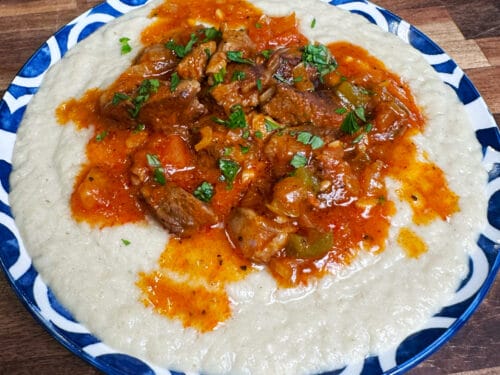
  1. Spoon the warm eggplant béchamel into the centre of each serving plate, spreading it into a generous base. Ladle the lamb stew on top of the purée, allowing the dark, glossy sauce to pool around and over the eggplant base. The visual contrast of the pale, creamy purée against the deep, mahogany-coloured stew is part of the dish. Scatter fresh flat-leaf parsley over the top.
  2. Serve immediately. Hünkar Beğendi does not wait and does not improve with time. The warmth of the stew against the creamy purée is the combination.

Notes

  • The charring of the eggplant is completely non-negotiable. The dish without the char is a completely different thing, missing the smoky depth that defines the purée and that contrasts with the richness of the béchamel. If you do not have a gas hob, place the eggplants under the highest possible heat of your oven grill on a foil-lined tray and turn frequently. It will take longer than over a direct flame but will produce adequate char if you persist.
 
  • The cheese is the second most important flavour element in the purée. Kashkaval, the traditional aged sheep's milk cheese of the Ottoman and Balkan tradition, has a specific tangy, slightly sharp flavour that enriches the purée differently from other cheeses. It is available at Turkish, Middle Eastern and Eastern European food shops. If unavailable, a mild mature cheddar works as a substitute though the flavour profile will shift slightly toward the familiar.
 
  • The lamb stew benefits from being made ahead and reheated. Like most braised preparations, the flavour deepens significantly overnight as the sauce continues to develop. If you have time, make the stew a day ahead and refrigerate it, then make the purée fresh just before serving.

Tried this recipe?

Let us know how it was!