Go Back
+ servings

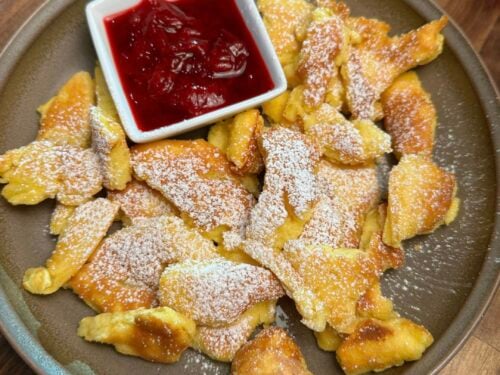
Kaiserschmarrn with Plum Compote

Donnie
No ratings yet
The Emperor's Shredded Pancake, associated with Emperor Franz Joseph I of Austria, 1848 to 1916 The name derives from Kaiser, emperor, and Schmarrn, mess or nonsense in Austrian dialect. The dish is documented in Viennese recipe collections from the latter half of the 19th century and remains one of the most widely eaten desserts across Austria and the former Austro-Hungarian territories.
Prep Time 20 minutes
Cook Time 20 minutes
Servings: 2

Jump To

Donnie Dodson

Don’t lose this one.

I’ll email it to you so it’s waiting when you’re ready to cook.

Ingredients
  

For the Kaiserschmarrn:
  • 3 large eggs separated into yolks and whites
  • ¾ cup whole milk
  • 1 tsp pure vanilla extract
  • 3 tbsp white sugar divided, 2 tbsp for the batter and 1 tbsp for sprinkling
  • ¾ cup all-purpose flour sifted
  • Pinch of fine salt
  • 2 tbsp unsalted butter for the pan plus extra for finishing if desired
  • Powdered sugar generous amount, for serving
For the plum compote:
  • 7 to 8 ripe plums pitted and halved
  • 3 tbsp white sugar adjust to the sweetness of your plums
  • 1 cinnamon stick
  • 1 tsp pure vanilla extract
  • 3 to 4 tbsp water

Instructions
 

Make the plum compote first

  1. The compote can be made ahead and served at room temperature or gently reheated. Place the pitted and halved plums in a medium saucepan. Add the sugar, cinnamon stick and water. Bring to a gentle simmer over medium heat, stirring occasionally. Cook for 12 to 15 minutes until the plums have completely collapsed and the liquid has reduced to a thick, jammy sauce consistency. Add the vanilla extract off the heat. Remove the cinnamon stick. Taste and adjust sugar. The compote should be pleasantly tart rather than overly sweet since it is served against a sweet caramelised pancake. Set aside.

Make the batter

  1. In a large bowl, whisk together the egg yolks, milk, vanilla extract and 2 tablespoons of the sugar until completely combined and slightly pale. Sift the flour and salt directly into the yolk mixture. Whisk until completely smooth with no lumps. The batter should be thin and pourable.
  2. In a completely clean, grease-free bowl, beat the egg whites with the pinch of salt using a whisk or electric beaters until they hold firm, glossy stiff peaks. This step is the foundation of the dish's lightness and cannot be rushed or skipped. The bowl must be clean and dry as any fat will prevent the whites from whipping properly.
  3. Add approximately one third of the whipped egg whites to the yolk batter and stir through completely to loosen the mixture. Add the remaining whites in two additions, folding gently each time with a large spatula using a cut-and-fold motion rather than stirring. Stop the moment the white streaks disappear. The batter should be light, airy and considerably thicker than it was before the whites were added.
Cook the Kaiserschmarrn

  1. Heat a wide ovenproof pan or skillet, approximately 26 to 28cm, over medium heat. Add the butter and allow it to melt completely and foam slightly. Pour the batter into the pan and spread gently to the edges. The batter should be approximately 2cm thick. Reduce the heat to medium-low.
  2. Cook without disturbing for 4 to 5 minutes until the edges are set and beginning to colour golden and the top surface is still slightly runny in the centre. Do not attempt to flip the whole pancake. Instead, using a knife or spatula, cut the pancake into four quarters directly through the runny top batter. Flip each quarter individually to reveal the deeply golden underside. The cut-and-flip method is both more practical than flipping the whole pancake and is the technique that produces the characteristic torn texture of the finished dish.
  3. Cook the flipped quarters for a further 2 to 3 minutes until the second side is golden and the centre is cooked through. Sprinkle the remaining tablespoon of sugar over the surface and add an additional small knob of butter if you want to caramelise further. Using two forks or a fork and a knife, tear and pull the quarters into rough bite-sized pieces directly in the pan. The pieces should be irregular and uneven, pulled apart rather than cut. Toss them in the pan so all surfaces make contact with the butter and sugar.

Serve

  1. Pile the warm Kaiserschmarrn onto a serving plate or serve directly from the pan at the table. Dust generously with powdered sugar immediately before serving. The powdered sugar should be genuinely generous, not a light dusting. Serve the warm plum compote alongside for spooning over each portion.
  2. Eat immediately. Kaiserschmarrn does not wait and does not improve with time. The warmth, the caramelisation and the contrast with the cold or warm compote are all at their best the moment it comes off the heat.

Notes

  • The egg white folding is the single most important technique in this recipe. Properly whipped, properly folded egg whites produce a Kaiserschmarrn that is light, almost soufflé-like, and significantly more satisfying than a dense batter version. The extra five minutes this takes is the difference between a good result and a genuinely extraordinary one.
 
  • The pan size matters. Too small and the batter will be too thick and take too long to cook through, producing a dense, undercooked centre. Too large and the batter will be too thin and lack the airy depth that makes Kaiserschmarrn itself rather than simply a flat torn pancake. A 26 to 28cm pan for this quantity of batter is the correct range.
 
  • The plum compote, zwetschgenröster in Austrian German, is the traditional accompaniment and the correct one. Apple sauce is the second most common accompaniment in Austrian restaurants and is an excellent alternative when plums are not in season. The compote can be made ahead and refrigerated for up to a week.

Tried this recipe?

Let us know how it was!