Go Back
+ servings

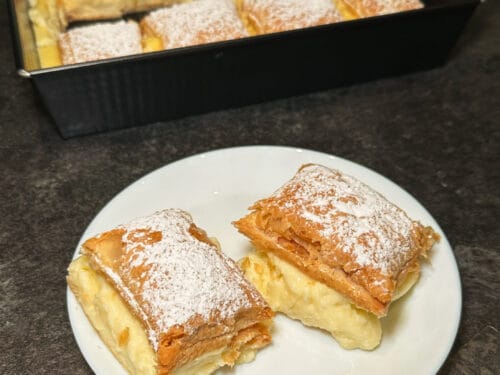
Kremówka Papieska (The Lazy Home Version)

Donnie
No ratings yet
Inspired by the traditional Polish Papal Cream Cake, adapted for home cooks without a stand mixer using a vanilla pudding method common in Polish households
Note on authenticity: this is not the classical kremówka recipe using handmade puff pastry and a full crème pâtissière. It is the home cook's version using pre-bought puff pastry and vanilla pudding powder as a thickening agent, a shortcut that Polish babcias will recognise and professional bakers will pretend not to.
Prep Time 30 minutes
Cook Time 25 minutes
Chill Time 4 hours
Servings: 12

Jump To

Donnie Dodson

Don’t lose this one.

I’ll email it to you so it’s waiting when you’re ready to cook.

Ingredients
  

For the pastry:
  • 2 sheets of pre-bought all-butter puff pastry thawed if frozen — all-butter puff pastry produces the best flavour and the most satisfying shatter. Do not use vegetable-fat pastry if you can avoid it
  • 1 egg beaten, for egg washing the top layer before baking
For the vanilla cream filling:
  • 500 ml whole milk divided — 375ml for the main pot and 125ml for mixing the pudding powder
  • 2 large egg yolks
  • 4 tbsp white sugar
  • 1 packet vanilla pudding powder approximately 40g — the Polish brand budyń waniliowy is the household standard. Dr. Oetker vanilla pudding powder available in most European food sections works equivalently
  • 1 tsp pure vanilla extract
  • 100 g unsalted butter cut into cubes, room temperature
For finishing:
  • Generous amount of powdered sugar for dusting

Instructions
 

Bake the puff pastry

  1. Preheat your oven to 200°C / 400°F. Line two baking sheets with parchment paper. Lay each sheet of puff pastry flat on a lined baking sheet. This is the moment for an important technique that will save you significant difficulty at serving: take a sharp knife and lightly score the top sheet of pastry into the squares or rectangles you intend to serve, cutting only halfway through the pastry rather than all the way through. Do not cut the bottom sheet. Scoring the top sheet before baking means that when the time comes to portion the finished kremówka, the top pastry will break cleanly along lines that are already defined rather than shattering unpredictably across the cream. Every Polish home cook I spoke to about kremówka mentioned this trick.
  2. Brush the top sheet lightly with beaten egg for a golden finish. Pierce both sheets all over with a fork to prevent excessive puffing. Bake both sheets for 18 to 22 minutes until deeply golden and completely cooked through. The pastry should be genuinely crisp and flaky throughout. Allow to cool completely on a wire rack. The pastry must be completely cold before assembly.

Make the vanilla cream

  1. In a medium saucepan, combine 375ml of the milk with the sugar and butter. Bring to a gentle simmer over medium heat, stirring occasionally, until the butter is completely melted and the sugar is dissolved.
  2. In a separate bowl, whisk together the egg yolks, the remaining 125ml of cold milk and the entire packet of vanilla pudding powder until completely smooth with no lumps. This mixture must be completely smooth before it goes into the hot milk. Any lumps at this stage will remain as lumps in the finished cream.
  3. Add the vanilla extract to the egg yolk mixture and whisk through.
  4. Now temper the egg mixture: take a ladleful of the hot milk from the saucepan and pour it slowly into the egg yolk mixture, whisking continuously as you pour. This gradually raises the temperature of the egg mixture without scrambling it. Add a second ladleful and whisk again. Now pour the entire tempered egg mixture back into the saucepan with the remaining hot milk, whisking continuously as you pour.
  5. Cook the mixture over medium-low heat, whisking constantly and thoroughly, until it thickens significantly. Do not stop whisking at any point during this stage. The cream will go through a thin watery phase and then quite suddenly begin to thicken. Continue whisking until the cream is very thick and holds clear lines when the whisk is drawn through it. It should be thick enough that a spoonful dropped back into the pot holds its shape briefly before settling. Remove from heat immediately.
  6. Allow the cream to cool for 10 to 15 minutes, stirring occasionally to prevent a skin forming on the surface. It will thicken further as it cools.
Assemble

  1. Choose a baking pan or deep dish that matches the dimensions of your pastry sheets as closely as possible. Place the first cooled pastry sheet in the base of the pan, pressing it gently to fit.
  2. Pour all of the cream filling over the base pastry and spread evenly with a spatula to the edges. The cream layer should be generous, at minimum 2 to 3 centimetres thick. More cream is better.
  3. Carefully lay the second pastry sheet over the top of the cream, scored side up, pressing very gently so it adheres to the cream beneath without sinking into it.

Chill

  1. Cover the assembled kremówka with cling film and refrigerate for a minimum of 4 hours. Overnight is better. The chilling time allows the cream to set completely and the pastry to slightly soften in contact with the cream, producing the characteristic texture of a properly made kremówka where the pastry gives way without complete resistance. If you serve it too early the cream will be loose and the pastry will slide.

Serve

  1. Remove from the refrigerator. Dust the top surface very generously with powdered sugar immediately before serving. Do not be conservative with the powdered sugar. It should be a white blanket, not a light dusting.
  2. Cut along the pre-scored lines using a sharp knife, pressing straight down rather than sawing. Place a small cross on each square before serving if you want to honour the papal tradition. Serve cold.

Video

Notes

  • The key to kremówka that does not collapse when cut is patience with the chilling step. Four hours is the minimum. Overnight is the correct choice if you are making this for any occasion that matters. The cream must be fully set and cold before you attempt to portion it.
 
  • The pre-scored top pastry technique is not optional if you want clean portions. Puff pastry that is not pre-scored will shatter unpredictably when cut, sending cream in all directions and producing portions that look dramatically different from the neat squares served in Polish confectioneries. Score before baking, every time.
 
  • The all-butter puff pastry specification matters. Vegetable fat puff pastry produces adequate flaky layers but lacks the flavour depth and the characteristic buttery richness that makes kremówka taste like something worth eating rather than simply something that holds the cream filling. The butter is the point.

Tried this recipe?

Let us know how it was!