
Go Back

Medieval Blancmange

Print Recipe
The original manuscript instructs that the rice be cooked until it completely bursts apart, that white grease be added to the chicken, and that blanched almonds and saffron be used as a garnish. This recipe follows those instructions as closely as possible using accessible modern ingredients.
Prep Time 20 minutes
Cook Time 45 minutes

Ingredients

  • 2 chicken thighs or breasts
  • 1 cup white rice
  • 5 cups almond milk
  • 1 tsp rosewater stirred into the almond milk for period authenticity
  • 1 tsp sugar in the almond milk plus more to taste
  • ½ tsp ground cinnamon
  • ¼ tsp ground ginger
  • Salt to taste
  • 2 tbsp lard divided
  • Sliced almonds to serve
  • Pinch of saffron threads dissolved in 1 tbsp warm water for the garnish

Instructions

Cook the chicken

  • Place the chicken in a pot, cover with cold water and bring to a simmer. Cook gently for 20 to 25 minutes until completely cooked through. Remove the chicken and allow it to cool slightly. Shred the meat finely with two forks or your fingers, pulling it apart until it is in small, soft pieces. Set aside. The original recipe calls for the chicken to be ground small in a mortar, which would have produced an even finer texture. Shredded is the practical modern equivalent.

Make the rice porridge

  • Combine the rice and almond milk in a heavy saucepan. Add the rosewater and sugar. Bring to a gentle simmer over medium-low heat, stirring regularly. Cook for 30 to 40 minutes, stirring frequently, until the rice has completely broken down and the mixture is thick and porridge-like with no distinct rice grains remaining. This is the key instruction from the Forme of Cury: cook until they completely burst apart. Add more almond milk if the mixture becomes too thick before the rice dissolves. Season with salt.

Combine

  • Add one tablespoon of lard to the rice porridge and stir through. Add the shredded chicken and stir well to combine. Add the cinnamon and ginger and stir through. The mixture should be thick enough to hold its shape slightly in a bowl but still soft and spoonable. Taste and adjust the seasoning with salt and sugar.

Toast the almonds

  • Heat the remaining tablespoon of lard in a small pan over medium heat. Add the sliced almonds and toast, stirring constantly, until golden. Watch them carefully as they burn quickly. Remove from the heat and drain on a piece of paper towel.

Serve

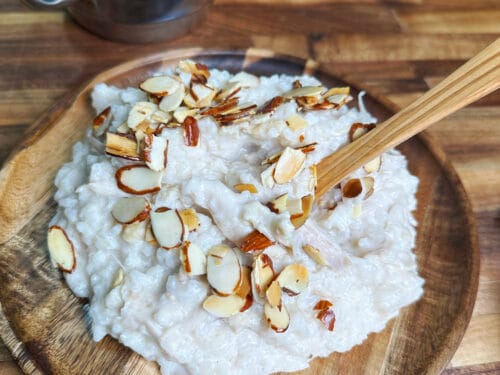
  • Spoon the blancmange into bowls or onto plates. Scatter the toasted almonds over the top. Drizzle the dissolved saffron over the surface so the gold threads run across the white surface. Serve immediately while hot.

Video

Notes

  • The rosewater is historically accurate and adds a floral note that medieval cooks would have recognised as a signature of refined cuisine. It is optional but worth including for the authentic flavour profile.
 
  • Lard is the historically correct fat for this recipe. White grease in the Forme of Cury refers to rendered lard, which was the standard cooking fat of the medieval English kitchen. You can substitute butter but the flavour will be different.
 
  • The dish should be white or very pale throughout. If your almond milk is heavily coloured or your spices are turning it brown, you have used too much. The visual whiteness was the point.