Go Back

Medieval Pease Pottage (c. 14th century, England)

Print Recipe
Pease pottage was the cornerstone of the medieval English diet, a slow-cooked stew of peas, grains, and vegetables that sustained common folk for centuries. Built from what could be grown or gathered—peas, onions, leeks, and roots—it was the dish that filled bellies when meat and spice were luxuries of the elite. Reconstructed from manorial accounts and archaeological finds, this version recreates the simple warmth of a peasant’s hearth, offering a taste of endurance and history in every spoonful.
Prep Time 10 minutes
Cook Time 1 hour 25 minutes

Ingredients

  • ½ cup dried split peas field peas or fava beans were also common
  • 2 cups water or weak vegetable broth ale or whey was sometimes used
  • ½ onion roughly chopped
  • 3 cloves garlic
  • 3 small carrots or parsnips chopped (period-accurate root vegetables)
  • 1 slice stale bread and ½ cup barley or oats to thicken
  • A few leaves of kale or cabbage
  • Pinch of salt limited but occasionally available
  • Optional: a spoonful of rendered fat or splash of ale for flavor

Instructions

  • Soak and simmer the peas: Place the peas in a pot with the water and bring to a slow simmer. Cook until soft and beginning to break down, about 30–40 minutes. In medieval kitchens, this would have simmered for hours over a hearth.
  • Add vegetables: Stir in the onion, garlic, and root vegetables. Continue simmering until the mixture thickens and the peas begin to dissolve, about 20–30 minutes.
  • Add greens and thickener: Add the chopped kale or cabbage. Stir in the bread or grains to thicken. Continue simmering until everything melds together into a hearty, porridge-like consistency.
  • Finish: Season lightly with salt if available. For a more authentic finish, stir in a small spoonful of rendered fat or a splash of ale for depth.
  • Serve: Spoon into a wooden or earthenware bowl. Serve with coarse barley or rye bread, a wedge of hard cheese, and a mug of small ale or cider.
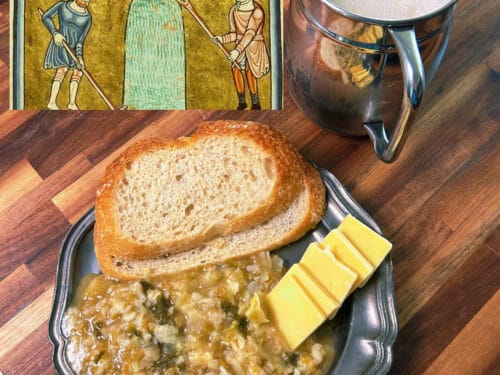
Video

Notes

  • Historical accuracy: Based on the Cuxham Manor Accounts (1320s), Winchester Pipe Rolls, and finds from Wharram Percy, this recipe represents what a working English peasant would have eaten in the 14th century.
 
  • Ingredient authenticity: Field peas, barley, and cabbage were the most common ingredients of the era. Root vegetables like carrots or parsnips would have appeared in later variations as they became more widespread in England.
 
  • Serving tradition: Pottage was eaten throughout the day as it thickened on the hearth. For a full experience, serve with coarse barley bread, a slice of hard cheese, and a mug of small ale or cider.