
Go Back
+ servings

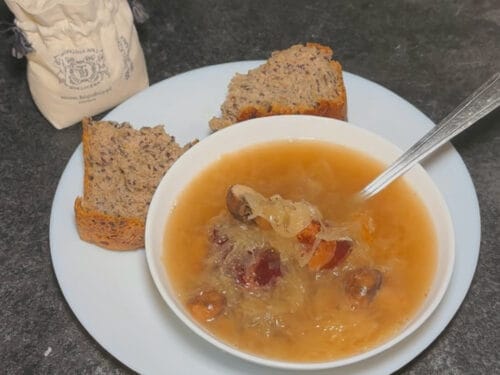
Medieval Polish Salt Miners' Soup

Donnie
No ratings yet
A boczek and kiszona kapusta soup from the medieval Polish tradition, made with salt from Wieliczka and the preserved vegetables that the mine's salt made possible
This is the direct descendant of the food that sustained the workers of the Cracow Saltworks during the mine's medieval heyday. Every ingredient, the smoked bacon, the fermented sauerkraut, the dried mushrooms, the caraway and the dark rye bread served alongside, is documented in the medieval Polish dietary tradition.
Prep Time 30 minutes
Cook Time 1 hour 15 minutes
Servings: 4

Jump To

Donnie Dodson

Don’t lose this one.

I’ll email it to you so it’s waiting when you’re ready to cook.

Ingredients
  

  • 300 g boczek wędzony smoked bacon, one thick piece not thin slices
  • 500 g kiszona kapusta sauerkraut, jarred from any good Polish delicatessen or supermarket, every drop of brine included
  • Small bag dried mushrooms grzyby suszone, soaked in cold water for at least 30 minutes, soaking liquid reserved and strained
  • 3 cloves czosnek garlic, crushed
  • 1 tsp kminek caraway seeds
  • 2 bay leaves liść laurowy
  • 6 whole black peppercorns pieprz ziarnisty
  • 1.2 litres cold water
  • Salt to taste Wieliczka salt if you have it, standard salt if you do not
  • Dark rye bread to serve chleb żytni

Instructions
 

Render the bacon

  1. Cut the boczek into rough 2cm chunks. Cold pot, no oil. Medium-low heat. Let the bacon render slowly for 10 minutes. You want the fat running and the edges just beginning to colour but not crispy. The rendered fat is your entire flavour base. Do not rush this step and do not drain it under any circumstances.

Build the broth

  1. Add 1.2 litres of cold water directly to the pot with the bacon and its rendered fat. Add the crushed garlic, bay leaves, whole peppercorns and the soaked mushrooms with every drop of their strained soaking liquid. Bring slowly to a simmer. Cook for 40 minutes. The bacon broth develops faster than a pork rib broth and does not need the longer time. The kitchen will smell extraordinary by the 20 minute mark.

Add the sauerkraut

  1. Add the kiszona kapusta and every drop of brine from the jar. Add the caraway seeds. Stir. The soup will immediately smell unmistakably Polish. Simmer for another 25 minutes until the cabbage is completely soft and the broth is a deep amber colour.

The salt moment

  1. Taste the soup before adding any salt at all. This is the historically honest moment of the recipe. Between the boczek and the fermented cabbage brine you may need nothing. The mine workers' soup was already salty because their salt went into the fermentation of the cabbage weeks earlier. If you add Wieliczka salt at the table it is symbolic rather than functional, a pinch of the same mineral that built the Polish state, added to a soup that would not exist without it.

Serve

  1. Ladle into deep bowls. Serve with thick slices of dark rye bread on the side. Nothing else is needed.

Notes

  • The boczek must be a thick piece rather than thin slices. Thin sliced bacon renders too quickly and produces a different texture and flavour to the slow-rendered chunky boczek that is the correct preparation for this soup. Ask at a Polish delicatessen or butcher for a proper piece of smoked bacon.
 
  • Every drop of the sauerkraut brine goes in. The brine is where the fermentation character lives and it is the most flavourful liquid in the recipe. Discarding it produces a less complex, less historically accurate result.
 
  • The mushroom soaking liquid must be strained before adding to the soup as it contains grit from the dried mushrooms. Strain through a fine cloth or coffee filter. The soaking liquid is intensely flavoured and adds enormous depth to the broth.

Tried this recipe?

Let us know how it was!