Go Back

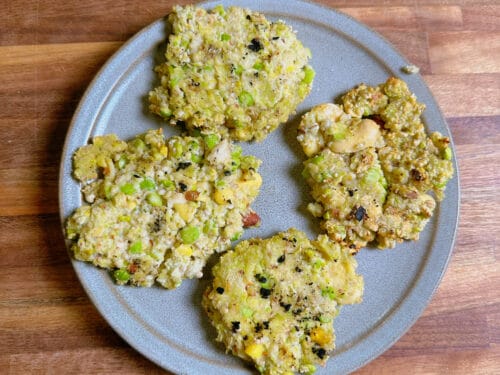
Neanderthal Bean and Pulse Cakes

Donnie
5 from 1 vote
Reconstructed from the charred food remains identified at Shanidar Cave, Iraqi Kurdistan, dated to approximately 70,000 years ago
Primary source: Ceren Kabukcu, Chris Hunt et al, Cooking in Caves: Palaeolithic Carbonised Plant Food Remains from Franchthi and Shanidar, Antiquity, Volume 97, Issue 391, November 2022, Cambridge University Press. Peer-reviewed study, freely available through Cambridge Core.
Secondary sources: Shanidar Cave Project, University of Liverpool; The Conversation, The Real Paleo Diet, November 2022; Smithsonian Magazine, Neanderthals Cooked Surprisingly Complex Meals, November 2022
The ingredients in this recipe are modern accessible equivalents of the wild plant species documented in the Shanidar charred remains: wild lentils, wild peas, wild grass seeds, wild mustard, wild pistachio and bitter vetch. No salt. No oil. No spices beyond what the evidence documents. This is what the evidence shows.
Prep Time 12 hours
Cook Time 20 minutes

Jump To

Donnie Dodson

Don’t lose this one.

I’ll email it to you so it’s waiting when you’re ready to cook.

Ingredients
  

  • ½ cup dried fava beans — the closest modern equivalent to the bitter vetch and wild pea documented in the Shanidar remains
  • ¼ cup dried lentils any colour — directly documented in the Shanidar charred food analysis
  • ¼ cup wheat berries — the closest accessible equivalent to the wild grass seeds found mixed with pulses in the Neanderthal layer
  • ¼ cup raw almonds — documented nut species present in the Zagros Mountains environment
  • ¼ cup raw pistachios — terebinth the wild pistachio, is specifically documented in the Shanidar food remains
  • 1 tbsp whole mustard seeds — wild mustard is documented in the charred remains from both Shanidar and Franchthi Cave
  • Water for soaking and binding
  • No salt. This is historically accurate and is the primary reason the rating is 1.3 out of 10.

Instructions
 

Soak overnight

  1. Place the fava beans, lentils and wheat berries in separate bowls covered with plenty of cold water. Leave to soak for at least 12 hours, ideally overnight. The soaking step is not optional and is the documented Neanderthal processing technique. It hydrates the seeds, begins to break down the outer husks and reduces the natural bitterness of the raw pulses.
  2. Drain all soaked ingredients thoroughly.

Crush and combine

  1. Using a mortar and pestle, food processor, or the flat of a heavy pan pressed against a solid surface as a rough stone equivalent, crush all the drained soaked ingredients together with the almonds, pistachios and mustard seeds into a rough, coarse paste. Do not process to a fine flour. The Shanidar remains show incompletely ground material with visible seed coat fragments remaining. A rough, slightly gritty texture is correct.
  2. Add water a tablespoon at a time until the mixture just holds together when pressed firmly. It should be dense and slightly sticky but hold a shape when formed. If it will not hold together, add a small amount of additional water. If it seems too wet to hold shape, remove moisture by pressing through a cloth.

Form the cakes

  1. Divide the mixture into 6 to 8 equal portions. Press each into a small flat round cake approximately 1cm thick and 6 to 7cm in diameter. Pack them firmly so they hold their shape during cooking.

Cook over fire or grill

  1. These were cooked directly on or near a Neanderthal hearth. The closest modern equivalent is a charcoal grill over direct heat, which produces the closest approximation of the charred exterior and smoky character that the Shanidar evidence shows. A cast iron pan over high heat is an acceptable alternative.
  2. Cook the cakes for 6 to 8 minutes per side until a dark, charred crust has formed on each surface and the interior is cooked through. The exterior will be noticeably burned in places. This is correct and is literally what the evidence shows. The word charred in charred food remains is not incidental.
  3. Allow to cool slightly before eating. They will be very dense, slightly bitter and completely unsalted.

Notes

  • The absence of salt is the defining characteristic of this recipe from a palatability perspective and it is historically accurate. There is no evidence of salt processing at the Neanderthal layer of Shanidar Cave. Salt extraction and processing is a technology that develops considerably later in human prehistory. Eating this recipe as documented gives you the most direct possible experience of what was wrong with prehistoric food, which is everything that salt fixes.
 
  • The soaking step is genuinely important beyond historical accuracy. Unsoaked fava beans and lentils will not crush to a workable consistency and will produce a gritty, dry cake that falls apart on the grill. Soaking overnight produces a workable paste that holds together adequately during cooking.
 
  • The charcoal grill produces a meaningfully better result than a gas grill or pan due to the smoky character it imparts to the exterior crust. Fire was the Neanderthal's only cooking technology and its specific flavour contribution to the finished cake is the most historically accurate element of the entire preparation.

Tried this recipe?

Let us know how it was!