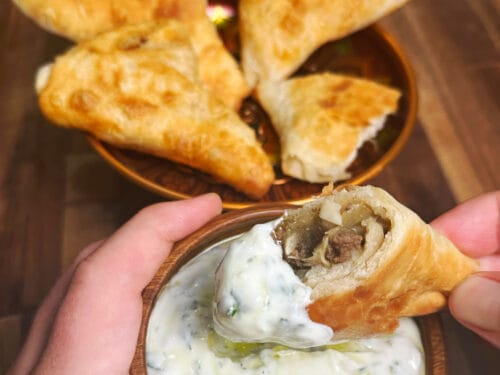

Go Back

Ni'matnama Royal Mughal Samosas

Print Recipe
Adapted from the Ni'matnama manuscript, c.1501-1510, British Museum. Translated by Nora Titley. A note on the saffron: the original recipe calls for saffron ground and steeped in rosewater, which is the most characteristically Mughal element of the dish. If you have it, use it. If you do not, the samosas are still excellent, but the saffron is worth seeking out for the full historical experience.
Prep Time 45 minutes
Cook Time 45 minutes
Resting Time 30 minutes

Ingredients

For the filling:

  • 1 lb ground lamb the original calls for well-cooked mince
  • 1 lb white onion very finely minced (equal weight to the lamb)
  • 2 oz dried or fresh ginger finely chopped (roughly a quarter of the onion weight)
  • 4 cloves garlic ground to a paste
  • 1 medium eggplant
  • Good pinch of saffron ground and steeped in 2 tbsp rosewater (omit if unavailable)
  • Salt to taste
  • Ghee for frying

For the pastry:

  • 2 cups plain flour
  • ½ tsp salt
  • 4 tbsp ghee or cold unsalted butter
  • Cold water added gradually until dough comes together roughly ½ cup

Instructions

Make the pastry

  • Combine the flour and salt in a bowl. Rub in the cold ghee with your fingertips until the mixture resembles coarse breadcrumbs. Add cold water a tablespoon at a time, mixing until a firm but pliable dough forms. It should not be sticky. Knead for 2 to 3 minutes until smooth. Wrap and rest for 30 minutes. The original manuscript notes that coarse flour bread, fine flour bread, or uncooked dough all work and any of the three are delicious. The uncooked dough made fresh is the most practical and produces the richest result.

Make the filling

  • Roast the eggplant in the oven at 400 for about 30-40 minutes, until soft.
  • In a wide pan, cook the lamb over medium-high heat until completely cooked through and any liquid has evaporated fully. The original specifies well-cooked mince and this matters for the texture of the filling. Drain any excess fat.
  • Add the finely minced onion to the pan with the lamb and cook together over medium heat for 10 to 12 minutes until the onion is completely soft and beginning to turn golden. Add the dried ginger and ground garlic and cook for a further 3 minutes.
  • If using saffron, grind the threads to a powder using a pestle and mortar. Steep in 2 tablespoons of rosewater for 5 minutes until the liquid turns deep amber-gold. Add to the lamb mixture along with the eggplant pulp. Stir well to combine everything thoroughly. Season with salt. Allow to cool completely before filling the samosas.

Assemble

  • Divide the rested dough into 12 equal pieces. Roll each piece into a thin circle roughly 6 inches across. Cut each circle in half to make two semicircles.
  • Fold each semicircle into a cone shape, sealing the straight edge with a little water pressed firmly together. Fill generously with the cooled lamb mixture, pressing it in firmly but leaving enough room to seal the top. Pinch the open top edge firmly closed, pressing and folding to create a tight seal. The samosas should be plump and fully sealed with no gaps.

Fry

  • Heat a generous amount of ghee in a deep heavy pan over medium heat. You need enough to come at least halfway up the samosas. The original calls specifically for ghee and it makes a significant difference to the flavour and texture of the pastry.
  • When the ghee is hot but not smoking, add the samosas in batches, do not crowd the pan. Fry for 3 to 4 minutes per side, turning carefully, until deep golden brown all over. Remove and drain briefly.
  • Serve immediately with a simple mint and yoghurt sauce alongside. The manuscript does not specify an accompaniment, which feels appropriate for a dish this self-sufficient. A royal Mughal table would have had chutneys, fresh herbs and yoghurt. A simple mint and parsley yoghurt is the most period-plausible accompaniment for a modern serving.

Notes

  • The equal weight of onion to lamb is not a typo. The original recipe is specific about this ratio and it is what gives the filling its sweetness and depth. Do not reduce it.
 
  • Dried ginger rather than fresh is historically accurate to the recipe and produces a different, warmer, more aromatic result than fresh ginger would. But feel free to use either if you do not have access to dried.
 
  • Ghee for frying is not optional if you want the authentic experience. The pastry fried in ghee has a richness, flavour and colour that vegetable oil cannot produce. It is available in most grocery stores and increasingly in mainstream supermarkets.