The samosa is one of the most eaten street foods on the planet. Billions of them are consumed every year across South Asia, the Middle East, East Africa, and increasingly everywhere else. It sits in a glass case at a petrol station in London, in a steel tray at a market in Mumbai, wrapped in newspaper outside a bus station in Nairobi.
It is so ubiquitous, so thoroughly absorbed into the daily food culture of half the world, that it is easy to forget it has a history at all. It has a very specific history. And part of that history is sitting in the British Museum, written in Persian, illustrated in vivid colour, and containing what may be the most extraordinary samosa recipe I have ever read. Saffron ground in rosewater. Roasted aubergine pulp. Lamb mince cooked until completely dry. All of it fried in ghee. I made it. These are my notes.
Where the Samosa Actually Comes From
Before we get to the manuscript, it is worth understanding where the samosa began, because it did not begin in India. The samosa is Persian in origin. The earliest documented references to the dish appear in 10th and 11th century Persian texts, where it is called the sanbusak or sanbusaj, a small fried pastry filled with minced meat, onions, and spices.
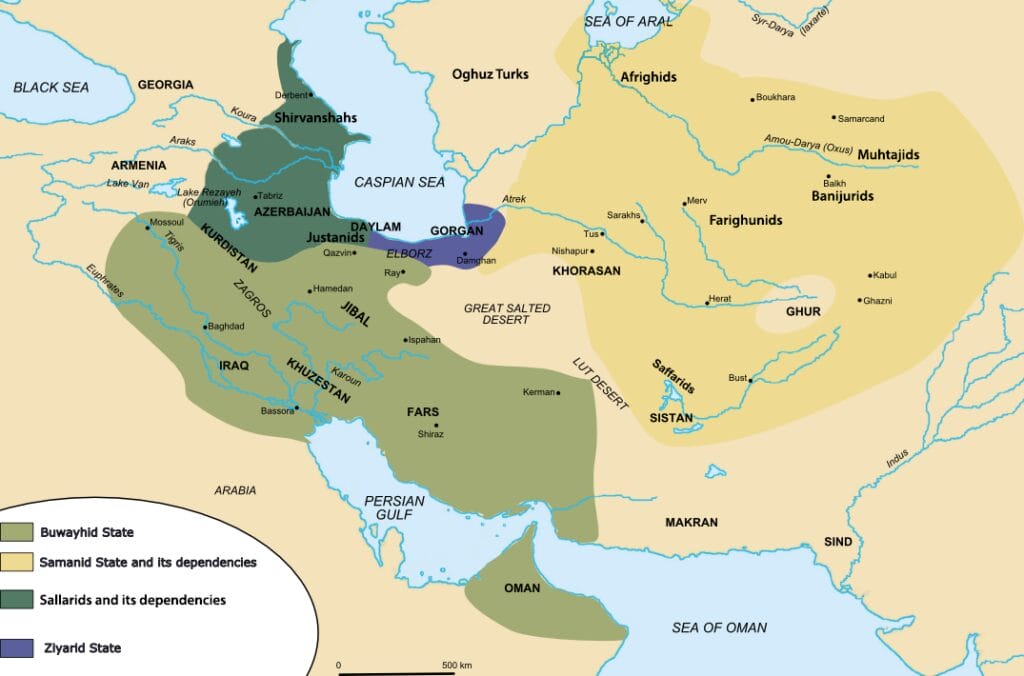
The 10th century Persian poet Ishaq al-Mawsili mentioned it by name. The 13th century Arab cookbook Kitab al-Tabikh, written by Muhammad bin Hasan al-Baghdadi, contains a recipe for sanbusak that describes a filling of minced lamb, onion, warm spices, and herbs wrapped in thin dough and fried in oil or fat. That recipe is recognisably a samosa in both structure and spirit.
Next week
I cook these before I write them. Some of it never makes the post.
The failures, the source documents, the version that actually tasted good. That part goes out by email, and next week’s is already on the stove.
 Written and cooked by Donnie
The dish travelled east along the trade routes of the medieval Islamic world, moving through Persia, Central Asia, and eventually into the Indian subcontinent with the waves of Persian-speaking Muslim traders, soldiers, and court cultures that shaped the Delhi Sultanate and later the Mughal Empire. By the time it arrived in India it had already been refined over centuries of courtly Persian cooking, and it arrived not as a street food but as a dish fit for a sultan’s table. The Indian subcontinent took it, made it its own, and eventually gave it to the world. But the Persian fingerprints are still visible in the oldest Indian recipes, and nowhere more clearly than in the Ni’matnama.
The Ni’matnama: The Book of Delights
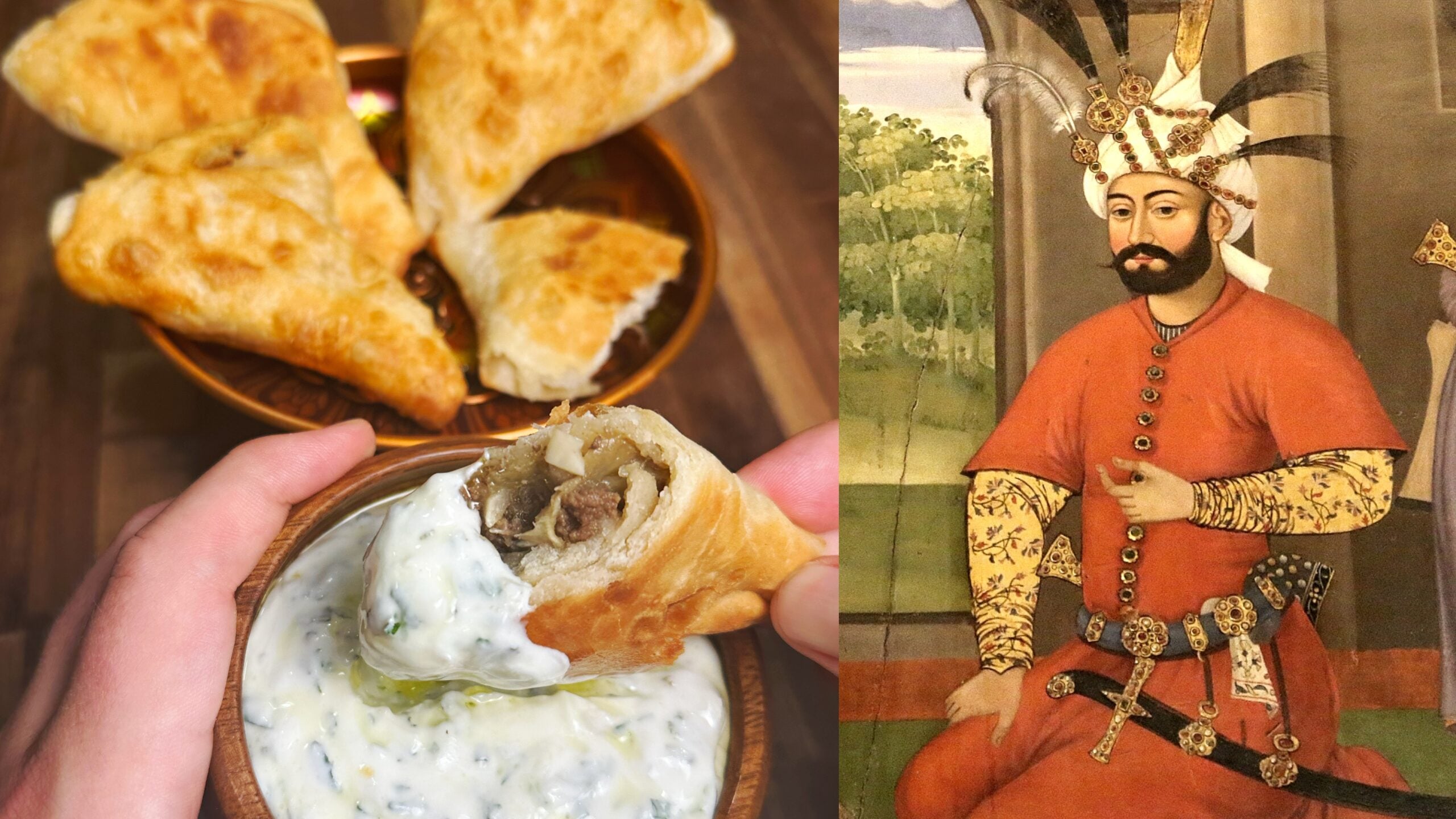
The manuscript that contains the recipe I am making today is called the Ni’matnama, sometimes translated as the Book of Delights. It was written and illustrated between approximately 1501 and 1510 for Ghiyath Shah, the Sultan of Mandu, a prosperous medieval sultanate in what is now central India. The Ni’matnama is not simply a cookbook. It is an illustrated record of royal pleasures, a compendium of the good life as understood by a medieval Indian sultan. It covers recipes for sherbets, betel preparations, perfumes, aphrodisiacs, medicines, and food, all illustrated with miniature paintings showing the Sultan himself being attended by women of his court as each preparation is made. It is one of the most visually extraordinary manuscripts of the medieval Islamic world.
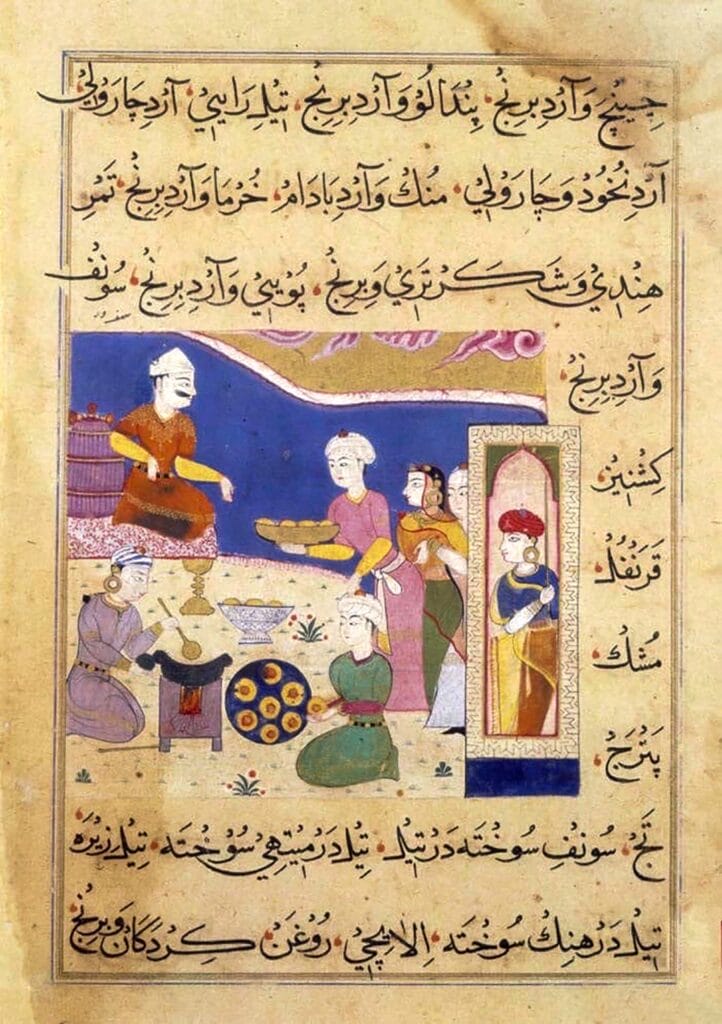
The Ni’matnama’s journey from the court of Mandu to the reading rooms of the British Museum is itself a story worth telling. After the fall of Mandu to the Mughal Emperor Akbar in 1562, the manuscript passed into the collections of the Adil Shahi Sultanate of Bijapur in the Deccan. From there it came into the possession of Tipu Sultan of Mysore, one of the most formidable opponents of British colonial expansion in India. When the British East India Company stormed Tipu Sultan’s capital at Srirangapatnam in 1799, killing Tipu Sultan in the assault, his library was seized along with his other possessions. The Ni’matnama was taken to England and eventually deposited in the India Office collections, where it now forms part of the holdings of the British Library and has been translated into English in full by the scholar Nora Titley.
The Recipe: What a Royal Mughal Samosa Actually Looked Like
The samosa recipe in the Ni’matnama is one of the more extraordinary things I have found in a historical food document. It reads as follows, in Nora Titley’s translation:
“Mix together well-cooked mince with the same amount of minced onion and chopped dried ginger, a quarter of those, and half a measure of ground garlic, and having ground three measures of saffron in rosewater, mix it with the mince together with aubergine pulp. Stuff the samosas and fry them in ghee.”
The manuscript then adds, and this detail I find genuinely moving across five centuries, that whether made from thin coarse flour bread or from fine flour bread or from uncooked dough, any of the three can be used for cooking samosas, and they are delicious. A recipe with a review attached, written in 1501, for a sultan who ate them in a palace that no longer exists.
The filling described here is nothing like a modern samosa. There are no potatoes, which did not reach India until the Portuguese brought them from South America in the 17th century, well after this manuscript was written. There is no chilli either, another post-Columbian introduction. What there is instead is something more perfumed and courtly: saffron ground to powder and steeped in rosewater until the liquid turns amber-gold, roasted aubergine pulp mixed through the mince to add body and smokiness, dried ginger rather than fresh, and lamb cooked until completely dry with equal weights of onion sweated slowly alongside it. The whole thing fried in ghee, which gives the pastry a richness that no vegetable oil can replicate. This is royal food. It is expensive, fragrant, and deliberately refined. The street food version the world knows today came much later and took a very different direction.
This recipe belongs to the same Persian courtly tradition that the samosa emerged from. The rosewater and saffron are Persian in character, used in the same way they appear in medieval Persian and Central Asian cooking, as perfume and colour rather than flavour in the modern sense. The aubergine is a classic medieval Islamic ingredient found throughout the cooking of the same period. What the Ni’matnama gives us is a snapshot of the samosa at a particular moment in its evolution, sitting at the intersection of Persian culinary tradition and the Indian subcontinent, before chillies, before potatoes, before it became the street food that half the world eats today.
My Recreation and Rating
I made these as faithfully as I could to the 1501 original, with one honest admission: I did not have saffron when I came to cook them and omitted it from the filling. This matters and I want to be transparent about it. The saffron steeped in rosewater is arguably the most characteristically Mughal element of the entire recipe, giving the filling its amber colour and its unmistakably courtly, perfumed quality. Without it the filling is still extraordinary, deeply savoury, fragrant from the dried ginger and the roasted aubergine, and genuinely unlike any samosa I have eaten before, but it is missing something. I will make them again with the saffron and I expect the result to be even more remarkable.
Even without the saffron, these are some of the best things I have made for this channel. The combination of lamb mince, roasted aubergine pulp, dried ginger, and garlic cooked to a completely dry, deeply savoury filling has a complexity that a modern potato and pea samosa simply cannot match. The ghee pastry is richer, flakier, and more satisfying than anything made with oil. And the simple mint yoghurt alongside cuts through the richness in exactly the right way.
Rating: 8.8 out of 10. With the saffron I suspect this would score higher. A remarkable dish from a remarkable document, and one of the more direct connections to a specific historical primary source I have cooked from for this channel. The sultan of Mandu was eating well in 1501.
The Recipe: Ni’matnama Royal Mughal Samosas
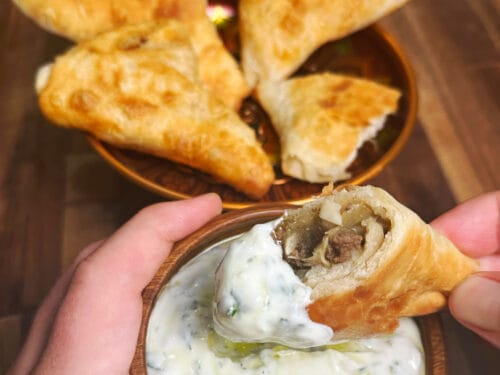
Ni’matnama Royal Mughal Samosas

Don’t lose this one.
I’ll email it to you so it’s waiting when you’re ready to cook.
Ingredients
Instructions
Notes
- The equal weight of onion to lamb is not a typo. The original recipe is specific about this ratio and it is what gives the filling its sweetness and depth. Do not reduce it.
- Dried ginger rather than fresh is historically accurate to the recipe and produces a different, warmer, more aromatic result than fresh ginger would. But feel free to use either if you do not have access to dried.
- Ghee for frying is not optional if you want the authentic experience. The pastry fried in ghee has a richness, flavour and colour that vegetable oil cannot produce. It is available in most grocery stores and increasingly in mainstream supermarkets.