Go Back

Parker House Rolls

Donnie
Boston, Parker House, 1855 / Fannie Farmer, 1896
Legend: An angry baker is said to have thrown unfinished rolls into the oven, creating the folded shape. The story is uncertain.
As it was written (Farmer, 1896): 2 cups scalded milk, 3 tablespoons butter, 2 tablespoons sugar, 1 teaspoon salt, 1 yeast cake dissolved in ¼ cup lukewarm water, flour. “Dip handle of a case knife in flour, and with it make a crease through the middle of each piece.”
Prep Time 40 minutes
Cook Time 15 minutes
Rise Time 3 hours

Jump To

Donnie Dodson

Don’t lose this one.

I’ll email it to you so it’s waiting when you’re ready to cook.

Ingredients
  

  • 2 cups whole milk
  • 3 Tbsp butter plus 6 Tbsp melted for brushing
  • 2 Tbsp sugar
  • 1 tsp salt Farmer’s amount; up to 1½ tsp to taste
  • 2¼ tsp active dry yeast in ¼ cup warm water
  • About 5½ cups all-purpose flour
  • Flaky salt to finish

Instructions
 

  1. Scald the milk, then stir in the 3 Tbsp butter, sugar, and salt. Cool to lukewarm (110°F).
  2. Add the yeast and 3 cups of flour, beat hard, cover, and let rise until light, about 1 hour.
  3. Knead in about 2½ cups more flour. Let rise until doubled, 1 to 1½ hours.
  4. Roll ⅓ inch thick and cut 3-inch rounds. Crease each with a floured knife handle, brush half with butter, fold, and press the edges.
  5. Set in a buttered pan, cover, and let rise 30 to 45 minutes. Bake at 400°F for 12 to 15 minutes.
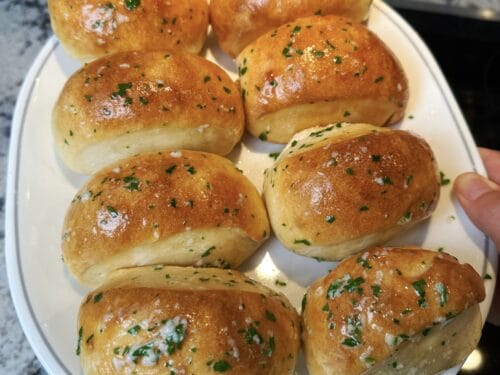
  6. Brush with melted butter and sprinkle with flaky salt.
  7. Farmer spaced the rolls an inch apart. Packing them snugly gives a soft pull-apart slab.
  8. Garlic butter finish (optional): Warm the 6 Tbsp melted butter with 2 to 3 minced garlic cloves for 1 to 2 minutes, then brush it over the hot rolls.
Notes

  • Cool the milk before the yeast goes in. Scalding the milk is traditional, but it has to cool to lukewarm (about 110°F) before you add the yeast. Hot milk will kill it, and the dough will never rise properly. If you don’t have a thermometer, it should feel comfortably warm on your wrist, not hot.
 
  • Keep the dough soft. Add the second batch of flour gradually and stop when the dough is smooth and slightly tacky. Too much flour is the most common reason these rolls turn out dense instead of pillowy. Since “about 5½ cups” varies with humidity and the brand of flour, go by feel, not just the measurement.
 
  • Crease deeply, fold, and press the edges. Use the back of a floured knife handle to make a firm crease, almost to the bottom of the dough, so the roll folds cleanly. Brush only half with butter, since the butter keeps the layers from sticking together and gives the rolls their pull-apart quality, then press the edges to seal. If you want to prep ahead, you can shape the rolls, cover them, and refrigerate for several hours, then let them come to room temperature and finish rising before baking. I have not tested that timing, so treat it as a starting point.