Go Back
+ servings

Portokalopita

Donnie
No ratings yet
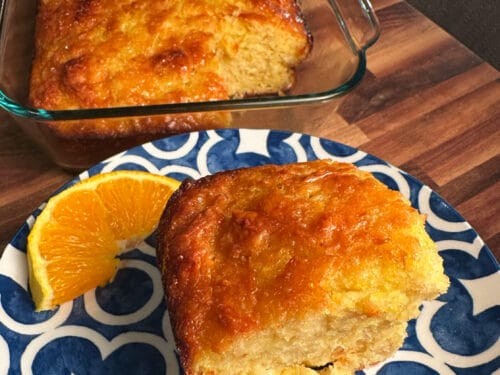
Traditional Greek orange phyllo cake from the siropiasta family
Originating in Cretan and Central Greek home cooking as a practical use of leftover phyllo dough and abundant local oranges. Still made today across Greece by the same method.
Prep Time 30 minutes
Cook Time 50 minutes
Resting Time 12 hours
Servings: 12

Jump To

Donnie Dodson

Don’t lose this one.

I’ll email it to you so it’s waiting when you’re ready to cook.

Ingredients
  

For the cake:
  • 5 large eggs
  • 200 g 1 cup white sugar
  • 150 ml ⅔ cup good quality olive oil — extra virgin Greek olive oil if possible
  • 400 g 1⅔ cups full-fat Greek yogurt — strained yogurt produces the best result
  • Zest of 2 large oranges
  • 120 ml ½ cup freshly squeezed orange juice
  • 1 tsp pure vanilla extract
  • 1 tsp ground cinnamon
  • tsp baking powder
  • 450 g 1 lb phyllo dough, dried out — see below for the critical drying method
For the orange syrup:
  • 250 g 1¼ cups white sugar
  • 250 ml 1 cup water
  • Zest of 1 orange removed in wide strips with a peeler
  • 60 ml ¼ cup freshly squeezed orange juice
  • 1 cinnamon stick
For serving:
  • Freddo espresso mandatory for the authentic experience

Instructions
 

The Critical Step: Drying the Phyllo

  1. This step cannot be skipped or abbreviated. The phyllo must be completely dried before it goes into the batter. Wet or even slightly pliable phyllo will not produce the correct texture in the finished cake.
  2. Air drying method (preferred, 2 to 3 hours): Remove the phyllo from its packaging and unroll the sheets onto a clean surface. Leave at room temperature for 2 to 3 hours until completely dry, papery and brittle. The sheets should crumble when touched. Crumple each sheet by hand into rough pieces, breaking it into irregular fragments of various sizes.
  3. Oven method (30 to 45 minutes, faster): Spread the phyllo sheets in a single layer on baking trays. Place in an oven preheated to 200°F / 100°C and dry for 20 to 25 minutes until completely crisp and papery. Remove, allow to cool, then crumple by hand into rough pieces. Work in batches if your oven cannot accommodate all the phyllo at once.
  4. The goal is phyllo that crumbles completely into rough, irregular pieces rather than tearing into strips. The more irregular the pieces the more textural complexity in the finished cake.

Method

  1. Make the syrup first
  2. The syrup must be completely cold when it goes on the warm cake, so make it well ahead. Combine the sugar, water, orange peel strips and cinnamon stick in a small saucepan. Bring to a boil over medium heat, stirring until the sugar dissolves. Add the orange juice and simmer for 5 to 7 minutes until the syrup has thickened slightly and is glossy. It should coat the back of a spoon lightly. Remove from heat. Discard the orange peel strips and cinnamon stick. Allow to cool completely to room temperature, then refrigerate until needed.
  3. Make the batter
  4. Preheat your oven to 340°F / 170°C. Grease a rectangular or square baking pan generously with olive oil. A 30cm x 20cm (12 x 8 inch) pan or a 25cm x 25cm (10 x 10 inch) square pan both work.
  5. In a large bowl, beat the eggs and sugar together with a whisk or electric mixer until pale and slightly thickened, approximately 3 to 4 minutes. Add the olive oil and whisk until fully incorporated. Add the Greek yogurt, orange zest, orange juice, vanilla extract and cinnamon. Whisk until completely smooth and unified. Add the baking powder and whisk through.
  6. Add the phyllo
  7. Add the dried, crumbled phyllo to the batter in two or three additions, folding gently after each addition to coat the phyllo pieces in the batter without crushing them completely. The mixture should look rough and irregular, with visible pieces of phyllo throughout a smooth batter base. This is correct. Do not overmix. You want the phyllo pieces to retain some of their individual character.
Bake

  1. Pour the mixture into the prepared pan and spread evenly. Place in the preheated oven and bake for 45 to 50 minutes until deeply golden on top and firm when pressed gently in the centre. A toothpick inserted in the centre should come out clean. The top should be a dark amber gold. Do not underbake.
  2. The syrup step — the most important step
  3. Remove the cake from the oven and immediately, while the cake is still hot, poke holes all over the surface using a toothpick or a skewer. Make the holes generously and throughout the entire surface of the cake, including the edges. The holes are what allow the cold syrup to penetrate into the warm cake and saturate it completely.
  4. Pour the cold syrup slowly and evenly over the entire surface of the hot cake. Do not rush this step. Pour in a steady stream, allowing each area to absorb before moving to the next. The syrup will hiss and bubble as it hits the hot cake. This is correct and is exactly what should happen. Use all of the syrup. Every drop.

Rest overnight (or at least a few hours)

  1. Allow the cake to cool completely at room temperature, then cover and refrigerate overnight. This resting period is not optional. It is the step that transforms the cake from good to extraordinary. During the overnight rest the syrup continues to penetrate through the entire structure of the cake, the phyllo continues to absorb the orange-infused liquid, and the flavours integrate in a way that no amount of patience on the day of baking can replicate.
  2. The cake you serve the following day is a significantly better cake than the one you pulled from the oven. Trust the process.

Serve

  1. Serve cold, cut into squares or rectangles directly from the pan. The cake does not need unmoulding and is best served from the pan in which it was baked. A sprig of fresh mint and additional orange zest are optional garnishes.
  2. Serve with a freddo espresso alongside. This is the authentic Greek café experience and it is the correct way to eat portokalopita. The cold, intensely coffee-forward freddo espresso against the cold, sweet, orange-saturated cake is the combination that every Greek café has understood for decades and that requires no explanation once you have experienced it.

Video

Notes

  • The overnight resting is the single most important instruction in this recipe. Every hour the syrup sits in the cake makes it better. A cake eaten two hours after baking is good. A cake eaten the following morning is extraordinary. Make it ahead without any reservation.
 
  • Full-fat Greek yogurt produces a significantly better result than low-fat versions. The fat in the yogurt contributes to the tender, moist texture of the finished cake. Strained Greek yogurt, the very thick version sold as total 0% or total 5%, is the most historically appropriate choice and produces the best result.
 
  • The olive oil replaces butter entirely and is part of what makes this cake taste Mediterranean rather than simply orange-flavoured. A good Greek extra virgin olive oil contributes a faint fruitiness to the batter that you can taste in the finished cake. Use the best Greek olive oil you have.

Tried this recipe?

Let us know how it was!