Go Back

The Funerary Feast of King Midas: Barbecued Lamb & Lentil Stew

Print Recipe
This is the funeral meal of the real King Midas. What the chemical analysis confirmed: fatty acids and cholesterol characteristic of goat or lamb, polycyclic aromatic hydrocarbons indicating the meat was barbecued, a plant steroid fingerprint for lentils, anisic acid indicating anise or fennel, and elaidic acid pointing to olive oil. The beverage residue revealed honey mead, wine and barley beer combined. The Phrygian cooks marinated the mutton or goat in olive oil, honey and wine, barbecued the meat, then stewed it along with lentils seasoned with anise or fennel.
Prep Time 20 minutes
Cook Time 2 hours

Ingredients

  • 2 lbs bone-in goat shoulder or lamb shoulder — goat is more historically accurate for the region. Ask a halal butcher. The bone contributes to the stew broth and should not be removed before cooking
  • 3 tbsp good quality olive oil — McGovern's analysis confirmed olive oil at a site where olive trees do not grow meaning it was an imported luxury. Use the best you have
  • 2 tbsp raw honey
  • ½ cup dry red wine — the closest modern equivalent to ancient Phrygian wine
  • 1 tsp coarse salt
  • 1 tsp fennel
  • 1 tsp cumin
  • 1 tsp star anise

Instructions

Marinate the meat — the night before

  • Combine the olive oil, honey, wine and salt in a bowl and whisk until the honey is dissolved. Score the goat or lamb shoulder deeply with a knife and rub the marinade thoroughly into the cuts and over the entire surface. Cover and refrigerate overnight. The wine and honey marinade is consistent with McGovern's chemical findings and produces a significantly more complex flavour than unmarinated meat after barbecuing.

Barbecue the meat

  • This step is the most historically significant in the recipe and is not optional. The polycyclic aromatic hydrocarbons found in the residue are the specific chemical signature of meat cooked over open flame. The Phrygians barbecued the meat before stewing it. Remove the meat from the marinade. Grill over the highest heat you have, charcoal preferred, until deeply charred and caramelised on all sides, 4 to 5 minutes per side. You are building a char, not cooking the meat through. The interior should still be raw at this stage. Remove from the grill and cut the meat off the bone into large rough chunks. Set the bones aside to add to the stew.

Build the stew

  • Heat 3 tablespoons of olive oil in a heavy pot or Dutch oven over medium heat. Add the onion and cook gently, stirring occasionally, until completely softened and beginning to turn golden, about 10 to 12 minutes. Add the fennel seeds, anise seeds and cumin and cook for one minute until fragrant. The spices should bloom in the oil and become clearly aromatic.
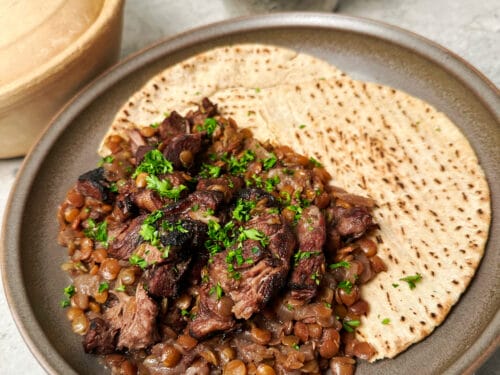
  • Add the charred meat chunks and any bones to the pot. Pour in the wine and honey and stir to combine, scraping up any bits from the bottom of the pot. Add the rinsed lentils. Pour in enough water or stock to cover everything generously, 2 to 3 cups depending on your pot. Bring to a gentle boil, then reduce to a low simmer. Cover and cook for 1.5 to 2 hours, stirring occasionally, until the meat is completely tender and falling apart and the lentils have dissolved into the broth creating a thick, deeply savoury stew. The lentils should not remain distinct. They should break down into the liquid and thicken everything around the meat.
  • Remove and discard the bones. Taste and adjust salt. The honey should be present as a background sweetness. The anise and fennel should be clearly detectable but integrated rather than dominant.
Serve

  • Serve directly from the pot over flatbread torn into pieces for scooping. The flatbread is both historically appropriate and the best possible vehicle for the broth. Eat with your hands if you want the full experience. The mourners at Gordion used their hands and their bronze bowls. No utensils required.

Notes

  • The charcoal barbecue step is what separates this from a standard lamb and lentil stew. The polycyclic aromatic hydrocarbons are not just a chemical detail. They produce a specific smoky, complex depth in the finished stew that cannot be replicated by browning in a pan. Use a charcoal grill if at all possible. A gas grill produces a lesser but acceptable result. A cast iron pan over high heat is a last resort.
 
  • Raw honey is worth using here. The floral quality of raw unfiltered honey is more complex than processed honey and contributes a noticeable difference to the finished stew. It is also more historically accurate. Processed commercial honey did not exist in 700 BC Phrygia.
 
  • For the drink alongside: Dogfish Head Midas Touch beer is the scientifically reconstructed beverage from this exact feast, commercially available at most specialty beer retailers and online. Serving the stew with a glass of Midas Touch is the closest possible approximation of the complete Gordion funerary feast experience available to a person in the 21st century. It is worth doing.