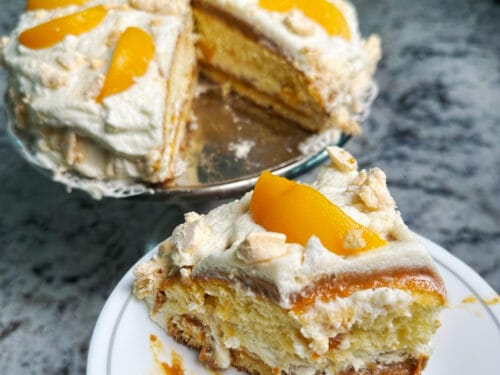

Created by Orlando Castellano, Confitería Las Familias, Paysandú, Uruguay, 1927. Named after the chajá bird of South America, whose white plumage inspired the meringue-covered exterior. A towering construction of light sponge cake soaked in peach syrup, layered with dulce de leche, whipped cream, canned peaches and broken meringue pieces, finished with meringue pressed all over the outside so it looks like something between a cloud and a celebration.
Prep Time 1 hourhr
Cook Time 2 hourshrs
Chilling Time 12 hourshrs
Ingredients
For the meringue discs:
3large egg whitesat room temperature
1cupwhite sugar
1pinchof salt
⅛tspcream of tartar
For the sponge cake:
4eggsseparated
1cupwhite sugar
1tspvanilla extract
1cupall-purpose floursifted
1pinchof salt
For the whipped cream:
2cupsheavy whipping creamat least 36% fat, cold
½cuppowdered sugar
1tspvanilla extract
For assembly:
1can peaches in syrup14 oz — drain and reserve all the syrup
1jar dulce de leche
Instructions
Prep the meringue discs
Preheat oven to 210°F. Line two baking sheets with parchment paper and trace an 8-inch circle on each sheet using your cake pan as a guide. Flip the paper so the pen mark faces down. Beat the egg whites with the salt and cream of tartar on medium speed until foamy. Increase to high and gradually add the sugar one tablespoon at a time, beating until the meringue is glossy and holds stiff firm peaks. Rub a small amount between your fingers. It should feel completely smooth with no sugar grains remaining. Divide the meringue between the two traced circles and spread evenly to the edges.
Bake the meringue discs
Place both baking sheets in the oven. Bake until the meringue is completely dry, crisp and lifts cleanly off the parchment without sticking. The meringue should be white or very pale ivory, not golden. Turn the oven off and leave the door slightly ajar, allowing the meringue to cool completely inside the oven. This slow cooling prevents cracking.
Make the sponge cake
Increase oven to 355°F. Grease and flour an 8-inch round cake pan. Separate the eggs with yolks in one bowl and whites in another. Beat the egg whites with the salt to stiff peaks. Set aside. In a separate large bowl beat the egg yolks with the sugar until pale, thick and ribbony, about 3 to 4 minutes. Add the vanilla and mix through. Gently fold one third of the beaten egg whites into the yolk mixture to loosen it. Add the remaining whites in two more additions folding carefully each time. Sift the flour over the batter in three additions, folding gently after each. Do not overmix. The batter should be light and airy.
Bake the sponge
Pour the batter into the prepared pan and smooth the top. Bake until the top is golden, the cake pulls away slightly from the sides and a toothpick inserted in the centre comes out clean. Allow to cool in the pan for 40 minutes then turn out onto a wire rack and cool completely. Do not assemble until the sponge is fully cold.
Prepare the peaches and syrup
Open the can of peaches and drain, reserving all of the syrup in a small bowl. Slice the peach halves into thin strips and set aside. The syrup should be at room temperature before using.
Whip the cream
Pour the cold heavy cream into a cold bowl. Chill the bowl in the freezer for 10 minutes if your kitchen is warm. Add the powdered sugar and vanilla. Beat on medium-high speed until the cream holds soft to medium peaks. Do not overbeat. Refrigerate immediately until needed.
Slice the sponge and break the meringue
Using a long serrated knife carefully slice the cooled sponge horizontally into three even layers. Work slowly with a gentle sawing motion. Set the three layers aside. Take the cooled meringue discs and break them by hand into irregular pieces, some small and crumbly, some larger. Reserve the most visually striking pieces for the outside of the cake.
Assemble the first layer
Place the bottom sponge layer on your serving plate or cake board. Soak it generously with peach syrup. The sponge should be moist throughout but not soggy. Spread a thin even layer of dulce de leche over the soaked sponge. Spread a generous layer of whipped cream over the dulce de leche. Scatter a layer of broken meringue pieces over the cream pressing them in very gently. Arrange a layer of sliced peaches over the meringue.
Build the second and third layers
Place the second sponge layer on top. Soak with peach syrup. Add another layer of dulce de leche, whipped cream, meringue pieces and peach slices exactly as before. Place the third and final sponge layer on top. Soak with the remaining peach syrup. Spread a thin crumb coat of whipped cream over the top and sides of the entire cake to seal. Refrigerate for 15 minutes to firm up.
Finish the outside
Apply the remaining whipped cream generously over the top and sides of the cake spreading it smooth or in soft swirls. Press the reserved meringue pieces all over the outside of the cake covering the sides and top. They should stand out from the surface at different angles. This irregular textured exterior is the signature look of Chajá. Arrange the remaining peach slices decoratively on top.
Refrigerate before serving
Refrigerate the finished cake for at least 2 hours before serving. Overnight is better. During this time the meringue pieces on the outside stay crisp while those inside the layers soften slightly in the cream creating the characteristic texture that is simultaneously crisp and melting. Serve cold sliced with a sharp knife.
Notes
The overnight refrigeration is the single most important instruction in this recipe. The cake is good on the day of assembly. It is significantly better the following morning when the textures have had time to integrate properly.
The dulce de leche should be spread in a relatively thin layer. It is intensely sweet and rich and a heavy hand will unbalance the cake. Think of it as a flavour accent rather than a primary layer.
The peach syrup from the can is the soaking liquid and should not be discarded. It is sweet and faintly tropical and penetrates the sponge with exactly the right flavour to complement the dulce de leche and peach layers.