Go Back
+ servings

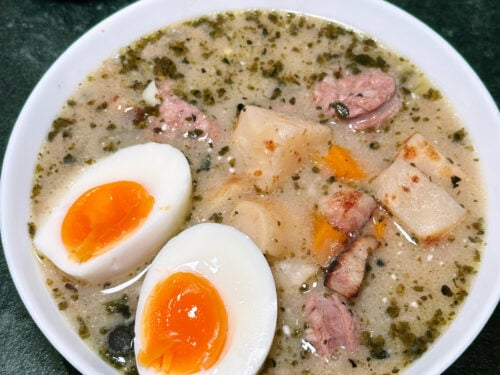
Traditional Polish Żurek

Donnie
No ratings yet
The oldest described soup in Polish cuisine, documented from the 13th century
Primary sources: Maria Dembińska, Food and Drink in Medieval Poland, University of Pennsylvania Press; first written references to sūr documented to the 13th century; the Polish term żur documented in literature from the 15th century; Hanna Szymanderska, Polish food historian
A note on timing: This recipe requires starting the zakwas fermented rye starter three days before you want to make the soup. If you have a Polish store near you, you might be able to find a premade start (zakwas).
Prep Time 20 minutes
Cook Time 1 hour
Fermenting Time for Starter 3 days
Servings: 4

Jump To

Donnie Dodson

Don’t lose this one.

I’ll email it to you so it’s waiting when you’re ready to cook.

Ingredients
  

Ingredients for the starter (zakwas):
  • 4 tbsp whole grain rye flour
  • 2 cups warm water not hot
  • 2 to 3 cloves garlic peeled and left whole
  • 1 small crust of rye bread — the yeast and bacteria on the bread surface accelerate the fermentation
The Broth and Meats Base:
  • 4 oz smoked bacon diced
  • 2 large raw Polish white sausages biała kiełbasa
  • 1 small yellow onion finely chopped
  • 3 cloves garlic minced
  • 4 cups vegatable broth
  • 1 carrot peeled and sliced
  • 1 parsnip or parsley root peeled and diced
  • ½ cup celery root celeriac, diced
The Flavouring and Thickening:
  • 1⅓ cups prepared zakwas shaken well before measuring
  • 1 tbsp dried marjoram
  • 2 bay leaves
  • 3 allspice berries
  • cup heavy cream or sour cream
  • Salt and freshly cracked black pepper to taste
For Serving:
  • 4 hard-boiled eggs halved

Instructions
 

For the starter:

  1. Mix the rye flour with the warm water in a clean glass jar until no lumps remain. Add the garlic cloves and the rye bread crust, pushing it down so it is submerged. Cover the jar loosely with a piece of gauze, a clean cloth or a paper towel secured with a rubber band. Do not use an airtight lid. The fermentation needs to breathe.
  2. Leave at room temperature for three days. Each day, stir gently with a clean spoon. After 24 hours you should see small bubbles beginning to form. By 48 hours the bubbles should be active and the liquid should smell pleasantly sour and yeasty. By 72 hours the zakwas is ready. It should smell deeply sour, complex and slightly earthy. If it smells off or unpleasant rather than pleasantly sour, discard it and start again.
  3. Remove and discard the bread crust and garlic cloves before using.

Render the bacon

  1. Place the diced bacon into a large cold soup pot over medium heat. Cook until the bacon turns crispy and the fat has fully rendered, about 5 to 7 minutes. Starting cold and rendering slowly produces more flavour from the bacon fat that will become the cooking base for everything that follows.

Sauté the aromatics

  1. Add the chopped onion directly into the rendered bacon fat. Sauté for 5 minutes until soft and translucent, then stir in the minced garlic and cook for 1 more minute until fragrant.

Simmer the broth

  1. Pour in the broth. Add the sliced carrot, diced parsnip, celery root, bay leaves and allspice berries. Drop the raw white sausages into the liquid whole. Bring to a gentle boil, then reduce heat to low, cover and simmer for 25 minutes.

Prep the sausage

  1. Carefully remove the cooked white sausages from the pot using a slotted spoon. Allow to cool slightly then slice into thick rounds and return them to the pot.

Add the zakwas

  1. Give your jar of zakwas a vigorous shake so that the settled flour at the bottom is fully incorporated. Slowly pour it into the simmering broth while stirring continuously to prevent clumping. Stir in the dried marjoram. Let the soup simmer gently for 10 minutes to thicken slightly and for the fermented rye flavour to integrate fully with the broth. The soup will develop a characteristic grey-white colour and a deeply sour, complex aroma.

Temper the cream

  1. Whisk your cream in a small bowl. Ladle a few spoonfuls of the hot soup liquid into the cream, whisking quickly to warm it without curdling. Pour the tempered cream mixture back into the main pot. Remove from heat. Season to taste with salt and black pepper.

Assemble and serve

  1. Place 1 hard-boiled egg, halved, into the bottom of each serving bowl. Ladle the steaming hot soup over the top, making sure every bowl gets plenty of sausage and bacon. Serve with rye bread alongside.

Video

Notes

 
  • The three-day fermentation of the zakwas is the most important technical element of this recipe and cannot be abbreviated. A zakwas fermented for only 24 hours will produce a mildly sour soup. Three days produces the deeply complex, layered sourness that defines authentic żurek. The difference is significant and immediately apparent.
 
  • Marjoram is not oregano. They are related but completely different herbs with different flavour profiles. The marjoram called for in żurek has a warmer, sweeter, more floral quality than oregano. Substituting oregano produces a soup that tastes Mediterranean rather than Polish. Dried marjoram is available at Polish delicatessens, at most European grocery stores and increasingly at well-stocked supermarkets.
 
  • Biała kiełbasa, Polish raw white sausage, is the specifically documented traditional sausage for żurek. It is available at Polish delicatessens worldwide and from online Polish food retailers. If genuinely unavailable, a mild bratwurst or fresh pork sausage is a functional substitute, but the specific garlic and marjoram seasoning of biała kiełbasa is what integrates so perfectly with the marjoram in the soup.

Tried this recipe?

Let us know how it was!