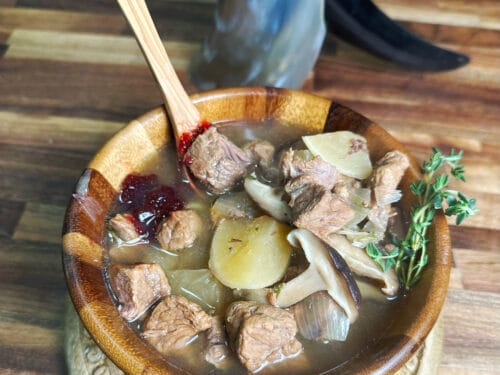
Reconstructed beef stew from the archaeological and dietary record of Viking Age Scandinavia. The stew contains meat, period-accurate vegetables like turnips and onions, salt, thyme, and lingonberries. Primary sources: Snorri Sturluson, Ynglinga Saga, 13th century; Fatur K., Sagas of the Solanaceae, Journal of Ethnopharmacology, 2019; Norse-Viking Diet, World History Encyclopedia.
Prep Time 15 minutesmins
Cook Time 2 hourshrs
Ingredients
2lbsbeefgoat or pork, cut into large rough chunks — all three are documented in Viking Age Scandinavia. Goat is the most historically underused and most authentic choice. Pork is the most commonly documented. Beef works. Do not trim the fat
2medium turnipsroughly chunked
2onionsroughly broken apart by hand
1 cupmushrooms(optional)
1litre water
1tbspcoarse sea salt
1tspdried thyme
1heaped spoonful of lingonberriesfresh or preserved, plus more to serve — archaeologically confirmed in Norse sites, tart and essential
Instructions
Prepare your vegetables
Chunk the turnips roughly. No need for precision or uniformity. Break the onions apart by hand into large pieces. Set aside.
Heat the water
Pour the water into your heaviest pot. Bring it to a boil over high heat.
Build the stew
Add the meat, turnips, onions, mushrooms, salt, thyme and a heaped spoonful of lingonberries to the boiling water. There is no browning step. There is no softening of the onions first. Everything goes in together. Reduce to a firm rolling simmer.
Cook uncovered for 2 hours. Do not skim the fat. Do not stir more than occasionally. The turnips will begin to dissolve into the broth in the final 30 minutes, thickening it slightly. This is correct.
Serve
Ladle the stew directly into bowls. Add a spoonful of fresh or preserved lingonberries on top. Scatter a little dried thyme over the surface as garnish. Drink the broth. Eat with your hands if you feel historically committed to the experience.
Serve with skyr or full fat plain yogurt on the side, cold, in a separate bowl. Drink mead alongside if you have it.
Notes
Lingonberries are available in most supermarkets in the Scandinavian or international foods section, or online. IKEA stocks them. They are not optional. The acidity is the only thing in this stew that provides any brightness and the dish needs it.
If you want to add some more wild mushrooms, a large handful of dried or fresh porcini soaked in warm water for 20 minutes and added along with their soaking liquid in the final 30 minutes of cooking is a historically accurate addition that improves the depth of the broth significantly.
The stew reheats well and is arguably better the next day after the broth has had time to settle and concentrate overnight. Norse warriors on campaign would have eaten yesterday's stew cold or reheated over a fire the following morning. This is not a bad way to eat it.