There are certain food history projects that start as a serious historical reconstruction and somehow end up producing something that tastes genuinely better than most things you have eaten this week. The Roman burger is that project.
I was invited to Olomouc in the Czech Republic by the Olomouc Museum of Original History to document their historical military cooking festival, a remarkable event spanning Czech military cuisine from the ancient Celts and Romans through to World War One, the Cold War and the modern Czech army. Every era represented by real food, real equipment, real historical sources and genuine enthusiasm from the reenactors who had been researching these recipes for years.
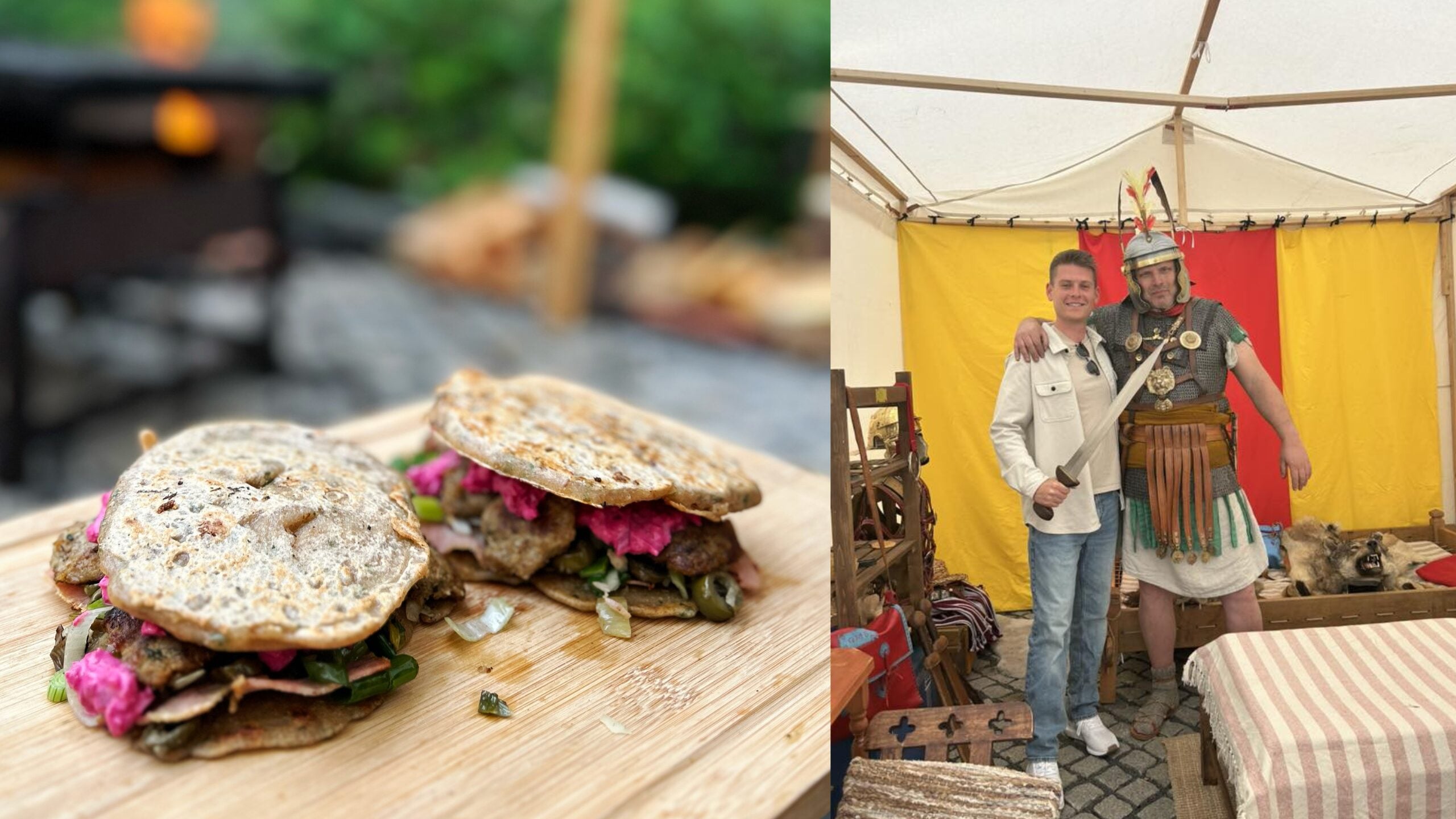
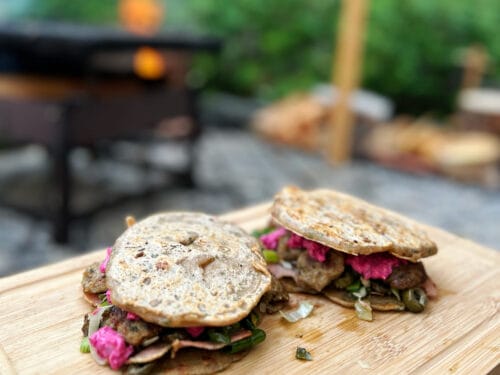
The Roman encampment was the highlight. Fully equipped legionary camp with period-accurate cooking equipment, reenactors in authentic kit, and food made directly from Apicius and Cato the Elder. And in the middle of all of that historical seriousness, we decided to have some fun. We took the Apicius meat patty recipe, pressed it flat, sandwiched it between two spelt flatbreads, dressed it with green onions, dried pork, olives, a beet dressing from Apicius, and a mild fresh cheese. The Romans ate none of these things together in this form. But every single component is documented in Roman culinary sources. The result was one of the best sandwiches I have eaten in recent memory. The ancient Roman burger. 9 out of 10. Here is the full story.
The Czech Region and Rome: The Edge of the Known World in Ancient Times
To understand why a Roman military cooking festival in Olomouc is historically significant rather than merely whimsical, you have to understand the relationship between this region and the Roman Empire.
Next week
I cook these before I write them. Some of it never makes the post.
The failures, the source documents, the version that actually tasted good. That part goes out by email, and next week’s is already on the stove.
 Written and cooked by Donnie
The area now known as the Czech Republic sits in the heart of Central Europe, in the territory the Romans called Germania Magna, the land beyond the Rhine and Danube rivers that marked the furthest frontier of the empire’s permanent expansion. The Romans knew this territory. They traded with it, fought across it, and documented it extensively. They simply never conquered it.
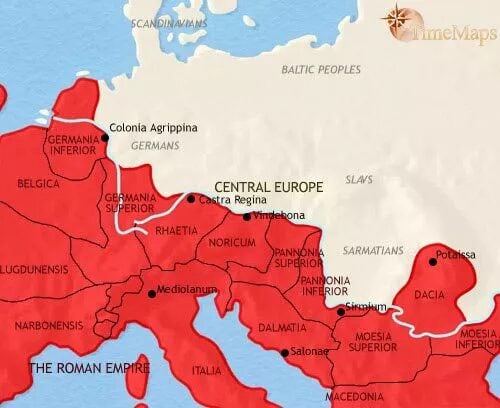
The Celts had been settled in Bohemia and Moravia, the regions that now make up the Czech Republic, since at least the 4th century BC. The Celtic tribe of the Boii, from whom Bohemia takes its name, were documented by Julius Caesar and other Roman writers as significant military opponents and trading partners. The Celtic settlements of this region maintained active trade relationships with the Roman world across the Rhine-Danube frontier, and Roman goods, Roman coins and Roman cultural influence penetrated deep into the territory without Roman political control ever following.
The Roman military presence in the region was significant and well-documented archaeologically. Legionary camps, marching camps and permanent fortifications along the Danube frontier in what is now Slovakia and Austria brought Roman soldiers to the edge of the Czech region repeatedly. Roman military expeditions under Marcus Aurelius during the Marcomannic Wars of 166 to 180 AD penetrated directly into what is now Moravia, the eastern region of the Czech Republic, and the winter quarters of the Roman army during those campaigns were established in territory directly adjacent to modern Olomouc. The Meditations of Marcus Aurelius were written at least partially during those Moravian campaigns, making the philosophical foundations of Stoicism a document of the Czech landscape as much as anything else.
The Roman cookware, amphora fragments and coins found at sites throughout the Czech Republic confirm what the literary sources suggest. Roman food culture reached this region even if Roman armies did not permanently occupy it. A Roman military cooking festival in Olomouc is not an anachronism. It is a historically grounded acknowledgment of a relationship between this region and Roman civilisation that lasted for centuries.
The Sources: Apicius and Cato the Elder
The recipes used at the Olomouc festival, and the recipes underlying the Roman burger reconstruction, come from the two most significant primary sources of Roman culinary history.
Marcus Porcius Cato, De Agri Cultura, 2nd century BC
Cato the Elder’s agricultural manual is the oldest surviving work of Latin prose and contains some of the earliest documented Roman recipes. It is the source for the libum recipe covered previously on this channel and for fundamental Roman baking preparations including the spelt-based breads that formed the foundation of the Roman diet. Cato’s documentation of spelt, emmer and other ancient grains gives us the primary source basis for the spelt flatbread used as the bun in our Roman burger reconstruction.
Apicius, De Re Coquinaria, 4th to 5th century AD
The collection of Roman cookery recipes known as Apicius is the most important surviving Roman culinary document. Containing over 400 recipes compiled from multiple sources over several centuries, it covers the full range of Roman elite cuisine from complex multi-component dishes to simple preparations. The two specific recipes from Apicius underlying the Roman burger are documented in detail below.
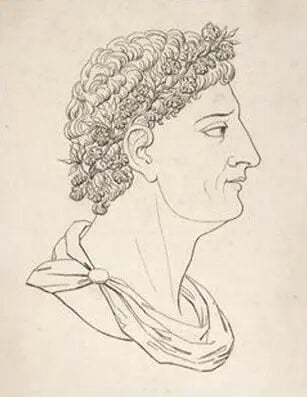
The original Latin text of Isicia Omentata, Book II, Recipe 7, reads: Isicia omentata: pulpam concisam teres cum medulla siliginei in vino infusi. piper, liquamen, si velis, et bacam myrtam extenteratam simul conteres. pusilla isicia formabis, intus nucleis et pipere positis. involuta omento subassabis cum caroeno.
Translated: Pound minced lean meat with the crumb of fine white bread soaked in wine. Grind together pepper, fish sauce if you wish, and a myrtle berry with the seeds removed. Shape small patties, placing pine nuts and whole peppercorns inside. Wrap them in caul fat and lightly grill with caroenum, reduced sweet wine.
The beet dressing comes from Apicius 3.11.2, documented in Sally Grainger and Christopher Grocock’s academic edition of Apicius published in 2006: aliter betas elixas: ex sinapi oleo modico et aceto bene inferuntur. Translated: Another recipe for boiled beets: they are served nicely in a sauce of mustard, a little oil and vinegar.
The Roman Burger: A Historical Note on What the Romans Actually Ate
The important caveat before the recipe is this: Romans did not eat sandwiches in the way that the Roman burger format implies.
The Isicia Omentata was eaten as a standalone dish, probably at a formal meal or as street food from a thermopolium. The spelt flatbreads, panis militaris or similar military bread preparations, were eaten separately as a staple accompaniment to most meals. The beet preparation was a side dish or condiment. The olives, dried pork and green onions were individual components of the Roman diet eaten separately or in combination at a meal.
What we did at Olomouc was assemble documented Roman ingredients and preparations into a format the Romans would not have recognised but that uses every individual component authentically. The burger format is the anachronism. The ingredients are not. It is the same intellectual approach this channel has always taken: historical accuracy in the components, honest acknowledgment of the creative reconstruction in the assembly.
The result, however, is extraordinary. Every component is doing exactly what it was designed to do in Roman cooking, and the combination they produce when assembled between two spelt flatbreads is one of the more compelling arguments for the sophistication of Roman cuisine that this channel has produced.
The Event: Olomouc Museum of Original History
The Olomouc Museum of Original History operates one of the most thoroughly researched and practically executed historical food events in Central Europe. The military cooking festival spans multiple eras of Czech military history with reenactors who have invested serious research into the food, equipment and techniques of each period.
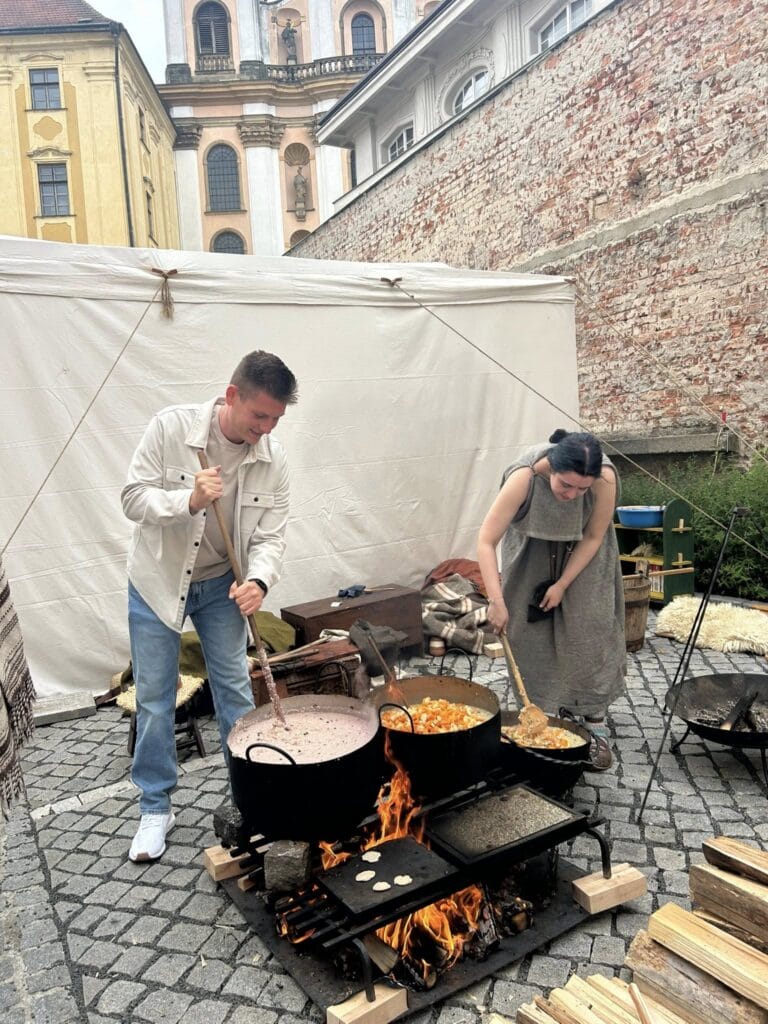
The Roman encampment was staffed by reenactors working from Apicius and Cato directly, cooking on period-accurate equipment including ceramic pots, iron grills and open fires, using ingredients that would have been available to Roman legionaries on campaign in the Danubian frontier region. Watching someone make Isicia Omentata over an open fire in full legionary kit, using a recipe from a 4th century cookbook translated from Latin, in a field in the Czech Republic that Roman soldiers actually camped in during the Marcomannic Wars, is an experience that collapses the distance between the ancient world and the present in a way that no museum exhibit quite achieves.
I am genuinely grateful to the Olomouc Museum of Original History for the invitation and for the quality of the historical research that underpins everything they do. This is exactly the kind of institution that food history content should be celebrating. Also a big shoutout to the reenactmenet group who made me this delicious burger and let me explore their camp: Legio XIII Gemina.
My Rating and Honest Assessment
The Roman burger is a 9 out of 10 and I want to be clear that the rating reflects how good it actually tastes rather than any historical significance bonus points. The Isicia Omentata patty is the best-seasoned ancient meat preparation I have made for this channel. The wine-soaked bread binds the mixture with a softness that modern burger patties rarely achieve. The pepper and pine nuts inside the patty produce textural and flavour surprises as you eat it. The beet dressing, vinegary and slightly sweet, is the component that ties everything together with a vivid colour and an acidity that cuts through the richness of the meat and the cheese. The spelt flatbread is denser and more flavourful than modern burger buns and holds everything together without falling apart.
This is one of the most genuinely enjoyable recipes I have made for this channel and the historical context of making it in an actual Roman reenactment camp in the Czech Republic, in a region that Roman legionaries actually camped in during the Marcomannic Wars, makes it something I will not forget easily.
Rating: 9 / 10
The Recipe: The Ancient Roman Burger
The Recipe: The Ancient Roman Burger

Don’t lose this one.
I’ll email it to you so it’s waiting when you’re ready to cook.
Ingredients
Instructions
Notes
- Myrtle berries are not widely available but are worth sourcing if you want the most historically accurate version. They are available online from specialty herb suppliers and some Mediterranean food importers. Dried juniper berries are an accessible and flavourally appropriate substitute.
- Caul fat is available from any butcher who breaks down whole animals. Call ahead. Most butchers have it but do not always display it. It produces a noticeably juicier patty than the unwrapped version and is worth the sourcing effort.
- The caroenum glaze is easy to make and dramatically improves the finished patty. Do not skip it. The reduction of red wine with honey produces a syrup that caramelises on contact with a hot grill pan and gives the patty a sweet, slightly jammy exterior that balances the pepper and fish sauce inside.
- The beet and ricotta dressing is the component that makes the burger work as a complete dish. Its acidity cuts through the richness of the meat and cheese while its vivid colour makes the whole construction visually extraordinary. Make more than you need and use the excess as a dipping sauce or a dressing for a simple salad of whatever Roman vegetables you have available.