
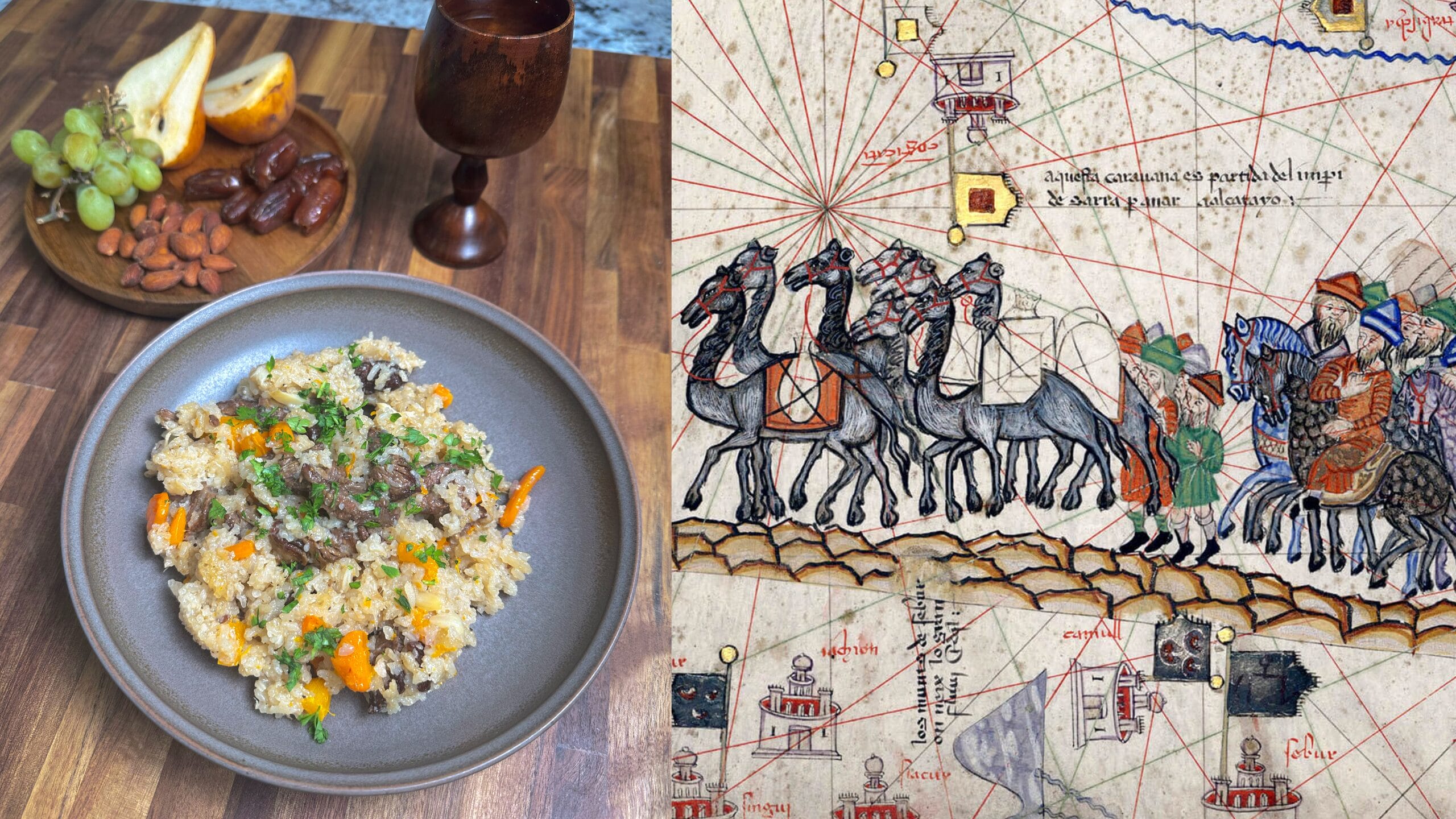
There is a rice dish that has been eaten continuously from China to the Mediterranean for over a thousand years. It fed Alexander the Great’s army in ancient Samarkand. It was prescribed as medicine by the greatest physician of the medieval world. It sustained Tamerlane’s armies before the most important battles of his empire. Silk Road merchants carried the recipe from Bukhara to Persia, from Persia to India, from India to the Ottoman court, and eventually to the tables of every culture that the ancient trade routes touched. It is still made today in the same cast iron kazan, with the same hand-cut carrots, the same whole head of garlic, the same lamb and rice, in essentially the same way it was made a thousand years ago in the oasis cities of Central Asia.
I made it this week. I rated it 9.2 out of 10. The garlic melting into the rice is one of the most extraordinary flavour moments I have experienced for this channel. Here is the full story.
The Source: Avicenna and the First Written Recipe
The earliest documented written recipe for plov comes from one of the most extraordinary figures in the history of human knowledge. The first written reference to plov is found in a 10th century work on medicine and nutrition by Persian polymath scholar Abu Ali Ibn Sina, known to the Western world as Avicenna, from Bukhara. Avicenna, born in 980 AD in the Samanid Empire near Bukhara in what is now Uzbekistan, is considered one of the most significant physicians and philosophers in the history of science. His Canon of Medicine, completed in 1025 AD and used as the standard medical textbook in European universities until the 17th century, contains detailed analysis of foods and their medicinal properties. Among those foods is plov.
Next week
I cook these before I write them. Some of it never makes the post.
The failures, the source documents, the version that actually tasted good. That part goes out by email, and next week’s is already on the stove.
 Written and cooked by Donnie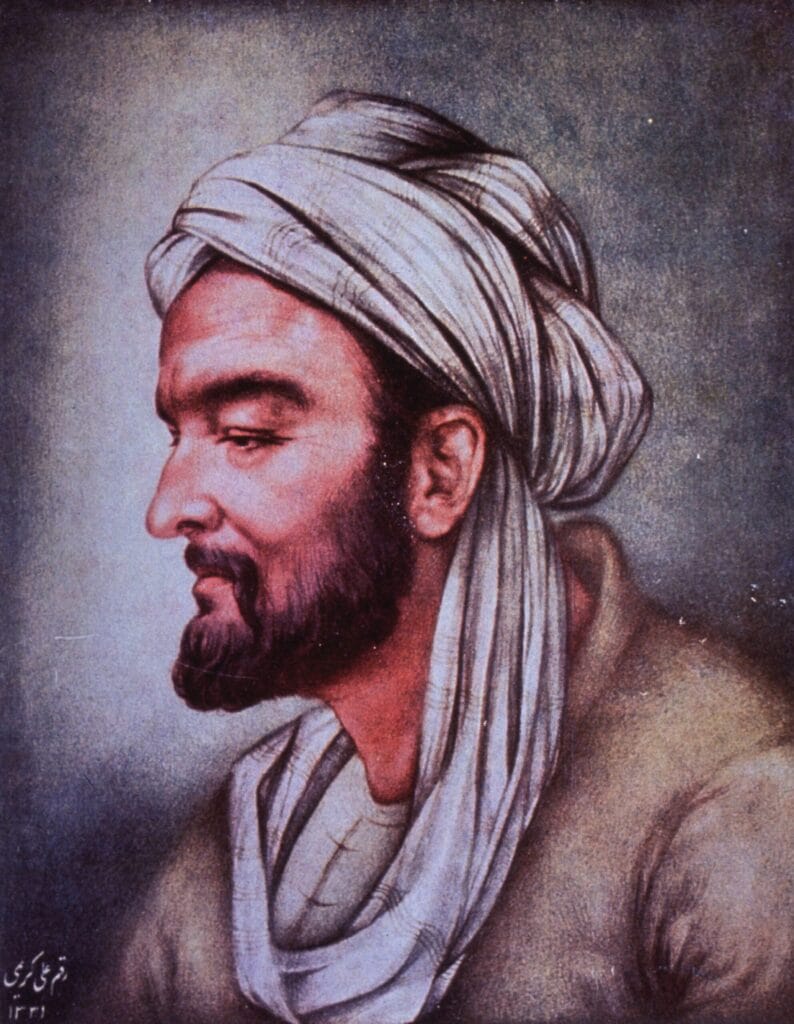
Avicenna did not simply document the recipe, he analysed each ingredient for its nutritional value and medicinal properties, combining the roles of physician, nutritionist and food historian in a single document in a way that reflects the medieval Islamic scholarly tradition of treating food as inseparable from medicine. The fact that the first written recipe for one of the most eaten dishes in Central Asian history comes from the pen of the medieval world’s most celebrated physician is not coincidental. It reflects the cultural status of plov in the Bukharan world that Avicenna inhabited.
The archaeological corroboration for Avicenna’s written account is extraordinary. A peer-reviewed archaeobotanical study published in Archaeological and Anthropological Sciences in 2023, the first such study from the ancient center of Bukhara, reveals that rice and millets were the most abundant cereal grains in the medieval period, with rice believed to have been cultivated in the Bukhara Oasis and adjacent regions to the Zarafshan River. The paper covers Bukhara’s period as the capital of the Samanid court between 893 and 999 AD, exactly the period when Avicenna was writing, and confirms through botanical remains that the ingredients of plov were being grown and consumed in Bukhara in precisely the era his recipe documents.
The secondary historical confirmation comes from the imperial Mughal records. Nuruddin Muhammad Jahangir, the fourth Mughal emperor, repeatedly documented in his memoirs that farmers near Samarkand grew exceptionally sweet apricots, peaches, melons and apples, as well as rice, millet and wheat, confirming that the agricultural foundations of plov production remained continuous across the centuries from Avicenna’s time through the Timurid and Mughal periods.
Life on the Silk Road: The World That Plov Fed
To understand plov you have to understand what the Silk Road actually was, because it was not a single road and it was not primarily about silk.
The Silk Road was a network of interconnected trade routes linking China and the Far East to the Mediterranean and Europe through Central Asia, active in various forms from roughly the 2nd century BC through the 15th century AD. It connected civilisations across an enormous geographic arc and facilitated not just the movement of goods but the exchange of technologies, religions, agricultural practices and culinary traditions on a scale that has no real parallel in premodern history. The cities that sat at the junctions of these routes, Samarkand, Bukhara, Merv, Kashgar, became among the most cosmopolitan and prosperous places in the medieval world.
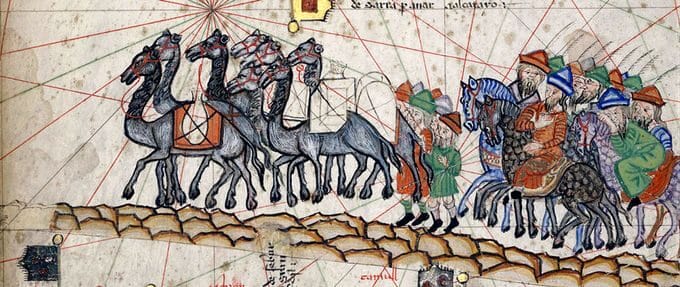
One of the main arteries of the medieval trade routes followed the middle and lower Zarafshan River and was connected by mercantile cities such as Samarkand and Bukhara. Bukhara developed into a flourishing urban centre between the fourth and sixth centuries AD, served as the capital of the Samanid court between AD 893 and 999, and remained prosperous into the Qarakhanid period until the Mongol invasion in AD 1220.
A medieval Silk Road merchant operating out of Bukhara or Samarkand in the 10th or 11th century was not the romantic lone camel driver of popular imagination. The trade routes were operated by sophisticated networks of merchants, many of them Sogdian traders whose commercial letters, discovered at Dunhuang in China, constitute the oldest surviving commercial correspondence in the world. These merchants operated in caravans of dozens or hundreds of animals, carrying silk, spices, glassware, lapis lazuli, cotton and paper between the great urban centres. They stayed at caravanserais, the roadside inns spaced approximately one day’s journey apart across the routes, where merchants from China, India, Persia, the Byzantine Empire and the Arab world would share common spaces, compare goods and exchange cultural knowledge including food traditions.
Plov was the ideal Silk Road food for reasons that go beyond taste. Its primary ingredients, rice, lamb, carrots, onions and oil, were available at every significant stop along the Central Asian routes. It could be cooked in a single vessel over an open fire. It scaled effortlessly from a personal meal to a feast for hundreds. It was nutritionally complete, combining the carbohydrate energy of rice with the protein and fat of lamb in a proportion that sustained physical labour over long distances. And it could absorb whatever the local environment offered in the way of additional flavourings, dried fruits in Bukhara, chickpeas in Tashkent, extra spices in the Fergana Valley, making it simultaneously universal and local in a way that few dishes achieve.
The Origins of Plov: From Alexander to Avicenna to Tamerlane
The earliest records of rice-based dishes similar to plov date back to ancient Persia and India around 1000 BCE. Historical texts from the Achaemenid Empire document elaborate rice dishes served at royal banquets.
One of the most enduring legends credits Alexander the Great with commissioning an early version of plov, or at least eating the dish after conquering the Sogdian capital of Marakanda, modern Samarkand. It is said that soldiers from Alexander’s army brought the preparation of plov back to Macedonia and spread it throughout the Balkans. Whether this specific account is historically accurate is debated, but what is not debated is that archaeological evidence confirms that rice cultivation and sophisticated cooking techniques existed in Central Asia during Alexander’s time.
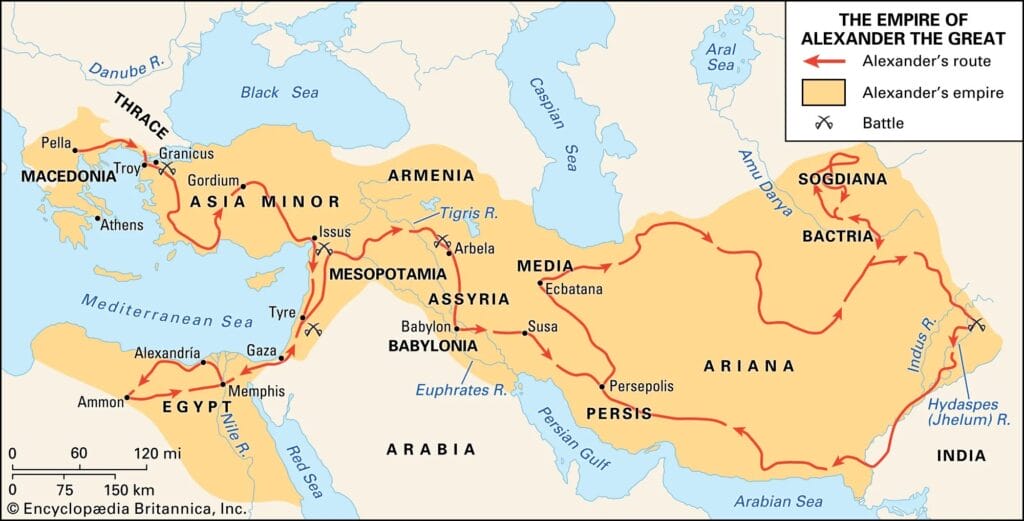
The word plov itself traces a revealing etymological journey. The word derives from the Persian word polow, which itself may have roots in Sanskrit pulāka meaning ball of rice. The linguistic genealogy mirrors the culinary one, a dish that moved westward from its South Asian origins through Persia and into Central Asia, picking up local characteristics at every stop.
The most dramatic historical account of plov comes from the Timurid period. Historical chronicles describe massive plov feasts during the reign of Amir Timur, known as Tamerlane. From the Zafarnama, the Book of Victory: before the great battle of Ankara in 1402, Timur ordered his cooks to prepare plov for 100,000 soldiers. The dish was cooked in enormous kazans, each requiring a team of men to stir. That a military commander preparing for what would prove to be one of the most significant battles of the medieval world chose plov as the meal to sustain his army is the most unambiguous possible statement about the dish’s status in Central Asian culture. Plov was the food of power, hospitality, and serious occasion.
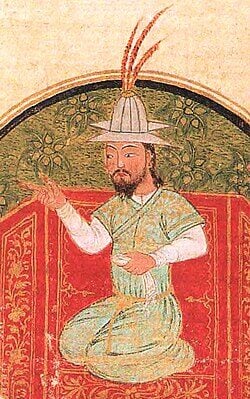
During the Timurid period, plov became associated with celebration, power, and hospitality. The Timurid courts in Samarkand and Herat developed elaborate variations, incorporating dried fruits, nuts, and exotic spices.
The Silk Road’s Culinary Legacy: How Plov Spread the World
The first written reference to plov is found in the 10th century work by Avicenna, considered by many Central Asians as the father of plov. But Uzbek legend claims that Alexander the Great tasted plov in Marakanda, now Samarkand in Uzbekistan, during his conquest of Persia in 329 BC. Regardless of which specific origin story is accurate, the mechanics of how plov spread along the Silk Road are clearly documented.
The influence of ancient Persians on pilaf was profound, leading to its rapid spread to neighbouring regions including Central Asia, the Middle East and India via the Silk Road. During their journeys, merchants and explorers not only transported goods but also carried culinary traditions and recipes with them. Pilaf thus became a staple dish along the Silk Road, evolving as it passed through different cultures, resulting in fascinating regional variations. In Uzbekistan and Tajikistan, pilaf became a symbol of hospitality and celebration, often prepared in large quantities for communal feasts, weddings, and various ceremonies.
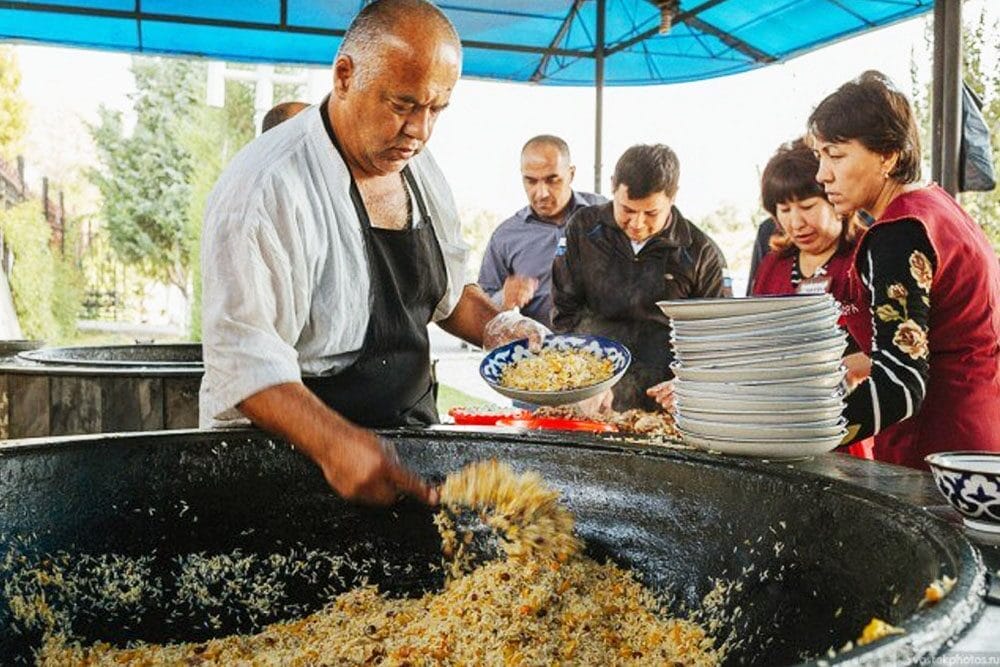
A flavored rice dish with similar ingredients, whether called plov, pilaf, pilav, pallao, pilau, pelau, pulao, pulaav, palaw, palavu, palov, polov, polo or polu, took hold in a large swath of the globe. Each region adapted the dish to local tastes and available ingredients and added its own conventions for preparation and use. It became a popular dish from Xinjiang in China to Azerbaijan, from Kazakhstan to north India and proceeded west via Greece to Europe and beyond.
The Silk Road’s greatest culinary legacy may be this single dish, transformed by a thousand years of cultural exchange from its origins in ancient Persia into the national dish of Uzbekistan, the biryani of India, the pilaf of Turkey and Greece, the pelau of the Caribbean, and the rice pilaf of every American dinner table that learned the technique from French cuisine, which learned it from the Ottomans, who learned it from the Persians, who built it from the same ingredients a merchant was cooking in a kazan in Bukhara in the 10th century.
Plov Today: Still Made the Same Way
Uzbek plov is regarded as the national dish of Uzbekistan and is of significant importance to the country’s history, tradition, and culture. Over fifty variations exist, some over ten centuries old.
Plov can be made differently depending on the occasion. For a funeral, most people will cook a basic plov with the main ingredients of oil, carrot, rice, meat and spices. But for a holiday or wedding, they will add ingredients like chickpeas, raisins and garlic. It’s the same dish, the same plov, but the mood is different.
It is regarded as the national dish of Uzbekistan and can be found prepared traditionally for weddings, holidays and communal gatherings, often in large quantities as a symbol of hospitality. The Central Asian Plov Center in Tashkent serves hundreds of kilograms of plov daily and is one of the most visited food institutions in Central Asia, essentially a living monument to the dish that Avicenna documented in the 10th century.
The technique that has remained unchanged across a thousand years is the hand-cut carrot. Uzbek plov is made with julienned carrots, onions, garlic, rice and cumin cooked together in oil or fat. The hand-cut matchstick carrot, distinct from grated or food-processed carrot in its texture, its moisture release and the way it integrates into the zirvak base without dissolving, is the technique marker that separates authentic plov from every other rice preparation in the world. It is documented in every historical account and it is not incidental. It is the dish.
My Rating
I need to talk about the garlic. The whole head of garlic, outer skin removed but otherwise left completely intact and buried in the rice to steam for the final stage of cooking, is the most extraordinary single technique I have encountered for this channel. After steaming inside the rice, the garlic cloves become completely soft, sweet and mild, the aggressive raw sharpness cooked away entirely and replaced by a deep, caramelised, nutty sweetness that is nothing like roasted garlic and nothing like raw garlic. It is something else entirely. Pressing those softened cloves out of their papery skin and into the rice and vegetables at the table is the finishing touch that no amount of spice or technique elsewhere in the recipe could replace.
The flavour profile of the finished plov is genuinely extraordinary. The lamb has browned deeply in the cottonseed oil and released its fat into the zirvak base. The carrots have softened into the broth without losing their structure. The cumin seeds have bloomed in the hot oil at the beginning and their fragrance runs through every element of the dish. The rice has absorbed all of that flavour entirely as it steamed. There is no single ingredient that announces itself separately from the others. Everything has become the same thing.
Served with fresh pears, dates and walnuts alongside, with a glass of wine in the spirit of the Silk Road merchant feast that these ingredients would have graced, this is one of the most complete and most culturally resonant meals I have made for this channel.
Rating: 9.2 / 10
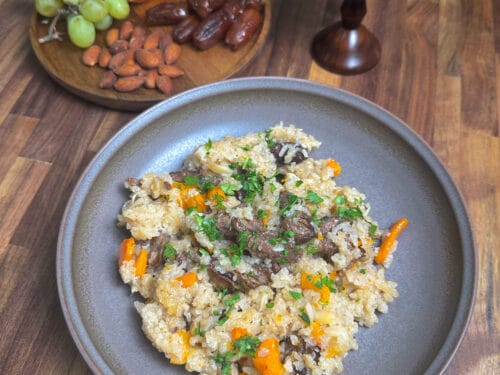
Medieval Silk Road Plov

Don’t lose this one.
I’ll email it to you so it’s waiting when you’re ready to cook.
Ingredients
Instructions
Notes
- The hand-cut carrot technique is the single most important technical detail of this recipe and the one most often shortcut in modern adaptations. The matchstick cut produces a carrot that integrates into the zirvak while retaining enough structure to provide texture in the finished dish. A grated carrot dissolves completely and becomes invisible. A food-processed carrot is too irregular. Hand-cut matchsticks are what every Uzbek oshpaz, the professional plov cook, has used for centuries and the difference in the finished dish is significant.
- The whole garlic is not optional. It is the technique that produces the single most extraordinary flavour element in the dish. An oshpaz in Tashkent will push garlic heads halfway into the rice before steaming, allowing them to turn soft and sweet, perfect for squeezing over your serving. The method in this recipe follows the same principle. Do not substitute minced or crushed garlic for the whole head. The result is completely different.
- Devzira rice is available online from Central Asian food importers and from some specialty grocery stores. This amber-coloured variety absorbs more liquid without turning mushy and produces a more authentic result than standard long grain rice. If you cannot find it, any good quality long grain rice that has been soaked and drained thoroughly will work.

My wife doesn’t like lamb, so I started this on crutches. Other than that this was awesome 👌. I used brown rice without thinking, not a deal breaker but I will know better next time.
Otherwise it was a pleasure to eat and fairly easy (my first try). The garlic cooked this way is better than amazing, and it will squeeze out of the papery clove like butter. Absolutely recomended.