Leonardo da Vinci is a name that resonates through history as one of the most versatile and brilliant minds to have ever lived. He was not just a painter or an inventor, but a man whose curiosity knew no bounds.
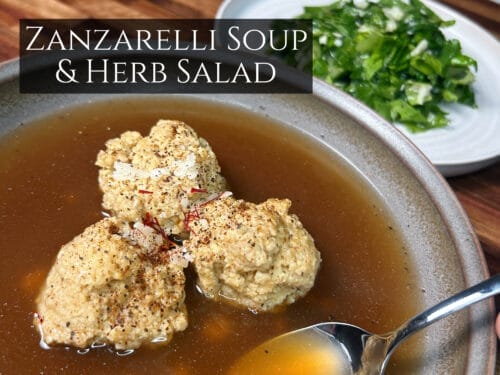
This episode of Eat Like the Greats invites us to sit at Leonardo’s table and share a meal inspired by his own grocery notes, blending the flavors of Renaissance Italy with a lesson in living boldly. Today’s menu: Zanzarelli in a rich beef broth, paired with a fresh herb salad worthy of a Tuscan garden.
Overview of Leonardo’s Life
Born in 1452 in the small town of Vinci, Leonardo entered the world as the illegitimate son of a notary and a peasant woman. Despite the social limitations of his birth, his talent and curiosity propelled him into the workshops of Florence, where he trained as an artist under Andrea del Verrocchio.

Over the decades, Leonardo’s genius spanned painting, engineering, anatomy, architecture, and even early concepts of flight. Works like the Mona Lisa and The Last Supper still inspire awe today, while his notebooks reveal a restless mind that never stopped exploring.
Next week
I cook these before I write them. Some of it never makes the post.
The failures, the source documents, the version that actually tasted good. That part goes out by email, and next week’s is already on the stove.
 Written and cooked by Donnie
Leonardo’s path was not without obstacles. He faced political upheaval, abandoned commissions, and constant criticism for his slow, meticulous working style. But it was precisely his refusal to conform—his insistence on following his own interests—that allowed him to leave behind one of the richest legacies in human history.
Keys to Greatness
Leonardo’s greatness was not merely the result of natural talent. It came from a set of principles that he lived by, many of which remain timeless. He followed his intuition, even when others could not understand his direction.
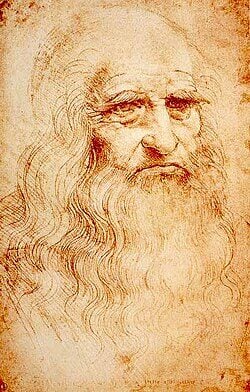
He embraced a life of observation, taking nothing for granted and learning from every experience. He understood that ideas cross-pollinate—lessons from engineering could inform his painting, and anatomy could improve his sculptures.
Perhaps most importantly, Leonardo valued patience over speed. He worked to achieve mastery, not merely completion. His life reminds us that greatness often emerges when we trust our instincts, keep our curiosity alive, and allow ourselves the time to create work that lasts centuries.
Leonardo’s Grocery List and Zanzarelli
Among Leonardo’s scattered writings are shopping notes that give us a glimpse into his diet. They list items like lettuce, mint, and parsley—ingredients we might easily imagine on a Renaissance table. Using these clues as inspiration, we pair a fresh herb salad with a medieval Italian dish called zanzarelli, a breadcrumb dumpling soup that appears in early Italian cookbooks.

The version recreated here draws from Libro de arte coquinaria, a 15th-century Italian text, adapted for modern kitchens. The result is a rich yet humble meal that Leonardo himself could have enjoyed—simple in presentation, but deeply satisfying in flavor.
Inspiration from Medieval Italian Cookbooks
Medieval Italian cooking often balanced luxury ingredients with frugality. Cheese, saffron, and nutmeg signaled refinement, while breadcrumbs and broth kept dishes accessible. Recipes were often flexible, allowing the cook to adapt to what was available that day at market. Zanzarelli was one such dish—warm, aromatic, and easy to prepare. It could serve as a modest supper for an artist or be enriched for a nobleman’s table.
For the salad, the inspiration comes from the leafy greens and herbs common in Tuscan gardens. Parsley and mint bring freshness, while arugula and romaine add depth. Parmigiano-Reggiano ties it together with the sharp, nutty flavor beloved by Renaissance diners.
If you’re enjoying my content, check out the Eats History Shop!
Leonardo da Vinci Recipe: Zanzarelli in Beef Broth with a Salad
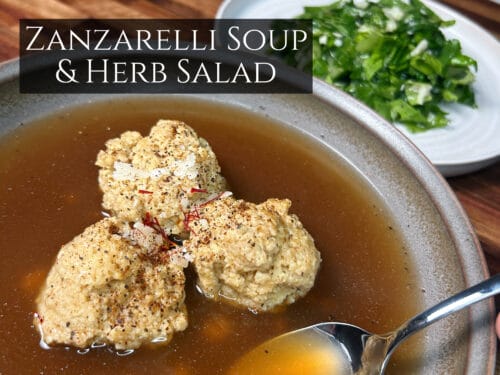
Zanzarelli & Herb Salad

Don’t lose this one.
I’ll email it to you so it’s waiting when you’re ready to cook.
Ingredients
Instructions
Notes
- Historical Touch – The saffron in the broth is a nod to medieval luxury, as the spice was highly prized in Renaissance cuisine.
- Texture Control – Adjust breadcrumb quantity slightly if your mixture is too loose or too dry; the dumplings should hold shape before cooking.
- Serving Suggestion – Serve immediately after cooking so the dumplings remain tender and the salad stays crisp.