After years of recreating historical recipes in my kitchen in Arizona, the Eats History Project officially begins. I am in Krakow, Poland, for the month of August, and over the coming months and years I will be traveling the world documenting traditional and historical recipes in the places where they were actually made, eaten and lived. Poland is the first stop. And the first dish I encountered on the streets of Krakow, jet-lagged and fresh off a flight from Phoenix, arriving into a ninety degree summer evening in one of Europe’s most beautiful medieval cities, is one of the most interesting food history stories I have found for this channel.
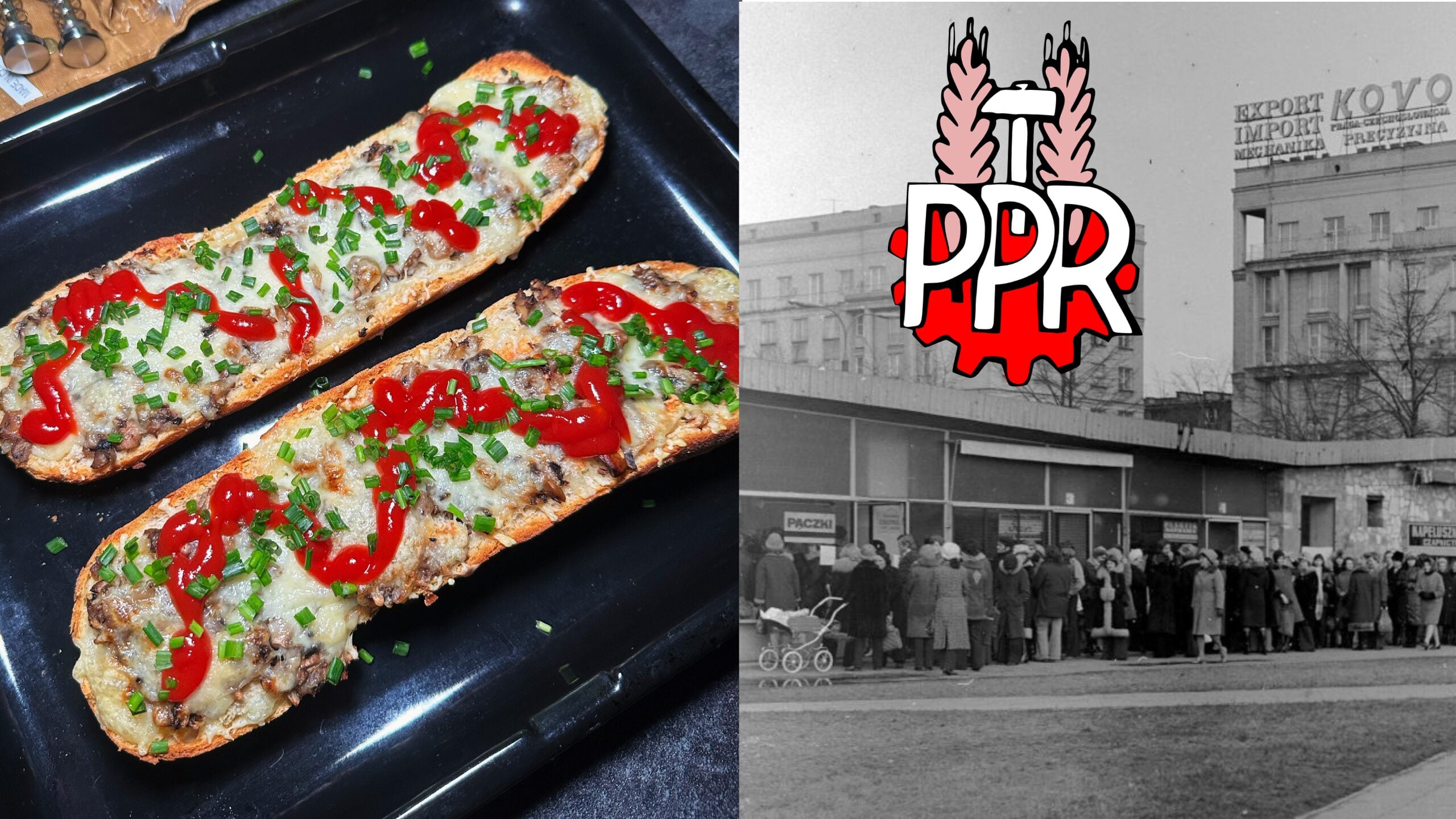
I had barely dropped my bags when I noticed something. Poles everywhere, on every street corner, at every market stall, emerging from every alley in the Old Town, eating the same thing. Long toasted baguettes, steaming hot, covered in mushrooms and cheese, finished with a drizzle of ketchup. I followed my nose to Zapiekanki Krolewskie, one of Krakow’s most celebrated zapiekanka vendors, ordered one, received it with a disposable bib which I wore without hesitation, and ate it standing on a cobblestone street in the shadow of a medieval church on a sweltering August night.
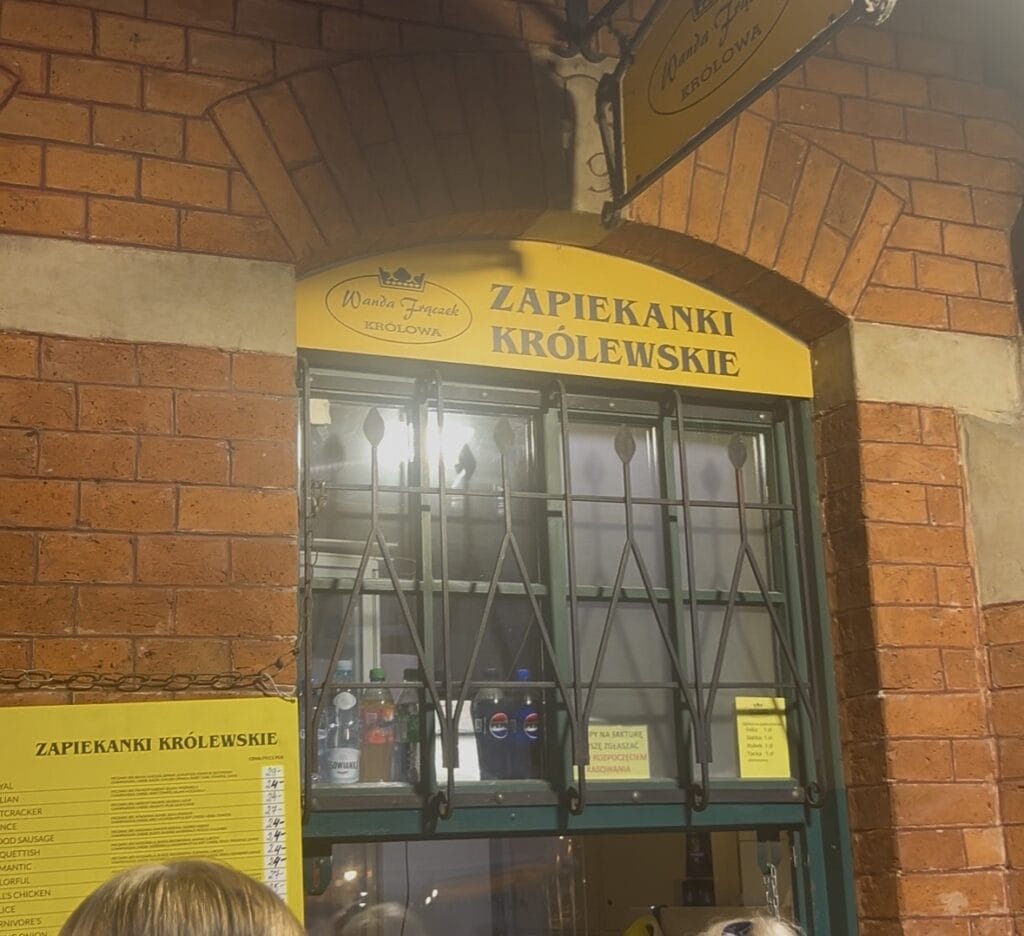
It was delicious. Slightly heavy for a ninety-degree heat wave evening, but genuinely, immediately delicious. Something tells me my twenty-year-old college self would have given this a 10 out of 10 at 2 am. With the blueprint established, I went to the local supermarket, gathered my ingredients, and made it myself.
Communist Poland and the Context of Scarcity
Next week
I cook these before I write them. Some of it never makes the post.
The failures, the source documents, the version that actually tasted good. That part goes out by email, and next week’s is already on the stove.
 Written and cooked by Donnie
To understand zapiekanka, you have to understand what Poland looked like in the 1970s, because this is not simply a street food; it’s a document of an era.
The 1970s were very lean times in Poland. Wages stagnated while the price of food and other basic goods, prices that were fixed by the government, rose and rose again, sparking protests, labour strikes and civil unrest. Poland was a Soviet satellite state operating under the Polish United Workers’ Party, and the economic management of the country had produced the specific conditions of communist scarcity that defined daily life for ordinary Polish people. Meat was rationed. Western consumer goods were inaccessible. The supply of basic foodstuffs was unreliable and dependent on the priorities of a centralised state planning system that consistently failed to match production with demand.
Food shortages in communist Poland were not occasional inconveniences. The agricultural sector, collectivised under Soviet influence, produced inadequate yields for the population. Distribution networks were inefficient. The gap between what the state announced it was providing and what ordinary Poles could actually find on shelves was a permanent feature of daily life rather than a temporary emergency. In this context, the question of what to eat was not a matter of preference but of availability. You ate what existed.
It was into this specific economic and political context that Edward Gierek rose to power in 1970, and it was his specific personal history and his specific policy decisions that would, entirely inadvertently, give Poland its most beloved street food.
The Man Who Brought the Baguette Behind the Iron Curtain
Edward Gierek was born in 1913 in what is now southern Poland and spent his formative years not in Poland at all but in France and Belgium, where he and his family worked in mines. He grew up speaking French as a functional daily language, embedded in the food culture of French-speaking Europe, eating French bread as an ordinary part of everyday life. When he returned to Poland and eventually rose through the ranks of the Polish United Workers’ Party to become First Secretary in December 1970, he brought that formative experience with him.
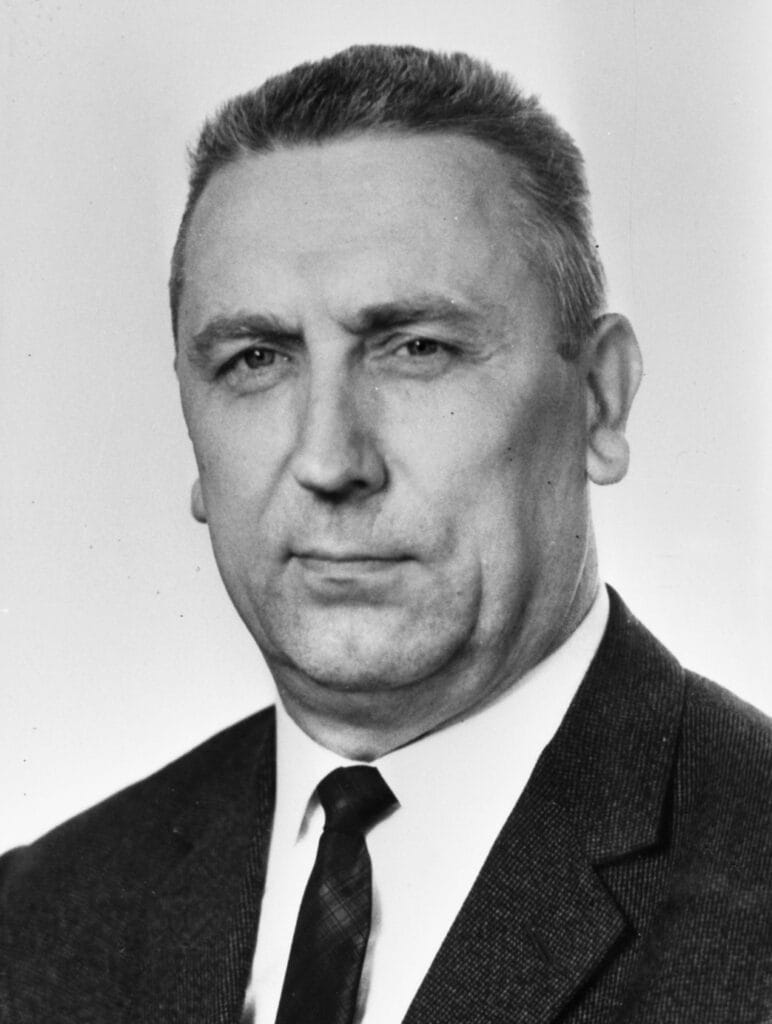
Under his leadership of the Polish United Workers’ Party, Gierek bought the licence for the production of baguettes from the French, a purchase that can be linked to his upbringing, as he spent his formative years in France and Belgium. This is the single most important and most overlooked fact in the history of Polish street food. The man who ran a communist state, ideologically committed to the rejection of Western capitalism and culture, bought a French baking licence and introduced French bread to communist Poland because he personally liked it and thought it was practical.
The new bread morphed into new sandwiches, naturally, and the most popular one was known as the zapiekanka. The mechanism was straightforward. Under Gierek’s leadership of the Polish United Workers’ Party, Poland’s Communist authorities allowed a degree of private enterprise in the catering industry. This move led to quick proliferation of small family-owned foodservice establishments, known in Polish as mała gastronomia, or small gastronomy. These small operations, family-run food stalls and bars operating in the narrow space of permitted private enterprise within the communist system, needed something they could make cheaply, quickly, from reliably available ingredients, and sell at a price that working Poles could afford.
The zapiekanka was the answer. A halved baguette, topped with whatever was available, which in practice meant mushrooms because mushrooms were one of the most reliably obtainable ingredients in Poland, covered with cheese and toasted until bubbling. The ketchup drizzled on top was both flavouring and a practical necessity, adding moisture and flavour to a preparation that was otherwise entirely dependent on the limited ingredient palette available in a shortage economy.
Polish Chicago and the Whisper of Western Pizza
There is a second origin thread in the zapiekanka story that runs parallel to the Gierek baguette licence, and that is worth acknowledging because it is documented and because it connects Poland to one of the most significant Polish diaspora communities in the world.
A cross between a sub and a pizza, the zapiekanka is a toasted half baguette traditionally topped with finely chopped white mushrooms and a mild meltable cheese which, once sizzling, is finished off with a generous slathering of ketchup. The pizza comparison is not casual. Polish emigrants in Chicago and New York, cities with large and long-established Polish communities, had been encountering American pizza since the postwar period. Letters home, visits, and the cultural osmosis that crossed even the Iron Curtain through personal connections described something called pizza, an open-face bread preparation topped with cheese and sauce, baked until golden. The concept was accessible even if the ingredients were not.
What mała gastronomia entrepreneurs in Polish cities produced with the new baguette was not Italian-American pizza. It was a Polish interpretation of a pizza concept, adapted to what was available behind the Iron Curtain. Mushrooms instead of tomato sauce. Polish cheese like Gouda instead of mozzarella. Ketchup as the finishing touch because it was what existed.
The zapiekanka was born from communist scarcity, shaped by a party boss’s personal taste for French bread, and distantly informed by the whisper of Western pizza that crossed the Iron Curtain through the letters and memories of Polish emigrants.
The 1988 Law, the Fall of Communism and Zapiekanka’s Second Life
Born in the 1970s, zapiekanki saturated the market thanks to a 1988 change in the law, the Ustawa Wilczka, that loosened Communist restrictions on private enterprise, prompting the proliferation of food trucks selling cheap rotisserie chickens and zapiekanki. The Wilczek Law, named after the minister who proposed it, was one of the most significant pieces of economic liberalisation in the final years of communist Poland. It allowed private individuals to operate businesses in virtually any sector without requiring specific permits, and the immediate result was an explosion of street food vendors who had previously operated in the limited space of mała gastronomia.
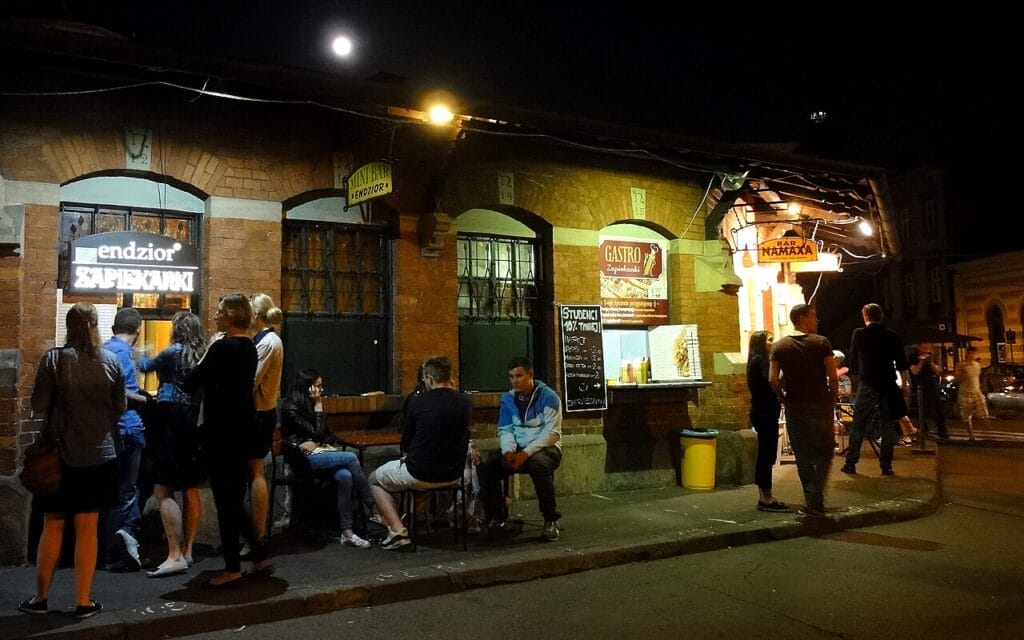
Zapiekanka vendors proliferated across Polish cities in the final years of communism. By the time the communist government fell and Poland transitioned to democracy and a market economy in 1989 and 1990, zapiekanka was so embedded in urban Polish food culture that it survived the transition even as the scarcity conditions that had produced it disappeared. Western fast food arrived in Poland in the 1990s and zapiekanka lost ground to McDonalds, KFC and the novelty of previously inaccessible international chains.
The 21st century brought a revival. Artisanal zapiekanki are now a thing, and these sandwiches, although still not the trendiest of foods, are now a fixture of the 21st-century Polish food truck scene. The zapiekanka is now simultaneously a historical document, a comfort food, and a street food staple, all three things simultaneously and all three things authentically.
In Krakow, Plac Nowy in the Kazimierz district, the historic Jewish quarter, is considered the epicentre of zapiekanka culture. Dozens of vendors operate from the circular market building at the centre of the square, serving zapiekanki from morning through the early hours of the morning. On a summer evening it is one of the most atmospheric street food experiences in Europe. I ate mine at Zapiekanki Krolewskie with a disposable bib and no regrets.
My Rating
Let me describe what a properly made zapiekanka actually tastes like because the description of the ingredients does not fully capture the experience.
The baguette goes into the oven halved and open-faced, the cut surface facing up. The heat of a high oven transforms the bread in two different ways simultaneously. The cut face, loaded with sautéed mushrooms and cheese, traps moisture from the mushrooms and the melting cheese and becomes soft and yielding, almost custardy in texture at the centre where the cheese has pooled deepest. The exterior crust of the baguette, exposed to the dry oven heat, becomes genuinely crisp, almost crackling when you bite into it. The contrast between those two textures in a single mouthful is the entire point of the preparation.
The mushrooms are the flavour foundation. Sautéed in butter with onion until they have released all their moisture and concentrated into something deeply savoury and slightly caramelised, they carry the entire savoury weight of the dish in a way that mushrooms cooked by any other method do not. The gouda melts into something glossy and slightly stringy that holds the mushroom mixture in place and adds a mild, creamy richness. The Polish ketchup, which is notably less sweet than American ketchup and has a more concentrated tomato character, is not a condiment in the burger sense. It is a finishing flavour, sharp and bright, that cuts through the richness of the cheese and mushrooms in the way that a squeeze of lemon cuts through a rich fish dish.
The chives on top are the garnish that makes the whole thing look beautiful. On a toasted baguette steaming hot from the oven, covered in golden bubbled cheese, finished with a streak of ketchup and a scatter of bright green chives, the zapiekanka is significantly more visually appealing than its communist-era origins would suggest.
As a street food eaten standing on a cobblestone street in Krakow at ninety degrees it was slightly heavy but genuinely delicious. Made at home in a controlled environment it is 8.7 out of 10 and one of the more satisfying things I have made since arriving in Poland. My twenty-year-old college self at 2 am would have given it a 10 without hesitation. I stand by both ratings.
Rating: 8.7 / 10
The Recipe: Traditional Polish Zapiekanka
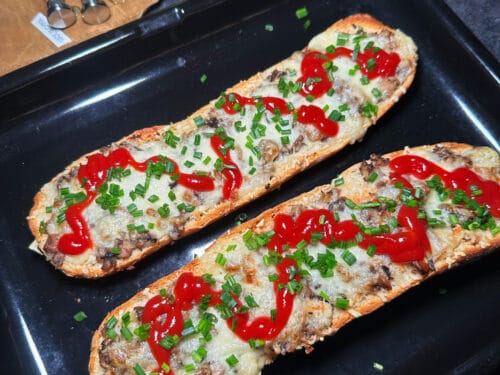
Traditional Polish Zapiekanka

Don’t lose this one.
I’ll email it to you so it’s waiting when you’re ready to cook.
Ingredients
Instructions
Notes
- The mushroom cooking step cannot be rushed or abbreviated. The transformation of raw mushrooms into a concentrated, slightly caramelised mixture takes the full 10 to 12 minutes and the moisture must be fully evaporated before the mushrooms go on the bread. Wet mushrooms will make the baguette soggy rather than crisp and will produce a fundamentally different and significantly less satisfying result.
- Polish ketchup is worth sourcing specifically if you are making this for the first time. It is available online and at Polish delicatessens in most major American and European cities. The lower sweetness and more concentrated tomato character of Polish ketchup is meaningfully different from American ketchup and produces a more authentic result.
- Variations are not just permitted but celebrated. This is the traditional baseline. Add ham, add pickled cucumbers, add garlic butter under the cheese, add jalapeños, add a fried egg on top. Zapiekanka in Poland comes in as many variations as pizza in Italy, and the street vendors of Krakow have developed every possible combination over fifty years of practice. The only rule is that it starts with a toasted baguette and ends with ketchup.