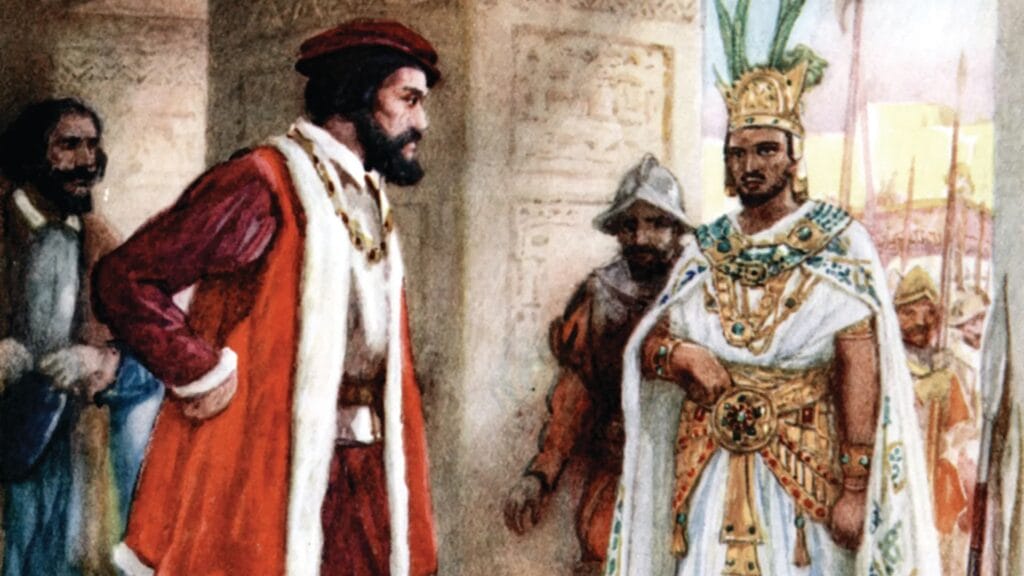
On November 8, 1519, two worlds collided on a causeway outside the city of Tenochtitlan. Hernán Cortés, a Spanish conquistador leading a force of several hundred soldiers, stood at one end. Moctezuma II, the emperor of the most powerful civilisation in Mesoamerica, stood at the other. Between them was the most consequential first meeting in the history of the Americas and within two years one of those worlds would be gone.
What they ate that day, or rather what Montezuma ate and what the Spanish could find, is one of the most thoroughly documented meals in pre-Columbian history. Bernal Díaz del Castillo, a soldier in Cortés’s army who was present at the meeting and later wrote one of the most important firsthand accounts of the conquest, described Montezuma’s table in extraordinary detail. He was not writing a food history document. He was a soldier trying to describe something so far outside his frame of reference that food was one of the few concrete details he could anchor his account in. The result is a primary source that tells us more about Aztec food culture in a few paragraphs than most civilisations left in centuries of culinary records.
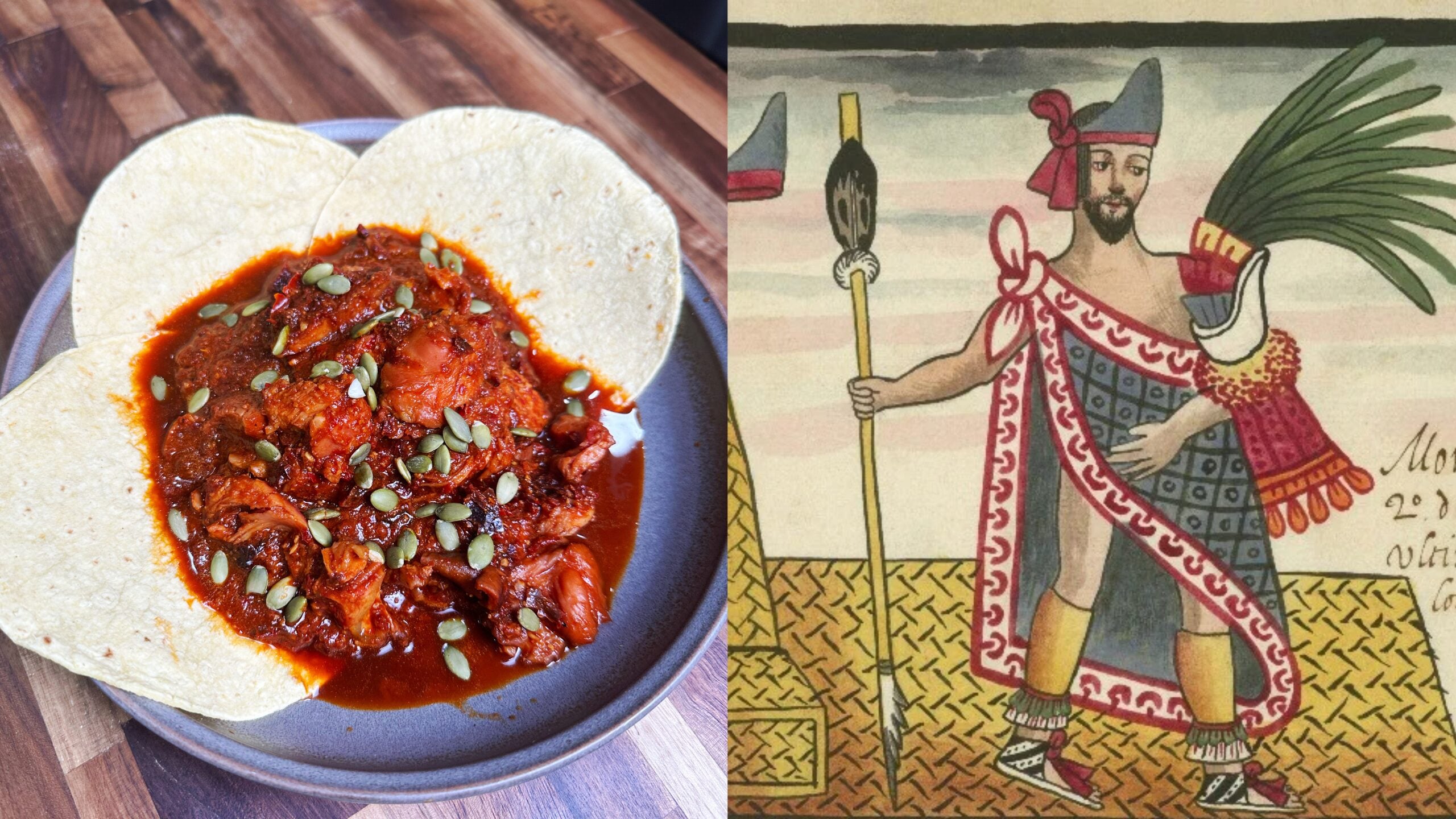
I made the turkey in red chile sauce that represents the centrepiece of an Aztec royal meal, reconstructed entirely from pre-Columbian ingredients. No onion. No garlic. No cinnamon. No black pepper. All of those arrived with the Spanish. What I made is what existed before the meeting on that causeway and what was served at Montezuma’s table in the days and weeks surrounding it. It is genuinely extraordinary food. Here is the full story.
The Sources: What We Actually Know
The primary source for Moctezuma’s table is Bernal Díaz del Castillo’s Historia Verdadera de la Conquista de la Nueva España, written from memory decades after the conquest and published in 1632. Díaz was not a scholar or a trained observer. He was a foot soldier who had been there and who wrote with the blunt clarity of someone trying to record what he had actually seen rather than what he thought he should have seen. His account of Montezuma’s meals is one of the most vivid passages in the entire document.
Next week
I cook these before I write them. Some of it never makes the post.
The failures, the source documents, the version that actually tasted good. That part goes out by email, and next week’s is already on the stove.
 Written and cooked by Donnie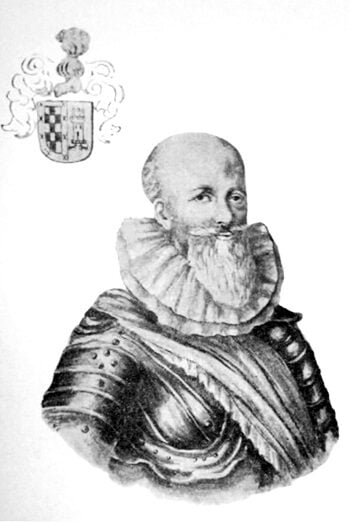
Hernán Cortés himself documented the feast in his Segunda Carta de Relación, his second letter to Holy Roman Emperor Charles V written in 1520. Cortés was writing for a political purpose, to impress the most powerful man in Europe with the scale and sophistication of what he had found, which means his account is somewhat shaped by the need to make Tenochtitlan sound impressive. Both accounts, despite their different purposes, agree on the fundamental character of Montezuma’s table.
The Florentine Codex, compiled by Franciscan friar Bernardino de Sahagún from the testimony of Indigenous Nahua elders beginning in the 1540s, provides the most systematic documentation of Aztec food culture including the specific dishes, preparation methods, ingredients and the social protocols governing who ate what and how. Where Díaz and Cortés give you the impression of abundance, Sahagún gives you the detail of what was actually in the pots.
Together these three sources produce one of the most thoroughly documented meals in pre-Columbian American history. The documentation is not perfect. It is filtered through Spanish eyes, shaped by Spanish purposes and limited by the inability of the Spanish chroniclers to fully understand what they were seeing. But it is more than most ancient food traditions ever produced and it is enough to reconstruct the broad character of what was served.
The First Meeting: November 8, 1519
The meeting on the causeway at Tenochtitlan is one of the most studied encounters in world history and every aspect of it has been interpreted and reinterpreted by historians across five centuries. What is documented is the setting. Tenochtitlan was built on an island in the middle of Lake Texcoco and connected to the mainland by long causeways. The city had a population of perhaps 200,000 to 300,000 people, making it one of the largest cities in the world at that moment, larger than any city in Spain, larger than London, comparable only to Constantinople and Beijing.
Cortés approached along the southern causeway with his force of Spanish soldiers, Indigenous allies and a substantial retinue. Montezuma came to meet him carried in a litter by nobles who did not allow his feet to touch the ground, shaded by a canopy of green feathers decorated with gold and silver, dressed in turquoise, gold and jade. Díaz describes the encounter as the meeting of two entirely different worlds, which it was, and he had the presence of mind to understand that he was witnessing something that would be written about for as long as anyone was writing.

Cortés dismounted and approached. Montezuma descended from his litter. They exchanged gifts. Montezuma placed a necklace of golden crabs around Cortés’s neck. The Spanish offered glass beads in return, which Montezuma received graciously despite their comparative worthlessness. They entered the city together.
What happened over the following days and weeks, as the Spanish were installed in the palace of Axayacatl and began their complex diplomatic and eventually military relationship with the Aztec court, is the context in which Montezuma’s meals were observed and documented. The Spanish were guests, then effectively prisoners, then conquerors. Throughout this period Díaz was watching and eating whatever he could find while Montezuma ate the most extraordinary food in Mesoamerica at a table the Spanish were not invited to share.
Montezuma’s Eating Habits: The Most Documented Royal Table in Pre-Columbian History
Bernal Díaz del Castillo devoted considerable space in his Historia Verdadera to describing Montezuma’s meals in detail, partly because the scale and ritual of it was so far outside anything he had experienced in Spain that it required explanation, and partly because food is one of the most universal human experiences and describing it gave his European readers a concrete way to understand the civilisation he was describing.
Montezuma ate alone. This is the first and most fundamental fact that Díaz establishes. While the rest of the Aztec court ate communally, Montezuma was separated from view by a decorated wooden screen and attended only by four beautiful young women who presented his food. No one watched him eat. No one sat with him. The emperor of the most powerful state in Mesoamerica consumed his meals in enforced private solitude while hundreds of courtiers waited in the surrounding rooms.
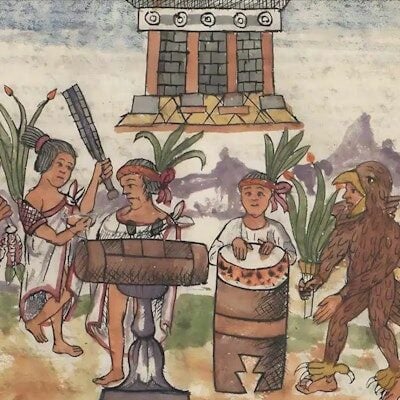
The volume of food prepared for a single meal was extraordinary. Díaz writes that more than three hundred dishes were prepared for each meal, though Montezuma himself ate only a few. The remainder was distributed to his household, his guards, his retinue and eventually to the poor. The three hundred dishes were not extravagance for its own sake. They were a demonstration of imperial power, the ability to mobilise the agricultural and culinary resources of an entire empire for a single person’s lunch, and a mechanism for the redistribution of that abundance downward through the social hierarchy.
The specific dishes Díaz documents include turkey, venison, pheasant, partridge, quail, duck, deer, wild pig and various other meats prepared in elaborate sauces of tomatoes, chiles, herbs and toasted seeds. He specifically notes the mole-like preparations, complex sauces ground in stone mortars from dried chiles, fresh tomatoes and various seeds, as unlike anything he had encountered in European cooking. He documents the tortillas, the corn-based flatbreads served warm to accompany the meat dishes. He documents the chocolate, served at the end of the meal in golden cups, cold, frothy and unsweetened, beaten to a foam by the repeated pouring technique that every Spanish observer noted as the defining characteristic of Aztec chocolate service.
Montezuma ate on fine ceramic pottery imported from Cholula, the finest ceramic producing centre in Mesoamerica. Before eating he washed his hands in a basin held by the attending women. After eating he washed them again. He smoked tobacco through a tube while the performance of entertainers, dwarfs, hunchbacks and acrobats concluded the meal. Then he retired to rest.
The contrast between this extraordinary ritual of imperial dining and the situation of the Spanish soldiers, eating whatever they could obtain from the market or from their Indigenous allies, using whatever vessels they had carried from Spain or acquired locally, in the courtyards of an unfamiliar palace in a city they did not fully understand, is one of the more quietly striking details of the entire conquest narrative. The Spanish had the weapons. Montezuma had the better dinner.
The Food of the Aztec Court: What Was Actually in the Pot
The specific dishes served at Montezuma’s table drew on an extraordinarily sophisticated culinary tradition that had been developing in Mesoamerica for centuries. The Aztec kitchen was built around a set of ingredients that are almost entirely distinct from the European culinary tradition of the same period. Corn in every form. Tomatoes. Chiles, dozens of varieties each with its own flavour profile and heat level. Squash and squash seeds. Beans. Chocolate. Vanilla. Avocado. Turkey, which was domesticated in Mesoamerica long before the Spanish arrived. Deer, rabbit and other game.
The chile and tomato sauces that Díaz describes as accompanying the meat dishes at Montezuma’s table are the direct ancestors of the mole tradition that remains the defining culinary achievement of Mexican cuisine today. The preparation of a complex chile sauce in pre-Columbian Aztec cooking involved toasting the dried chiles to develop their flavour, rehydrating them in water, blending them with fresh tomatoes and toasted seeds in a stone mortar or on a grinding stone called a metate, and frying the resulting paste in rendered fat before adding liquid to produce the finished sauce. This technique, documented in the Florentine Codex and in the work of subsequent Spanish chroniclers, is essentially unchanged in traditional Mexican cooking five centuries later. The mole negro you eat at a Oaxacan restaurant today is the direct descendant of the sauce in Montezuma’s golden bowl.
The absence of European ingredients in this cooking is worth dwelling on. No onion. No garlic. No black pepper. No cinnamon. No cumin. All of those ingredients arrived with the Spanish and became integrated into Mexican cuisine in the colonial period. The pre-Columbian Aztec kitchen achieved extraordinary complexity and depth of flavour without any of them, using instead the remarkable diversity of the chile, the acidity of the tomato, the earthy depth of toasted seeds and the herbal character of pre-Columbian herbs like epazote and Mexican oregano. Recreating that cooking in a modern kitchen requires setting aside most of what European-influenced cooks instinctively reach for and trusting ingredients that are less familiar but no less sophisticated.
My Rating
Turkey in red chile sauce is genuinely extraordinary food and I want to be direct about that because it would be easy to approach this recipe with a kind of anthropological detachment and miss the fact that it is simply delicious.
The combination of smoked turkey, ancho and pasilla chiles, tomatoes and toasted pumpkin seeds produces a sauce of extraordinary depth and complexity without a single European ingredient. The ancho chiles bring a deep, fruity, mildly sweet heat. The pasilla adds a darker, more earthy note. The toasted pumpkin seeds contribute body and a subtle nuttiness. The tomatoes bring acidity. The lard in which the sauce is fried adds richness. The turkey broth ties everything together. The epazote, if you can find it, adds an herbal character that no other herb replicates and that gives the dish an authenticity you can taste.
The technique of frying the blended sauce in hot lard before adding liquid is the step that makes the difference between a good chile sauce and a great one. Do not skip it and do not be alarmed by the splatter. That step is what drives off the raw flavour of the chiles and produces the roasted, complex depth that defines the finished sauce.
Served with warm corn tortillas, this is a complete and deeply satisfying meal. It is also, as closely as I can reconstruct it, what was being served at the most powerful table in the Americas in November 1519 while Hernán Cortés was eating whatever he could find in the courtyard of the palace next door. History has a tendency to be won by the people with the better weapons. The food was clearly better on the other side.
Rating: 8.2/10
The Recipe: Montezuma’s Turkey in Red Chile Sauce
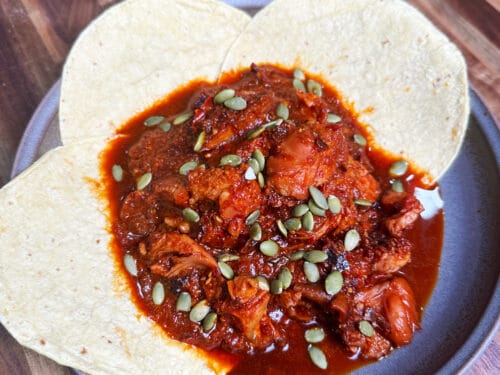
Montezuma’s Turkey in Red Chile Sauce

Don’t lose this one.
I’ll email it to you so it’s waiting when you’re ready to cook.
Ingredients
Instructions
Notes
- Epazote is worth sourcing specifically for this recipe. It is the herb that does the flavour work in pre-Columbian Mexican cooking that garlic and onion do in European-influenced cooking. Its absence is noticeable. It is available at most Latin grocery stores fresh or dried and online from various herb suppliers.
- The ancho and pasilla or guajillo combination is important. Ancho alone produces a one-dimensional sauce. The second chile adds a darker, more complex background note that gives the sauce its depth. Do not substitute generic chili powder which will produce a completely different and far inferior result.
- Rendered lard is available at most Latin grocery stores and at any butcher. The difference in the finished sauce between oil and lard is immediately and significantly noticeable.